Author: Todd Scott

  • Clinton River Trail bridge ready for construction

    The Oakland Press has an article on the new pedestrian/bike bridge over Telegraph Road just north of Orchard Lake. This is a critical missing piece of the Clinton River Trail and will be very welcomed as there are no safe alternatives given the area’s poor road designs.
    Bids were expected Thursday on the project with construction starting in late May and early June.

    The bridge should be completed by Nov. 15, according to officials.

    Mayor Leon Jukowski said the bridge would provide a safe place for people to enjoy the natural beauty of the parks and river trail.

    “It’s a great opportunity for the city and it will connect us with our neighboring communities,” he said.

    This project is being paid for through the American Recovery and Reinvestment Act (ARRA) also know as the stimulus funding.

  • Bike racers helped create Ford Motor Company

    We’ve documented how the bicycling industry helped birth the automotive and road building industries. So it shouldn’t be a surprise that bicycle racing helped birth auto racing — and the Ford Motor Company.

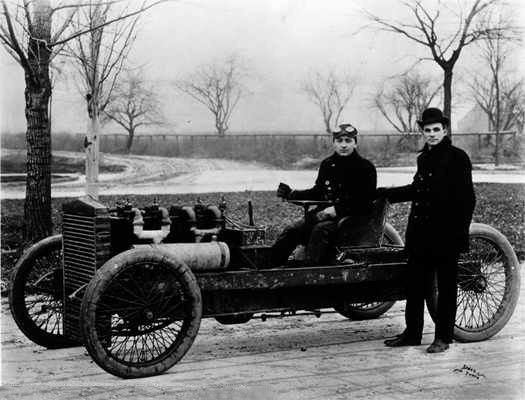
    In 1902, Henry Ford worked with two famous professional bicycle racers, Tom Cooper and Barney Oldfield. This partnership was instrumental in the creation of the Ford Motor Company.

    The below story by Anthony J. Yanik was originally published in Winter 2009/2010 issue of WHEELS, a journal of the National Automotive History Collection, located at the Skillman Branch of the Detroit Public Library.

    Barney Oldfield Meets Mr. Ford

    YEARS AFTER HE HAD BECOME a famous racing star, Barney Oldfield would kid everyone about the day he “made” Henry Ford. “Henry Ford said “we made each other, I guess I did the better job of it,” he commented in 1915.

    That he helped add to the reputation of Henry is indisputable, but the truth of the matter was that Henry Ford launched Barney Oldfield on a career that made his name a household word on the racing barnstorming circuit prior to World War I.

    In April 1902, having been let go by from his second auto company, Henry Ford had become enamored of the racing scene. He asked Tom Cooper, then the most famous professional bicycle racer of the day, to join him in a new project: the build a race car and enter it in the Manufacturers Challenge Cup that would take place at Grosse Pointe, Michigan on October 25.

    (more…)

  • Dangerous Roads Recalled by Transportation Department

    This is a clever story from the Project for Public Spaces with a nod to Detroit. Now if only it weren’t the first of April…

    Pointing to a “clear and present danger” to the American public, Secretary of Transportation Ray LaHood announced today the “recall” of all urban and suburban arterial roadways in America. These are the familiar roads built since the 1960s that function more as speedways than city streets.

    Every four-lane road in a metropolitan area with a population of more 50,000 will be examined by Department of Transportation (DOT) engineers over the next 18 months to determine whether they pose “an undue threat” to motorists, pedestrians and bicyclists.

    LaHood made the announcement at an outdoor press conference on Detroit’s famed Woodward Avenue, which he vowed would be the first urban road reinvented to meet new standards for safety and livability. “It only makes sense that this street, which 101 years ago became the first in the world to be paved in concrete, a breakthrough that transformed transportation in the 20th Century, should be the street where we transform transportation safety in the 21st Century,” he said to a cheering crowd.

    Read the rest of the story

  • Granholm signs State Park funding bills

    Great news!

    Shortly after 3pm today, Governor Jennifer Granholm signed the four state park funding bills — collectively known as the Recreation Passport — into law.

    The Department of Natural Resources is now working on Question & Answer sheets that explain the effects of this new fundamental change in how our Michigan state parks as well as state forest recreation, are funded.

  • Spring is here: Detroit biking in the media

    W. Vernor improvements to target pedestrian safety, add bike lanes

    Model D has published follow up to the open house we mentioned earlier in Southwest Detroit.

    Concepts shared at the Open House include the installation of bike lanes on W. Vernor between Waterman and Lansing, which would mean narrowing the road down in some areas to one lane of vehicular traffic; redoing the street surface and water and sewage lines on the stretch of W. Vernor that passes under the viaduct just east the W. Vernor/Dix/Waterman intersection, as well as the installation of new sidewalks and lighting; the incorporation of a left-turn lane on eastbound W. Vernor at Livernois to prevent illegal and unsafe turns; and improving lane configuration at the W. Vernor/Dix/Waterman intersection to prevent lane jockeying.

    Plans will be submitted for approval to the Michigan Department of Transportation this month in the hope that construction can begin this year.

    All total this will be about two miles of bike lanes (1 mile westbound, 1 mile eastbound.) Plans also call for lighting underneath the viaduct.

    Sounds like a Complete Street to us!

    Sharing Woodward Avenue

    Metromode has an article on returning Woodward Avenue to a Complete Street.

    That means making the thoroughfare friendly to all forms of transportation, like pedestrians, bicyclists, trains and automobiles. It also means building density and economic opportunity along Michigan’s Main Street. The belief is that by making Woodward less car-dominant it can grow into one of Metro Detroit’s primary economic engines.

    “The time has come,” says Heather Carmona, executive director of the Woodward Avenue Action Association, a non-profit that advocates for the avenue. “The irony is decades ago Woodward was a transportation-inclusive corridor, but it lost that with the rise of the automotive industry. However, it’s coming back full circle.”

    Detroit Has to Demolish Before it Can Rebuild

    ABC News has a story on Mayor Bing’s efforts to rebuild and reinvent Detroit.

    Demographer Kurt Metzger envisions small urban villages connected by parks and bike paths.

    “We could become the greenest city in the country because of the land that we have if we start to manage it correctly,” he said.

    We share that vision as do many others. While the Mayor in his recent state of the city address did not specifically say bike paths and greenways, he did mention “parks and green space” twice:

    Strengthening our city will take a long-term strategy for how we use Detroit’s 140 square miles more productively. The harsh reality is that some areas are no longer viable neighborhoods with the population loss and financial situation our city faces. But instead of looking at our land as a liability, we need to begin to think creatively about how it can be a resource as we rebuild our city. That conversation is in its initial stages but let me take a moment to dispel some myths out there.

    We’re not giving away or selling any neighborhoods to anyone. This is about determining what areas of our city are best suited for residential use, commercial and industrial businesses, parks and green space.

    When I imagine Detroit’s future, I see a city with vibrant neighborhoods, with retail and grocery stores, a city that’s home to thriving small businesses, better mass transit and community parks and green space. But it will take all of us to make that happen and it’s a process that will not happen overnight.

    And he also mentioned Detroit’s Safe Routes to School effort.