Author: Todd Scott

  • Monday Media Roundup

    Little Stimulus Money for Michigan State Parks

    Despite the huge backlog in much-needed capital improvements, the Lansing State Journal is reporting that our state parks will not be receiving much economic stimulus funding.

    Before all the details of the federal stimulus plan were known, the department put together a wish list of projects it could have ready to go in 90 days. The list included 586 proposals totaling $356.6 million, including more than $200 million and more than 300 projects involving park improvements. So far, only three DNR requests have got to the final round for consideration by federal officials.

    Of course the stimulus money is going towards road projects. Our state parks have hundreds of miles of roads, many of which require repairs. However, the state considers these parks roads as “private” and not eligible for funding. These roads don’t even receive funding from the state fuel tax. This is just another fundamental reason why our state park operations are not sustainable.

    Best Cars in a Crash (but not the safest)

    Auto-centric viewpoints are common. Here’s one that’s often blindy repeated.

    Forbes Magazine is reporting on the best cars in a crash and only considers safety from the viewpoint of those inside the car. A quarter of all road fatalities in Metro Detroit are pedestrians and cyclists. Which cars are safer for them? Large SUVs that take more lane width, have larger blind spots, have longer stopping distances, and are less manueverable?

    Another problem with this type of article is it assumes a crash is inevitable. In a one-on-one situation, more manueverable, lighter vehicles are more likely to avoid a crash than their heavier counterparts.

    This topic was well covered in an older New Yorker article. They review a study of fatalities per million cars which includes drivers, passengers, and the other crash victims. Mid-size cars were in found to cause the least number of fatalities.

    Conservative Voice against Sprawl

    We’ve spoken up against sprawl largely because it results in auto-centric communities that are often unsafe or impractical to bike or walk in.

    Christopher Caldwell has this excellent op-ed in the Financial Times that points out the costly and inefficient economics behind sprawl:

    In 1958, the great journalist William Whyte coined the term “sprawl”, in an article for Fortune. He noted with horror that, a mere two years after the Highway Act, already huge patches of once green countryside have been turned into vast, smog-filled deserts that are neither city, suburb, nor country. Developments were concentrated in random political no-man’s-lands near interchanges and exits. Road lobbyists and real estate developers colluded against meaningful regulation and planning, with the result, Whyte wrote, that “development is being left almost entirely in the hands of the speculative builder”.

    Whyte warned that sprawl was not just bad aesthetics but bad economics. A subtler and more serious problem than blight was that, for local authorities, the cost of providing utilities and other services was exorbitant. “There is not only the cost of running sewers and water mains and storm drains out to Happy Acres,” Whyte wrote, “but much more road, per family served, has to be paved and maintained.” The infrastructure network that came out of the Highway Act had higher overheads than the one it replaced. It became a bottomless pit of spending.

    Of course the Road Commission for Oakland County is paying the price for building a sprawled road network that it can no longer afford to maintain. They did no land use planning. And the Oakland County Commission has regularly selected road commissioners from the county’s sprawling communities, so this outcome is no surprise.

    And the article even includes a nod to Detroit: “The encirclement of Detroit’s neighbourhoods by highways is often cited as a primary cause of its decline.”

  • Biking, Trails, and the New Economy

    lpi-logo1

    Last week the Land Policy Institute (LPI) at Michigan State University released a study summary that for biking and trail advocates only reinforces the obvious: this region needs to make prioritized investments to improving biking, walking, and trail opportunities in order to retain and attract residents.

    The report, Chasing the Past or Investing in Our Future: Placemaking for Prosperity in the New Economy, emphasizes the need to attract three specific categories of residents in order to grow in the new knowledge-based economy: young workers, retirees and well-educated immigrants.

    Currently, Michigan lags “far behind” most other states in achieving this.

    Michigan does poorly in nabbing the highly desired 25- to 34-year-old age group–the so-called Generations X and Y. Michigan sits nearly 15 percent below the national average and in the company of states like North Dakota and Kansas–not with leaders, such as Colorado and Georgia.

    According to Dr. Soji Adelaja, the report’s lead author:

    The winners will be those regions that build strategies and bolster vibrant urban cores, green recreation opportunities and diverse, entrepreneurial populations, among other assets.

    In the Old Economy, people moved somewhere new or lived somewhere for 30 years because that was where their jobs were. Not anymore. People who create the most jobs directly and indirectly are also those people moving to those places in the country that have the best amenities and quality of life. They are seeking places first, not jobs first.

    One item we’d add is our region often fails to market what green recreation we have. Metro Detroit has a very respectable collection of singletrack trails and rail-trails. Urban biking in the city of Detroit is top-notch.

    Perhaps it’s our Motor City moniker that leads many to believe we lack these green facilities.

    Either way, Michigan will not be competitive hanging out with the likes of North Dakota and Kansas.

  • Why We Need Bicycle Boulevards

    [geo_mashup_map width=”300″ height=”300″ zoom=”13″]

    If you’ve never heard of a bicycle boulevard, don’t be alarmed. They are relatively new and I’m not aware of any that have been built in Metro Detroit.

    Recently the Streetsblog Wiki added an entry that describes bicycle boulevards. That’s a great place to start and the Berkeley video is certainly worth watching.

    So where does it make sense to add these in Metro Detroit?

    We think of some typical street scenarios that make sense, including lightly-traveled residential streets that:

    • provide direct connection to downtowns or other major destinations, but are not fire routes.
    • parallel a main arterial or trunkline road with relatively high traffic volumes.
    • are boulevards or one-ways.

    We’ve shown two sample bicycle boulevards for Royal Oak above: Vinsetta Boulevard and Sherman Drive.

    Vinsetta is a natural. It already has high recreational use, it’s very scenic, provides a park connection, and has low traffic volumes. Converting it to a bicycle boulevard would likely involve:

    • removing all stop signs along Vinsetta
    • traffic calming the street so cars are naturally inclined to drive a steady 20 MPH
    • reduce vehicle cut-through traffic
    • improving the major road crossings for cyclists and pedestrians

    The advantage for cyclists is the street would be much more friendly for riding, especially with younger riders.

    It really wouldn’t slow the trip time for motorists since time lost due to lower travel speeds would be offset by having fewer signs — and they’d save gas.

    The advantage for pedestrians is lower motorist speeds drastically reduces the odds for injuries or fatalities in the case of collisions — even for a reductions from 25 MPH to 20 MPH. This is especially true for child and senior pedestrians.

    Of course adding the Sherman Drive takes one directly downtown making this a no-brainer. Engineering a route on the commercial properties south of Catalpa would be a challenge but certainly possible. This would connect with the Sherman Drive “alley” and then Sherman Drive itself.

  • Meeting Planned for I-275 Bike Path Extension

    Mark your calendars. Next month MDOT is hosting an open house to discuss one phase of an I-275 bike path extension to the north from 13 mile to 14 mile.

    The meeting is from 6pm until 8pm at the Novi Civic Center.

    Here’s the official notice from MDOT with all the details.

    (more…)

  • Dequindre Cut Community Roundtable

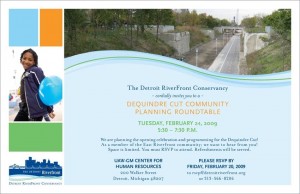
    dqThe Detroit RiverFront Conservancy is hosting a community planning roundtable for the Dequindre Cut on Tuesday, February 24th from 5:30pm until 7:30pm.

    According to the invite:

    We are planning the opening celebration and programming for the Dequindre Cut! As a member of the East Riverfront community; we want to hear from you! Space is limited. You must RSVP to attend. Refreshments will be served.

    The rountable is being held at the UAW-GM Center for Human Resources on the river. Their address is 200 Walker Street Detroit, Michigan 48207.

    RSVP’s were due Friday so don’t delay. As they note, space is limited.

    One can RSVP using email or by calling 313.566.8206.