Who is the Menace to Society?

October 1st, 2009

Menace to Society

Distracted driving by motorists certainly has gotten much media coverage of late due to a recent national summit. The Detroit News reported yesterday:

Secretary Ray LaHood kicked off a two-day summit on distracted driving this morning, calling it a “menace to society” and a “deadly epidemic.”

LaHood wants to crack down on texting behind the wheel and other activities that take drivers’ focus from the road as the government issued a report that said 6,000 deaths last year were linked to distracted driving.

We agree. Distracted driving is a menace to society and the ones who are most likely to pay the price are the most vulnerable: cyclists and pedestrians.

What we haven’t seen in print is the role road agencies play in accommodating distracted driving. Groups like the Road Commission for Oakland County provide wider roads and remove roadside trees in the name of safety. This PBS article discusses recent studies that show these forgiving roadways in more built up areas actually decreases safety.

Unwilling to accept Responsibility

According to the AAA Foundation, motorists have a “Do As I Say, Not As I Do” attitude.

American motorists blame other motorists for unsafe driving,
despite the fact many admit to doing the same dangerous practices themselves,
according to a new report out today by the AAA Foundation for Traffic Safety. For
example, Americans rated drinking drivers as the most serious traffic safety issue, yet in
the previous month alone, almost 10 percent of motorists admitted to driving when
they thought their blood alcohol content was above the legal limit.

American motorists blame other motorists for unsafe driving, despite the fact many admit to doing the same dangerous practices themselves, according to a new report out today by the AAA Foundation for Traffic Safety. For example, Americans rated drinking drivers as the most serious traffic safety issue, yet in the previous month alone, almost 10 percent of motorists admitted to driving when they thought their blood alcohol content was above the legal limit.

And that same AAA study found:

  • 82 percent of motorists rated distracted driving as a serious problem, yet over half of those same individuals admitted to talking on the cell phone while driving in the past month, and 14 percent even admitted to reading or sending text messages while driving.
  • Over seven out of ten motorists rated red light running as a serious problem, yet over half of those same individuals admitted to speeding up to get through yellow lights, and 5 percent even admitted to having run a red light on purpose in the past month.
  • Nearly three out of every four motorists rated speeding as a serious problem, yet 40 percent of those same individuals admitted to driving 15 mph or more over speed limit on the highway in the past month, and 14 percent even admitted to having driven 15 mph or more over the limit on a neighborhood street.

Since this is a self-reporting survey, the numbers are likely under reported.

Need further proof? WCBS has video coverage of the distracted driving issue, which includes their reporter driving while reporting! (via Streetsblog)

Blaming Bicyclist Behavior

Clearly a significant number of motorists practice unsafe driving habits and either fail to recognize it or take responsibility for it. They are an unreliable source for opinions on road safety.

It seems this is lost on some bicycle advocates and organizations who tell us that bicyclists must earn the respect of motorists. This is pure nonsense.

Bicyclists that practice unsafe cycling or who break the “rules of the road” are not a menace to society. They rarely if ever cause harm to other road users. The safety priority needs to be placed on motorists and road designers.

Motorists need to be held accountable and made responsible for their unsafe driving.

We need to ensure our road agencies design safer, livable roads that require the driver’s attention.

For perspective, today a motorist ignored a bus stop sign and hit two school children in Rochester Hills. From a safety standpoint, this single crash is perhaps more egregious than the sum of all objectionable Michigan cyclist behavior — ever.

Any focus on bicyclist behavior must be redirected to the real menace to society.
Edward Hines asks you to join the League

September 29th, 2009

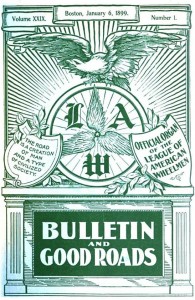
LAW-bulletin-good-roadsHere’s a piece of Detroit cycling history: A membership plea from Edward Hines that was published May 11th 1899 in the League of American Wheelmen Bulletin.

Here are 20 arguments why you should belong to the Michigan Division LAW. If you are a member read them over carefully and then present them to your friends urging them to join our ranks. Also send in your renewal promptly. If you are not a member read them over and be convinced that you should be a member and then forward us your application.

  1. Drafted introduced and passed the Anderson Bicycle Baggage Bill compelling the railroads of Michigan to carry bicycles as personal baggage free of charge (1897)
  2. Defeated the passage of a special tax of $1 a year on wheelmen in 1897
  3. Issued a road book in 1897 and 1898
  4. Secured a Supreme Court decision against the toll-road corporations, prohibiting them from charging wheelmen toll
  5. Put an active and wide awake wheelman on the Park Board in Detroit
  6. Secured the passage of an anti glass and tack law in Detroit
  7. Secured the passage of a most liberal bicycle ordinance for Detroit – no lamps, no bells, 12 miles an hour speed limit, keep to the right for all vehicles, no riding hands off, no riding more than three abreast, and sidewalk riding permitted on unpaved streets
  8. Prosecuted 23 “road hogs” in 1898 winning every case
  9. Secured a more severe punishment for bicycle thieves
  10. Secured an appropriation of $10,000 from the city of Detroit to build a bicycle pavilion for wheelmen on Belle Isle in 1898
  11. Secured an additional appropriation of $2,500 to furnish up bicycle pavilion with pump repair outfit racks and other conveniences for wheelmen in 1899
  12. Drafted and secured the passage through the state legislature in 1899, a bill to protect cycle paths and to provide for punishment of violations
  13. Encompassed the defeat of a bill before the present legislature to prohibit wheelmen using sidewalks under all circumstances in all parts of the state
  14. Secured a dry strip of five feet in width on all the principal sprinkled streets in Detroit
  15. Arranged with the Board of Public Works in Detroit to remove glass or other hurtful substances, likely to damage bicycles or bicycle tires immediately upon notification
  16. Secured the passage of some good roads amendments before the present session of the state legislature – not all we hope to secure in the way of a good roads bill, but an entering wedge
  17. Have kept up a constant agitation for good roads is gradually bearing fruit
  18. Have secured the repeal of a dozen local ordinances in various parts of the state which worked a hardship upon wheelmen
  19. Has made cycle path building possible in Michigan
  20. Maintains a sharp lookout on all legislative matters the rights and privileges of wheelmen and creates and stimulates wheeling enthusiasm

Now when you have read the above through carefully yourself the question. Don’t I as a wheelman get $1 a benefit through the LAW whether if ride much or little. Are you not willing to lend a helping hand to help us carry our future plans. We want more cycle paths, we want roads, we want danger signs erected, we want guide erected, we want to be fully protected at all times with our bicycle, we want our rights and privileges maintained, and can get what we want by joining the LAW, sticking to LAW, and getting our friends in the LAW. We spent all of our money to secure benefits and privileges for wheelmen and to have our various wants taken care of we must have the financial and numerical support of the wheelmen of our state. It isn’t enough that you should merely belong you should do something occasionally for the wheelmen’s cause and the time to start is now. I again say read the above over carefully then hand this to a friend get his application and have him pass it along to a friend of his.

Edward N Hines, Chief Consul
League of American Wheelmen (L.A.W.) Michigan Division

There was a bicycle pavilion on Belle Isle? There still is. We’ll post more about that soon.

Also the LAW had folded by 1924. At some point thereafter, Detroit’s “most liberal” bicycle ordinances were changed to require bicycle bells, lights, and registrations.

Pedal Press: Media coverage of Detroit’s bike culture

September 28th, 2009

Assignment Detroit

Time Magazine recently bought a house in Motown as part of their Assignment Detroit project. Why? In their words, “As a story, Detroit has been misunderstood, underreported, stereotyped, avoided and exploited for decades. To get it right, we decided to become stakeholders.”

Their project includes a blog and one of it’s early entries was about biking in Detroit.

In Detroit, there are cars. And then there is something known as non-motorized transportation.

That means bicycles, y’all.

Believe it or not, people in the Car Capital of the World love their bikes. And there is a huge movement to create a culture here that is friendlier to two wheels than four.

Yep. Believe it.

Alleycats in Detroit

Model D once again has some great coverage of Detroit’s biking scene, include this article on Alley Cats (which also drifts into the Tour de Troit and greenways…)

Since 2006, [Ron] Shelton has organized Alleycats in Detroit. These unsanctioned cycling races draw riders from throughout the metro area to compete in a crisscrossing sprint down streets and through intersections. Participants fly from checkpoint to checkpoint, collecting clues and directions to their next destination while dodging cars and other riders. The course tests both the riders’ knowledge of the city and their guts as they navigate a virtual collision course that backtracks and veers over 35 miles.

“People don’t realize it, but in Detroit, we have ridiculously wide roads that are ready to be converted to include bike lanes,” [Shelton] says. “Michigan has a lot of potential for cycling and has many fantastic trails already.”

Aaron Wagner, an organizer for the annual Tour De Troit agrees. “Definitely there’s been an upswing in biking in Detroit,” he said. “With the opening of the Detroit RiverWalk and bike shops like the Wheelhouse and the Hub, it’s gotten a lot more people into it. We’re seeing more people leaving their cars at home and riding their bikes to work.”

Don’t forget that the next Alleycat is in Hart Plaza on October 30th. The time has not been posted yet but we’re guessing it’ll be after the critical mass ride.

Tour de Troit

And finally Model D and Tom Hendrickson have made a great video on this year’s Tour de Troit bike ride. Tour Director Bil Lusa provides some commentary on the ride.

Shared space: Detroit in 1890

September 28th, 2009

Fort Street in Detroit, 1890The Shorpy.com web site publishes some amazing photos.

One recent addition is of Fort Street in Detroit. It’s looking west from Woodward Avenue back in 1890.

Notice what’s missing in the photo besides cars and trucks? There are no signs or traffic lights or crosswalks.

At this time, there really were no rules of the road because they weren’t necessary. Road users operated at similar, slower, and safer speeds. Everyone was responsible for not crashing into others.

This type of road design is becoming more popular in Europe. It’s called shared space.

After a recent MDOT training with John LaPlante, I asked him about implementing shared space. He said it can work in America in some residential areas or downtowns. He brought up the excellent point that European drivers have a culture of sharing the road with other users like pedestrians and bicyclists. That makes it much easier for them to successfully implement shared spaces. Too often American drivers suffer from a sense of road entitlement.

Did you notice all the bikes parked in front of the now-demolished Hammond Building? This was the “Golden Age” of bicycling in Detroit.

Photos from the Tri-Centennial sneak peek

September 27th, 2009

Today Detroit Riverfront Conservancy members were treated to a sneak peak of the Tri-Centennial State Park’s latest expansion.

This will be an amazing addition to the RiverWalk. It’s certainly softer and more natural than the other sections. All of the plantings are native to Michigan.

There was an initial concern that geese would try eating many of the early plantings, but the DNR was able to prevent that. Now there is a muskrat that has been digging up the young plantings. He may be trapped and moved so that the plants have a better chance of establishing themselves.

You may notice the monarch butterflies on the purple coneflowers. There were quite a few there today as they make their way south towards Point Pelee, Ontario. The butterflies gather at the Point and make the flight across Lake Erie in large groups.

There was no official word on when this portion of the park will open. The bike path still needs to be paved and landscaped.