Detroit Tiger’s Going, Going, GREEN

July 28th, 2009

Bikes parked outside of Comerica Park during a Detroit Tigers gameLike other baseball stadiums around the country, the Detroit Tigers are looking at steps they can take to reduce their environmental impact of the games.

And to help highlight their efforts, they hosted a Going, Going, Green event at Comerica Park.

The event included many green-oriented booths including one for the Michigan Trails and Greenways Alliance (MTGA). I was at the booth for Saturday and Sunday to share information on trail efforts throughout Detroit as well as Michigan.

While there, I had a opportunity to discuss bike parking at Comerica Park with Tigers management. I suggested that next year’s Going, Going Green event have guarded valet parking for bikes, but the discussion shifted to how can we improve bike parking for all of the Tiger home games.

Stay tuned…

Pedestrian and bicycle safety data analysis

July 21st, 2009

If you spend much time perusing the available safety publications for Michigan, it becomes fairly evident that not much serious effort is put into bicycle and pedestrian analysis.

SEMCOG

One example is SEMCOG’s Crash Facts report where more analysis and pages are devoted to vehicle-deer crashes than either pedestrian crashes or bicycle crashes. This is despite the fact that deer caused just one driver fatality in 2007. There were 65 pedestrian fatalities and 7 bicyclist fatalities in 2007.

For 2008, SEMCOG issued a cheery press release because overall fatalities and crashes were down.

“We are extremely happy to report this continuing decline in traffic crashes in Southeast Michigan,” notes SEMCOG Executive Director Paul Tait.

SEMCOG failed to note that both bicycle and pedestrian fatalities were up. In fact, 18% of all fatalities were pedestrians and bicyclists in 2007. In 2008 that pecentage jumped to 24%.

It seems the “analysis” is simply plugging this year’s numbers into the same old template.

A worthwhile analysis would look at trends within the region and where within the roadway these crashes are occuring.

Do we really need SEMCOG telling us that “bicycle crashes were more common in warmer months…likely due to the difficulties of bicycling in snowy or icy conditions?” They’ve been recycling this same text since 2002.

MDOT

To their credit, MDOT has supported some pedestrian safety studies within the city of Detroit. The city of Detroit’s Traffic Engineering department is has applied for safety funding to make improvements that should reduced pedestrian crashes.

GTSAC

Also, the Governor’s Traffic Safety Advisory Council includes some good analysis within the Michigan Pedestrian and Bicycle Safety Action Plan.

Michigan Pedestrian and Bicycle Safety
Action Plan

OHSP

One interesting analysis from the Office of Highway Safety Planning (OHSP) compares 2007 bicycle crash injury severity for helmeted and non-helmeted riders. We’ve rebuilt their data table as follows:

2007 Bicycle Crashes Total crashes Fatal or serious injury Minor or no injury
With helmet 177 18% 46%
No helmet 795 10% 51%

(Note that it is unreported whether helmets were worn in a little over half of the crashes.)

Among bicyclists wearing helmets in crashes, a significantly higher percentage suffered serious injury or death when compared those without helmets. One would expect the helmeted riders would have a reduced percentage of serious injury or death.

Can this be explained by risk compensation or demographics?

Nonetheless, the OSHP apparently didn’t do much analysis since they’ve cut-and-pasted a quote that’s unsupported by their own data: “Making the use of helmets the single most effective countermeasure available to reduce head injuries and fatalities resulting from bicycle crashes.”

And just to be sure that 2007 wasn’t simply a unique year, we looked at this data back to 2004. For every year, bicyclists wearing helmets in crashes suffered an equal or greater percentage of serious injury or death.

For what it’s worth, there is not a trend towards increased helmet use among those involved in reported bicyclist accidents within Michigan.

That’s a wrap: Detroit Bicycle Film Festival

July 20th, 2009

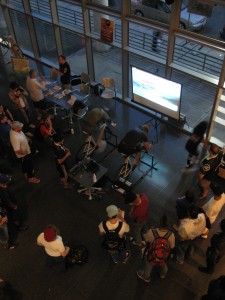
IMG_2926By all accounts, the first-ever Detroit Bicycle Film Festival was a big success.

It seemed Friday attacted the biggest crowd to the Boll YMCA downtown. The first movie even sold out.

Prior to the movie, audience was offered complimentary cocktails complements of 42 Below vodka. They also sponsored the Goldsprints: two singlespeed bikes on rollers where cyclists can sprint head-to-head with a real time full screen display.

The Goldsprints were operated by the Hub. And the great news is the bikes, rollers and other hardware were donated to them. So if you missed the Goldsprints this weekend, don’t worry. There will be more.

Photos from Detroit’s film festival are on-line.

Metro Detroit biking in the media

July 20th, 2009

Dequindre Cut

It’s grand opening in May officially kicked off the Summer of Dequindre Cut Love. It was far and away the most talked about trail at the MTGA RiverDays booth. And at the Palmer Park Green Fair, Lt. Governor John Cherry was quick to locate the Dequindre Cut on the Detroit Greenways brochure.

The word is out.

And one major reason is the world class graffiti along the Cut. Yesterday’s Detroit News ran an article that discusses that graffiti with some of the artists that created it. The article includes both a video and an audio tour. It was interesting to learn that some of the graffiti is over 20 years old.

Additional link: Photos of the Dequindre Cut graffiti prior to the trail construction

Detroit Ferry Service?

Currently the only convenient means for getting ones bike across the Detroit River into Canada is by driving it. That may change as the Wayne County Port Authority will soon have support facilities for ferry service on the RiverWalk. The Free Press is reporting their receipt of $7 million in funding to further that effort thanks to Senator Carl Levin.

Imagine if taking your bike to Windsor, Canada was as straightforward as taking it to Mackinaw Island (with customs, of course.)

Special Needs Bike Camp

Today’s Detroit News has a great article called, Bike camp clears hurdle for special needs children:

Because of their limitations, only 10 percent of children with Down syndrome and 18 percent of children with autism can ride a bike, said Dale Ulrich, director of U-M’s Center for Physical Activity & Health in Pediatric Disabilities.

But after the camp, most who attend can ride a bike, and the study is finding the children are more likely to stay physically active, leading to many health benefits. This is especially good for children with Down syndrome since it often leads to excess weight. Children with autism often suffer from sleep disorders that are treated with medications, some of which cause weight gain.

Besides the health benefits, learning how to ride a bike also helps the children become more social, verbal and independent, Ulrich said.

No Sidewalks

This Free Press article, Road sound raises residents’ fury, shows how backwards some communities can be.

…The residents did post one victory. The township board agreed not to run a sidewalk alongside Square Lake Road.

“The beautification project is not most important right now, safety is the issue,” township Clerk Janet Roncelli said.

Apparently pedestrians safety is not a priority for Bloomfield Township.

Downsizing Detroit

The Free Press revisits how we can manage the downsizing of Detroit. While not directly about biking, a planned downsizing would lead to vast greenspace and opportunities for additional greenways and trails.

And in a related vein, the Detroit News is noting the return of wildlife within the city, including red foxes.

The red fox is carving out a place of its own deep into downtown, joining the ranks of raccoons, skunks, opossum, white-tailed deer and red-tailed hawks finding homes in untended lots, houses and buildings in the rusting one-time car capital.

And don’t forget the red-necked pheasants!

Impeding Traffic: Looking at the bigger picture

July 18th, 2009

Throughout the Detroit suburbs, cyclists can expect to hear the occasional verbal assault from motorists. The typical theme is “you don’t belong on the road” or “you’re in my way.”

Clearly state law says that cyclists have the same access to all Michigan roads except limited-access highways.

Some argue that since cyclists can’t travel at the speed limit, they shouldn’t be on the road and that bicycles impede traffic. But courts have dismissed that argument since it would effectively ban bicycles (and pedestrians, pack-animals, farm machinery, Amish wagons, etc.) from all roads.

But are motorists really that concerned about being occasionally slowed due sharing the road with cyclists? How much time do Metro Detroit motorists “lose” to cyclists on the roads?

Rather than attempt to answer that question, it’s perhaps more important to step back and judge all the issues that delay motorists.

How much time do motorists lose to:

  • Road construction
  • Stop lights and stop signs
  • Speed limits
  • Rush hour traffic
  • School buses loading and unloading children
  • At-grade train crossings
  • Inclement weather
  • Emergency vehicles
  • Slow downs due to vehicle crashes
  • Other cars on the road

Motorists’ time lost to bicyclists is certainly minor compared with most of these. So are these same motorists yelling at school buses and emergency vehicles to get off the road? It seems that if they were so consumed with decreasing their travel delays, they’d focus on the issues causing the biggest delays.

And speaking of travel delays, this past week an apparently careless driver caused a horrific tanker explosion on I-75 which caused over a $1 million in damage and has left the expressway closed for days. This portion of I-75 carries 160,000 vehicles per day and the closure is causing many minutes of delay per vehicle.

This single crash has likely caused more motorist delay than all the cyclists in Metro Detroit combined — ever.

That certainly helps put this all in perspective.