Thursday was the second annual Regional Trails and Greenways Summit in at U of M Flint.
While the focus was primarily on Genesee County, the sessions were applicable to similar efforts elsewhere. And there were many familiar faces from Oakland and Wayne County, including engineering staff from the City of Royal Oak.
There was full day of excellent session topics, including road diets, complete streets, and creating non-motorized master plans. We were even treated to an rousing welcome from Bobby Crim.
For those unable to attend, Genesee County Planning will be putting all of the presentations on their web site.
Yesterday’s Detroit Free Press had a decent article on those still commuting by bike during the winter.
Bike enthusiasts, law enforcement and transportation officials say people like Bierman are among a growing number of commuters in metro Detroit who are responding to the sluggish economy and rising gas costs by riding bikes to work during the winter — despite a total snowfall that measures more than 21 inches above average so far.
We’ve heard from naysayers that Detroit won’t be popular for biking because of our winters.
Not true.
A higher percentage of people bike to work in Canada than the U.S. — three times higher according to one report. In fact a much higher percentage of people bike to work in the Yukon Territory than either California or Florida.
This same report offers some explanations as to why.
One explanation is safety, and that was a highlighted concern in the Free Press article. Since 1988 Canada has done a signficantly better job at making biking safer compared with the U.S.
In fact, compared with many European countries, the U.S. is much more dangerous.
Due to the lack of comparable time-series data on cycling levels in Canada and the United States, we can only attempt a standardized comparison for the latest available year. We also include selected European countries as a basis for comparison, since cycling is generally considered safer in Europe than in North America (Pucher and Dijkstra, 2003). That impression is certainly confirmed by Fig. 4, which shows rates of cycling fatalities per 100 million km cycled in each country. Fatality rates range from a low of 1.03 in Denmark to a high of 5.74 in the USA. With fatality rates well under 2.0, Denmark, the Netherlands, and Sweden have the safest cycling. Canada has 2.39 cycling fatalities per 100 million km cycled, just about the same rate as France (2.04) and Germany (2.43). The United States has, by far, the most dangerous cycling, with a fatality rate of 5.74 almost six times as high as in Denmark, almost three times as high as in Canada, and about twice the rates in Italy and the UK.
Besides safety, the report notes one other statistically significant explanation for biking levels: the price of gas.
The Detroit News is now reporting that the Gateway Project, including the Bagley Pedestrian bridge “could be completed in August instead of MDOT’s initial forecast of December.”
That’s great news for those who want a calmer, safer biking option over I-75 in the Mexicantown area.
And this is not going to be just another run-of-the-mill pedestrian bridge, as we noted earlier. It will be suspended and showcase local artists.
The recent construction photo (taken last Friday) on the right confirms the impressive design as well as the progress being made. That tower on the right will hold the cables suspending the bridge.
Coincidenly there were two videos posted yesterday about getting bike lanes in our area.
The first video is from the good folks at Scaledown. As we recently noted there’s a big battle brewing in Windsor over extending bike lanes along Riverside Drive. Their video reveals the likely source of resistance to the bike lanes: the landowners have apparently encroached on the Riverside Drive right-of-way.
This second video is from Mike Wendland whose enjoying the bike lanes while vacationing in Florida. Mike asks why we can’t have these in Michigan?
Yesterday the Detroit News reported on a new store in Plymouth Michigan that’s selling electric bicycles and electric motor kits. The shop is called eCo Wheelz and they have a pretty thorough web site for a startup.
While some bicycle purists may scoff at those getting an electrical assist, these bikes could increase our numbers and increase demand for safe bicycling facilities such as bike lanes.
Many lack the physical condition to jump right into bicycle commuting. This might ease those folks into a healthier lifestyle.
Are electric bicycles considered bicycles? They are according to federal law so long as they can be pedaled and don’t have too much power.
That means they are allowed in bike lanes and on trails.
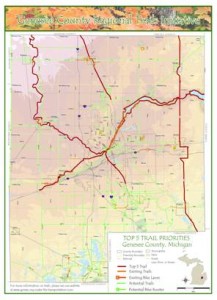 Thursday was the second annual Regional Trails and Greenways Summit in at U of M Flint.
 The
The  Yesterday the