October 8th, 2008
 There’s been plenty of debate about the value of two Southeast Michigan ghost bikes.
One positive thing they have resulted in is front page media coverage. The October 1st Royal Oak Review put the story on page one with a photo. The October 5th Mirror Newspaper just did the same.
For many, the incident, and the stark reminder of it, have heightened the awareness for bike safety in what is still largely a car-dominant metro area.
It was great to read informed public officials talking about bike lanes as an option for safer cycling in Metro Detroit. Cullen Watkins, store manager for American Cycle & Fitness also said the same.
He thinks bike lanes would go far to protecting bicyclists. “When all is said and done, every community can put in bike lanes. People are walking on the sidewalks; we don’t belong on the sidewalks.”
So at this point is remains to be seen if this recent media attention will help put this issue on the City of Royal Oak and the City Commission agendas’ — something we have not been able to achieve to date.
Tags: bike lanes, Ghost, Royal Oak
Posted in On-road bicycling, Safety | 2 Comments »
October 7th, 2008
The Wheelhouse Detroit began hosting neighborhood bike tours this fall. They are more than your typical bike tour as they raise funds for the neighborhood in which they visit.
Last Sunday was a 26-mile neighborhood bike tour to Detroit’s Eastside to raise funds for the Conner Creek Greenway.
Our tour highlights included:
- the Better Made Potato Chip Factory
- art deco manufacturing buildings along Grinnell
- a red-tailed hawk that flew overhead
- a ride through Mt. Olivet Cemetery
- lunch at the historic Two Way Inn
- Pat’s homemade cabbage soup
- the mound that gave Mound Road its name
- the Dorais velodrome
- the Milbank greenway
- the Conner Creek Greenway
While at lunch, Pat Bosch (Nortown CDC) and Mary Aganowski (Two Way Inn) discussed the history of Norris a.k.a. North Detroit. Before being annexed by Detroit, it was a small village built around the Mt. Elliot and Nevada intersection. The town’s founder and main promoter was P.W. Norris. Norris had a storied history that included helping create then manage America’s first National Park — Yellowstone.
For more background on this historic Detroit area, I recommend reading this Metro Times article.
-
-
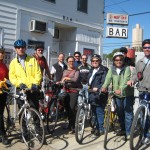
The tour included a lunch stop at the Two Way Inn
-
-
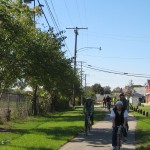
Riding on the Milbank Greenway
-
-
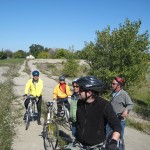
Regrouping after a lap around the velodrome
Tags: bike tours, Conner, Detroit, Wheelhouse Detroit
Posted in Detroit | 1 Comment »
October 4th, 2008
We recently received an email from an active cyclist in California. Their relatives in Southeast Michigan could not understand why Hines Drive bicyclists were on the road shoulder instead of the parallel bike path. She wondered if we could provide an answer.
[geo_mashup_map height="200"]
To an experienced cyclist, the reasons seem quite apparent. Riding on the Hines Drive’s wide paved shoulder is:
- Faster and more direct
- Much safer at the intersections
- Free of pedestrians (which you must yield to on the bike path)
- Better lit at night
- Plowed of snow and ice in the winter
- Less flooded after a rain
- Has less debris (e.g. rocks) that can cause flat tires
Besides, the road lanes are wide, the paved shoulders are generous, and the speed limit is low. And due to the lack of commercial/residential access along the road, it is absolutely an ideal place to ride a bike.
If motorists can’t safely share this roadway with cyclists then they probably shouldn’t be driving.
Coincidentally in 2004 I was asked a similar question while giving testimony before the House Transportation Committee in Lansing. Hines Drive passed through one of the committee member’s districts.
We should also mention that Edward Hines, whom the road is named after, was Chief Consul of the League of American Wheelmen in Michigan (forerunner of the League of American Bicyclists), as well as a major “Good Roads” advocate. Hines invented the double-yellow center line, pioneered snowplowing roads, and created the first mile of concrete pavement. Hines is just another famous Michigan bicyclist that all road users can thank.
Tags: Edward N. Hines, Hines Drive, On-road bicycling, Wayne County
Posted in On-road bicycling | No Comments »
October 3rd, 2008

Congressman Earl Blumenauer
The bailout bill passed the Senate and is awaiting a vote in the House today. This bill has gotten many additional unrelated items added to it, presumably to gain the vote of certain legislators.
Congressman Earl Blumenauer is our biggest bicycling advocate. He voted against the first bailout bill. And although he did not request it, this new bailout bill includes his bicycle commuter legislation.
What does this bike commuter legislation do? Currently, employers get a tax break when they provide company cars or pay for their employee’s use of public transit in order to get to work. This legislation would add bicycles as a tax break. This would give employers a financial incentive to provide a bicycle and cover the expenses associated with riding it to work.
According to the Congressman’s web site, this legislation “provides a strong incentive for employees to bike to work, which is a cleaner, healthier, more efficient mode of transportation.”
Even though Blumenauer’s bike bill is in the bailout, he’s indicating he will vote against the overall package.
Tags: bike to work, commuting, Earl Blumenauer
Posted in Law | 3 Comments »
October 2nd, 2008
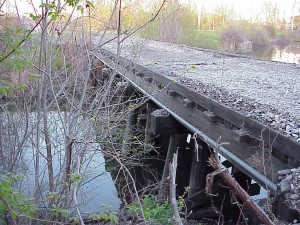
This abandoned railway is now a trail through Pontiac
Back in 2001, I was working for the Rails-to-Trails Conservancy and taking photos of what is now the Clinton River Trail in Pontiac. The rail line passed behind a cul-de-sac of new houses just west of downtown Pontiac.
One of the homeowners approached me and asked what I was doing. He didn’t seem too enthused about me walking behind these homes and taking photos.
I began by explaining our plan to convert this abandoned rail line into a walking and biking trail. He didn’t seem too sold on the idea, so I noted that trails increase the property values of surrounding homes. That worked.
He offered me a glass of cold lemonade and said if there was anything I needed, just ask.
A new trail study out of Ohio only confirms what other studies have found and what I told that concerned homeowner:
Across the United States, many conversions of abandoned railroad rights-of-ways into trails have faced opposition from surrounding property owners. Much of the opposition derives from the fear that developing trails would cause a decrease in property values because of loss of privacy, increase in noise, traffic, litter and crime.
The objective of this study is to assess the impact of the Little Miami Scenic Trail on property values. To accomplish this task, the hedonic pricing technique was employed to measure the impact of the trail on single-family residential property values in southwest Ohio. Several of the variables used in this model were measured using Geographic Information Systems (GIS) software.
The analysis suggests that, each foot increase in distance to the trail decreases the sale price of a sample property by $7.05. In other words, being closer to the Little Miami Scenic Trail adds value to the single family residential properties.
Tags: Clinton River Trail, NIMBY, Property values, Trails
Posted in Trails | No Comments »
 There’s been plenty of debate about the value of two Southeast Michigan ghost bikes.