Author: Todd Scott

  • Obesity costs justify more bicycling investments

    A Free Press article last week centered on a new report that exposes the high cost of obesity, which now makes up an estimated 9.1% of all medical spending.

    Obesity’s not just dangerous, it’s expensive. New research shows medical spending averages $1,400 more a year for an obese person than for someone who’s normal weight.

    Overall obesity-related health spending reaches $147 billion, double what it was nearly a decade ago, says the study published today by the journal Health Affairs.

    RTI health economist Eric Finkelstein offers a blunt message for lawmakers trying to revamp the health care system: “Unless you address obesity, you’re never going to address rising health care costs.”

    Earlier this week we covered a new report from the CDC that gave strategies on how to reduce America’s obesity rate. Those strategies included investing in our communities to make them more walkable and bikable.

    More bike lanes, more sidewalks, etc.

    So if obesity costs $147 billion annually, with roughly half financed by Medicare and Medicaid, how much does the federal transportation bill invest in bicycle and pedestrian facilities?

    $541 million in 2008 or 0.7% of the obesity-related Medicare and Medicaid costs.

    This is further justification to take a more holistic approach to transportation funding. It’s not just about mobility and concrete.

    Wise investments in more livable, walkable, and bikeable communities can reduce obesity and the related federal medical spending — as well as everyones health insurance costs.

  • David Byrne biking on Eight Mile

    Bicycle Diaries by David Byrne
    Though not on the bookshelves yet, the Observer has a review of David Byrne’s new book, Bicycle Diaries.

    From the review:

    Byrne has cycled in Berlin, Buenos Aires, Istanbul, Manila and Sydney… Even more impressively, he once cycled from the centre of Detroit to the suburbs, through, as he puts it in his inimitably understated way, “some funky but at least inhabited neighbourhood”. He describes the experience of cycling along “Eminem’s now famous Eight Mile Road”, where the desolation makes him think of postwar Berlin, as “one of the most memorable bike rides I’ve ever taken”.

    We’re looking forward to reading the book when it’s released this September.

  • Bicycle parking and racks updates

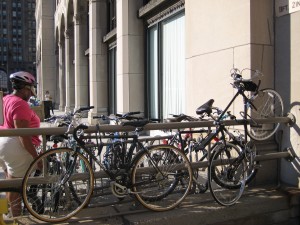
    bike parking around the New Center in DetroitBike parking has been a hot topic of late.

    In Ann Arbor and Hamtramck

    Both cities’ efforts to promote bicycling were mentioned in this recent metromode article, Cheap Ways To Revitalize Your Downtown. And both cities are looking to improve bicycle parking — a hot topic this past couple weeks within the city of Detroit.

    In Detroit

    We recently mentioned a rekindled bike parking discussion with the Detroit Tigers that was initiated last year by Wheelhouse Detroit.

    There’s also been discussion at various meetings that not only recognized the importance of improved, safe, and convenient bike parking, but included some steps we can take.

    It’s been noted that bike parking within parking structures could be a very good option. And they’re shelted too. The city owns 11 structures. We probably need to not only add bike racks but produce signage so bicyclists can find them.

    And rather than buy racks, why not solicit local designs and local builders to create them as is done in Buffalo, New York? Let’s keep the money local and create green jobs.

    We’re also looking to pull together some recommendations on bike racks, including designs and location. Many cities have such recommendations, so Detroit’s will likely take the best of those.

    Reduced Motor Vehicle Parking Requirements

    And, Detroit’s city planning commission is revising motor vehicle parking zoning requirements and may include language for bike parking. ?We’ve suggested that businesses along bike routes might be required to have fewer vehicle parking spaces. And perhaps space requirements could be reduced for any business so long as they provide bike parking. (By the way, providing bike parking is easy points for LEED certification too.)

    A Washington Post article, Don’t Build Parking, And They’ll Come–Without Cars, while primarily addressing transit and walking, certainly applies to cycling as well.

    Free or nearly free parking induces car usage, the planners say… Don’t build the parking, and residents will be more likely to buy into a transit- and walking-based urban life.

    In New York City

    The New York City recently took steps to help improve bike parking within some buildings. They also have a great design guide, which we’ve previously mentioned which includes specifications for bicycle racks. And finally, kudos to NYC for this map showing nearly all of their CityRacks.

  • CDC: Build bike lanes, lose weight

    Centers for Disease Control and Prevention (CDC)This week the Centers for Disease Control and Prevention (CDC) released a report called Recommended Community Strategies and Measurements to Prevent Obesity in the United States.

    In the report, they recommend the following strategies:

    Communities Should Enhance Infrastructure Supporting Bicycling

    Enhancing infrastructure supporting bicycling includes creating bike lanes, shared-use paths, and routes on existing and new roads; and providing bike racks in the vicinity of commercial and other public spaces. Improving bicycling infrastructure can be effective in increasing frequency of cycling for utilitarian purposes (e.g., commuting to work and school, bicycling for errands). Research demonstrates a strong association between bicycling infrastructure and frequency of bicycling.

    The report also cites evidence that “improving bicycling infrastructure is associated with increased frequency of bicycling.” In other words, if you build it, they will bike it.

    Also their suggested means for measuring success is the “total miles of designated shared-use paths and bike lanes relative to the total street miles (excluding limited access highways).”

    Note that shared-used paths are trails that are nearly always within their own right-of-way (e.g. rail trails.) They should not be confused with side paths or sidewalks, often called safety paths within Oakland County, which should not be designated bicycle facilities according to national guidelines.

    Other related suggested strategies include:

    • Enhance infrastructure supporting walking.
    • Improve access to public transportation.
    • Zone for mixed-use development.
    • Support locating schools within easy walking distance of residential areas.

    If this sounds like the CDC is promoting Complete Streets then you’re certainly in agreement with Barbara McCann from the National Complete Streets Coalition.

    And if you’re interested in staying on top of the Complete Streets movement within Michigan, visit the relatively new Michigan Complete Streets web site.

    (via Streetsblog)

  • Help the Hub: Safe Streets Youth Ride Fundraiser

    Safe Streets Youth RideThe Hub of Detroit is a great resource for Detroiters looking to get a great deal on a used, functional, and often hip bicycle.

    Located in the Cass Corridor, they also help Detroit youth get into bicycling and bicycling repair.

    Here’s a great opportunity for a nice afternoon ride in Detroit that will help fund their youth education program:

    Saturday August 1st, 2:30 PM to 6:30 PM @ The Hub of Detroit, 3611 Cass Ave.

    Join the youth graduates of The Hub’s Earn-A-Bike program on a city of Detroit bike tour. ?This is an opportunity for the youth, ages 6-18, to take the bikes they have built during the program on the road and ride with adult role-model cyclists.

    • Route includes the Eastern Market, Heidelberg Project, Riverwalk, Downtown, Cass Corridor, and more places of interest along the way.
    • Ride ends at the U-M Detroit Center for refreshments and snacks.

    Register Online: http://safestreetsyouthride.eventbrite.com/

    All proceeds will support The Hub’s youth education programs.

    $25 Adult Tickets
    $10 with Student ID