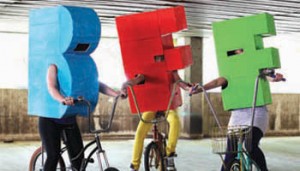
Mark your calendar. The Bicycle Film Festival is coming to Detroit on July 17th and 18th.
The films will be shown at the Downtown YMCA’s Boll Family Theatre at 1401 Broadway, just a couple blocks south of Comerica Park.
Friday, July 17th
6:30 PM – Opening reception in the theatre lobby
7:00 PM – Program 1 – Where Are You Go – Premiere
9:00 PM – Program 2 – Fun Bike Shorts
10:00 PM – Goldsprints at The Park Bar (2040 Park Ave.) with “real cheap drinks” and DJ Haute To Death
SATURDAY JULY 18
6:30 PM – Opening reception in the theatre lobby
7:00 PM – Program 3 – Road To Roubaix
9:00 PM – Program 4 – Urban Bike Shorts
10:00 PM – After party at the Cass Cafe (4620 Cass Ave.) with the bands bands Pedal Shop, Steven And The Reelers and The Reverend Robert David
Program 1 & 3 are full length feature films while programs 2 & 4 are shorts.
Tickets are $8 dollars per program and are now on sale.
There are also plans for a 30 mile Saturday morning ride, a picnic at Campus Martius, and a late afternoon Alleycat Ride before the Saturday reception.
John R with four one-way vehicle lanes and negligible traffic — an urban cyclist dream street.
We think so.
Apparently former New Yorker Toby Barlow may as well according to this Metromode article:
Toby Barlow finds it ironic that Detroit is known as the “Motor City”, since its flat and relatively calm streets make it the country’s most perfect bicycle city as well.
Yesterday the New York Times ran an opinion piece from Barlow about biking in Detroit:
While bike enthusiasts in most urban areas continue to have to fight for their place on the streets, Detroit has the potential to become a new bicycle utopia. It’s a town just waiting to be taken. With well less than half its peak population, and free of anything resembling a hill, the city and its miles and miles of streets lie open and empty, beckoning. And lately, whether it’s because of the economy or the price of gas or just because it’s a nice thing to do, there are a lot more bikers out riding.
Our abandoned landscape suggests an opportunity that alternative-transportation proponents should consider: instead of raging against their cities’ internal combustion machines, they might consider a tactical retreat to the city that cars have pretty much abandoned.
A Seattle blogger responded with the suggestion of moving to Detroit: “Not now, of course, because it’s warm and sunny in Seattle, and we’re not broke yet.” It’s warm and sunny in Detroit, too.
National Recognition?
Just because Detroit is a bicycle-friendly city, don’t expect to receive a bicycle-friendly designation from the League of American Bicyclists.
The scoring for that award is based on assumptions such as:
government has the lead role in developing and managing bicycle facilities
the city does not have significant vacant land
that urban streets have traffic levels that necessitate bike lanes
None of these assumptions are correct in Detroit and so we do not score well.
Erroneous Benchmarking
And similarly, the Alliance for Biking and Walking is currently benchmarking U.S. cities. Most of the benchmarking questions asked were not relevant to Detroit’s reality, so we can expect to be erroneously scored. (This should not be unexpected as the Alliance’s 2007 benchmarking estimated that the city of Detroit had 34 bike shops and that Detroiter’s spent $92/person annually at these shops!)
In my role as MTGA’s Detroit Greenways Coordinator, I’ve discussed this with the Alliance, but they don’t seem to grasp that not all cities fit their expected mold for bicycle friendliness.
Of course it doesn’t help that they’ve never biked in Detroit either.
It’s apparent that the surveys and assumptions are made so that the cities they expect to score well do so. In other words, recognition is reserved for cities following in Portland’s footsteps.
Detroit’s not. We’re making our own trail.
We may not get recognized by the big nationwide bicycle advocacy groups, but we’re sure to keep getting recognized from cyclists like Barlow and others.
Started in April of 2001, the Frazz comic strip from time to time reflects author Jef Mallett’s love of biking. Today’s Fourth of July strip is a great example.
Jef was raised in Big Rapids and his addiction to cycling began with riding to school because he despised taking the bus. Jef now lives in Lansing, where his cycling addiction continues.
For those less familiar with the strip, Frazz is a thirty-something school custodian who lives an idyllic life being around well-behaved kids and getting plenty of time to ride both on-road and off.
“Frazz is who I want to be,” says Jef. “Frazz is a just a regular, likeable guy.”
Bicycle facility funding often takes verbal punches from some conservative voices who don’t consider it as a valid transportation option as driving.
Here are a couple advocacy approaches that might be more successful when appealing to conservative audiences.
Increasing National Security
William Lind, director of the Center for Cultural Conservatism at the Free Congress Foundation, was recently intereviewed in the Infrastructurist. And though he was talking about public transit, one could easily substitute biking into this same argument.
National Security is always a big interest to conservatives and any time you can talk in those terms, you’re going to have their attention. Virtually every American knows that our greatest single national security vulnerability at the moment, the one that has enmeshed us in the middle east, is our dependence on foreign oil, most of it coming from unstable parts of the world. And this can drag us into unwanted wars, as it has it can result not only in high gas prices, like we had last summer, but in complete cutoffs like we had in ’73 and ’79, where events halfway around the world suddenly leave our gas stations without any gas to sell. And at present, if that happens, most Americans have no backup.
Health economists once made the harsh financial calculation that the obese would save money by dying sooner, notes Jeff Levi, executive director of the Trust for America’s Health, a nonprofit public health group. But more recent research instead suggests they live nearly as long but are much sicker for longer, requiring such costly interventions as knee replacements and diabetes care and dialysis. Studies show Medicare spends anywhere from $1,400 to $6,000 more annually on health care for an obese senior than for the non-obese.
“There isn’t a magic bullet. We don’t have a pill for it,” said Levi, whose group is pushing for health reform legislation to include community-level programs that help people make healthier choices like building sidewalks so people can walk their neighborhoods instead of drive, and providing healthier school lunches.
“It’s not going to be solved in the doctor’s office but in the community, where we change norms,” Levi said.
Making our communities more bikeable can play a major role in reducing obesity and reducing public health care costs.
Where does Michigan stand? Here are some health statistics from the report:
29% of Michigan adults are obese
Michigan has the ranked ninth in the percentage of obese adults
12% of Michigan high school students are obese
On average, this obesity costs Michigan residents $291 per person in medical expenses. This is $33 per person above the national average.
Which state is the fattest? Mississippi has the highest obesity rate at nearly 33% — a title they’ve held for the past five years.
MDOT announced that the ramps will be completed in a later construction phase. According to the Detroit News, it won’t open until November.
Metro Detroit Trails
The Detroit News recently published an interactive map showing shared-use trails in Metro Detroit. It really shows how these trails are starting to connect into a larger regionwide network — a process largely led by the Michigan Trails and Greenways Alliance.
Draft Trailway Master Plan
The Spinal Column is reporting the completion of a draft master plan for the Huron Valley Trail extension eastward from Wixom to M-5.
The Commerce, Walled Lake and Wixom Trailway Management Council will hold a public hearing at 7 p.m. on July 30 in the Commerce Township Hall to receive public comment on a proposed master plan for the Michigan Airline Railroad corridor.
The trailway council, made up of representatives of three communities that seek to acquire stretches of the railroad running through their jurisdiction, is expected to adopt the master plan at the July 30 meeting.
This plan was paid for by a $5,250 donation from the Michigan Trails and Greenways Alliance.
 Mark your calendar. The Bicycle Film Festival is coming to Detroit on July 17th and 18th.


