W. Vernor improvements to target pedestrian safety, add bike lanes
Model D has published follow up to the open house we mentioned earlier in Southwest Detroit.
Concepts shared at the Open House include the installation of bike lanes on W. Vernor between Waterman and Lansing, which would mean narrowing the road down in some areas to one lane of vehicular traffic; redoing the street surface and water and sewage lines on the stretch of W. Vernor that passes under the viaduct just east the W. Vernor/Dix/Waterman intersection, as well as the installation of new sidewalks and lighting; the incorporation of a left-turn lane on eastbound W. Vernor at Livernois to prevent illegal and unsafe turns; and improving lane configuration at the W. Vernor/Dix/Waterman intersection to prevent lane jockeying.
Plans will be submitted for approval to the Michigan Department of Transportation this month in the hope that construction can begin this year.
All total this will be about two miles of bike lanes (1 mile westbound, 1 mile eastbound.) Plans also call for lighting underneath the viaduct.
Sounds like a Complete Street to us!
Sharing Woodward Avenue
Metromode has an article on returning Woodward Avenue to a Complete Street.
That means making the thoroughfare friendly to all forms of transportation, like pedestrians, bicyclists, trains and automobiles. It also means building density and economic opportunity along Michigan’s Main Street. The belief is that by making Woodward less car-dominant it can grow into one of Metro Detroit’s primary economic engines.
“The time has come,” says Heather Carmona, executive director of the Woodward Avenue Action Association, a non-profit that advocates for the avenue. “The irony is decades ago Woodward was a transportation-inclusive corridor, but it lost that with the rise of the automotive industry. However, it’s coming back full circle.”
Detroit Has to Demolish Before it Can Rebuild
ABC News has a story on Mayor Bing’s efforts to rebuild and reinvent Detroit.
Demographer Kurt Metzger envisions small urban villages connected by parks and bike paths.
“We could become the greenest city in the country because of the land that we have if we start to manage it correctly,” he said.
We share that vision as do many others. While the Mayor in his recent state of the city address did not specifically say bike paths and greenways, he did mention “parks and green space” twice:
Strengthening our city will take a long-term strategy for how we use Detroit’s 140 square miles more productively. The harsh reality is that some areas are no longer viable neighborhoods with the population loss and financial situation our city faces. But instead of looking at our land as a liability, we need to begin to think creatively about how it can be a resource as we rebuild our city. That conversation is in its initial stages but let me take a moment to dispel some myths out there.
We’re not giving away or selling any neighborhoods to anyone. This is about determining what areas of our city are best suited for residential use, commercial and industrial businesses, parks and green space.
When I imagine Detroit’s future, I see a city with vibrant neighborhoods, with retail and grocery stores, a city that’s home to thriving small businesses, better mass transit and community parks and green space. But it will take all of us to make that happen and it’s a process that will not happen overnight.
And he also mentioned Detroit’s Safe Routes to School effort.
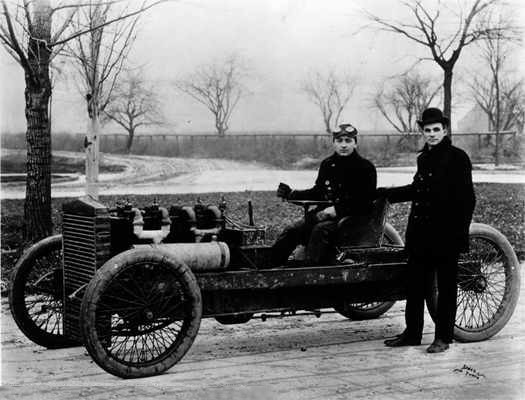 We’ve documented how the bicycling industry helped birth the automotive and road building industries. So it shouldn’t be a surprise that bicycle racing helped birth auto racing — and the Ford Motor Company.