June 26th, 2009
 Yesterday, the below letter was sent to the Highland Park Chief of Police, Theodore G. Cadwell II:
Dear Chief Cadwell,
I am writing to express concern that some of the Highland Park police officers may not be familiar with state law and bicycling.
Last night I was riding home from the Detroit Fireworks along Woodward Avenue through Highland Park.
At 11:11pm, I passed a Highland Park squad car at a traffic stop on northbound Woodward near Church. The police officer yelled “Sidewalk” to me. Apparently he expected me to ride on the sidewalk rather than the road. However, under state law, I have the same access to the road as any motorist (though I must stay to the right.)
According to MCL 257.657:
Each person riding a bicycle, electric personal assistive mobility device, or moped or operating a low-speed vehicle upon a roadway has all of the rights and is subject to all of the duties applicable to the driver of a vehicle by this chapter, except as to special regulations in this article and except as to the provisions of this chapter which by their nature do not have application.
I would also note that bicycling on a sidewalk is far more dangerous than bicycling on a road. There have been numerous studies which have come to that conclusion.
Also, last month the Secretary of Transportation posted the article, Bicycling is only healthy when you ride safely. In the article he said, “Motorists should recognize that bicyclists have a right to ride on the roadway” and “bicyclists should ride on the roadway, rather than on sidewalks.”
I will drop off some booklets called “What Every Bicyclists Must Know” at the police station. They were printed in partnership with MDOT and help explain bicycle laws in the state of Michigan.
Tags: Highland Park, police enforcement, state law
Posted in Law, On-road bicycling | 2 Comments »
June 26th, 2009
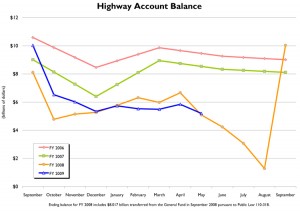 There’s been a huge flurry of news stories on the next transportation bill during the past couple weeks.
In summary, while Congressman James Oberstar introduced a new transportation bill, the White House announced they wanted to simply extend the existing transportation bill for 18 months. And today Senate leader voiced their support for an extension.
This situation is best summarized by this Infrastructurist article: Transportation Bill Is Dead As A Doornail For 2009 Because Nobody Can Figure Out How To Pay For It
But even the current transportation fund is in the red and may require an additional $20 billion to get through an 18 month extension.
In this economy, no one wants to raise gas taxes. Also, waiting 18 months means the gas tax issue could be dealt with conveniently after the 2010 elections.
What does this mean for cyclists?
We’re good either way. While some of the features in Oberstar’s transportation bill are very welcomed, it’s likely they may also appear in the future transportation bill. That is unless the 2010 elections change the balance of power in Congress.
Tags: Funding
Posted in Funding | No Comments »
June 25th, 2009
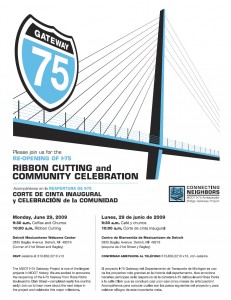 Coffee, churros, and a ribbon cutting are planned for next Monday at the Mexicantown Welcome Center at 2835 Bagley in Detroit.
We’re looking forward to riding over the Bagley Street pedestrian bridge, whose progress we’ve monitored over the past year.
This is a great example of a transportation project that improves the livability of a community. This bridge helps mitigate some of the harm done when I-75 was first cut through the Mexicantown community and dividing it in two.
Tags: Bagley bridge, Mexicantown
Posted in Detroit | No Comments »
June 25th, 2009
 Back in January, we reported on one of President Obama’s urban policy goals, which should push our local road agencies and elected officials to build more bike-friendly communities:
Build More Livable and Sustainable Communities: Our communities will better serve all of their residents if we are able to leave our cars to walk, bicycle and access other transportation alternatives.
In March, the Secretary of Transportation Ray LaHood further addressed livable communities in his blog by saying, “One of my highest priorities is … to help promote more livable communities through sustainable surface transportation programs.”
LaHood reiterated that message at the National Bike Summit since livable communties are bikeable communities and Complete Streets.
Again from his blog:
The upcoming reauthorization of DOT’s surface transportation programs provides an opportunity for us to feature bicycling as part of a new American mobility within livable communities.
Now more recently, LaHood outlined six livibility principles that “help us coordinate federal transportation, environmental protection, and housing investments at our respective agencies.”
- Providing more transportation choices;
- Expanding access to affordable housing, particularly housing located close to transit;
- Enhancing economic competitiveness, giving people access to jobs, education and services as well as giving businesses access to markets;
- Targeting federal funds toward existing communities to spur revitalization and protect rural landscapes;
- Increasing collaboration among federal, state, and local governments to better target investments and improve accountability;
- Valuing the unique qualities of all communities–whether urban, suburban, or rural.
Clearly, at least for most of Metro Detroit, the federal government is taking the lead promoting livable communties. How that filters down to our local level remains to be seen, but certainly transportation funding will play a major role.
And for now, it seems bicycle advocates need to start using the terms “livability” and “livable communities” when we push for Complete Streets, bike lanes, etc.
We have friends and support in Washington D.C.
We need to take advantage of that as we try bringing Metro Detroit’s transportation priorities into the 21st century.
Tags: Barack Obama, complete streets, livable communities, Ray LaHood
Posted in General bike news | No Comments »
June 24th, 2009
 Both Crain’s and Model D are reporting updates on the trail connection between the Dequindre Cut and the RiverWalk.
From the Crain’s article:
The Economic Development Corporation of the city of Detroit today approved a $871,900 contract with Detroit-based WCI Contractors Inc. for an 800-foot extension of the Dequindre Cut, the Dequindre Trail extension, to begin in July.
The extension will continue the paved bicycle and pedestrian path from the below-grade Dequindre Cut on the street level between Woodbridge and Atwater Street and is expected to be completed by end of this year.
This is much welcomed news.
This reduces the confusion in getting between the two trails, especially for first-timers. While at the recent RiverDays event, the most often asked question is, “How do I get to the Dequindre Cut?” and unfortunately the answer wasn’t that straigthforward.
We posted the conceptual design of this trail connection back in October.
Tags: DEGC, Dequindre Cut, Detroit Riverwalk
Posted in Detroit, Trails | No Comments »