April 4th, 2009
 The first round of Metro Detroit’s transportation stimulus checks are in the mail and some are for major bike projects.
This funding is mostly from 3% transportation enhancements sub-allocation, which is $25.4 million for all of Michigan.
I-275 Bike Path (MDOT)
The original $10 million request to recontruct the bike path was reduced to two requests. The first is for $4 million. The second is for $5 million and will only be available if Michigan can recover unused road funds from other states.
Clinton River Trail Bridge (Pontiac)
This bridge at Telegraph and Orchard Lake Road has been long awaited. It will connect the two developed rail-trail segments on both sides of Telegraph. The funding amount is $2.1 million.
Midtown Loop (Detroit)
This $2.3 million in funding is going towards Phase I of the Midtown Loop, a 2-mile walking and (casual) biking loop through Wayne State and cultural center. It’s expected that this stimulus money will push previously secured funding into the second phase and possibly help fund the connector between this project and the Dequindre Cut.
Streetscaping
These projects are aimed at making a road more pedestrian and bicyclist friendly. For example, the Woodward project includes “sidewalks, tree planting, street lights, trash receptacles, bike racks.”
- Woodward in Detroit between I-94 and Euclid (MDOT)
- Monroe and Brush Streets in Greektown, Detroit
- Michigan Avenue in Detroit between Cass and Woodward
- Shelby Street in Detroit between State and Griswold
Transit-Related Projects
Both DDOT and SMART are receiving funds to improve/build bus shelters and related amenities. We’ll contact both to determine whether these projects include bike racks. DDOT has been pursuing bike racks for their bus shelters as well as their buses.
Other Detroit Road Work
We checked and none of MDOT’s Detroit stimulus road work coincides with the city’s non-motorized plan. However MDOT is replacing some bridge decks over I-96 which may coincide with the plan.
Wayne County is receiving funds to reconstruct sections of 7 Mile and Fenkel Roads. Both should have bike lanes. We will contact both Wayne County and the city officials to make sure this is known.
The city of Detroit is receiving over $14.4 million for major street repair. Once we learn which roads those involve we’ll cross check them with the non-motorized plan to see if they are scheduled for bike lanes.
This should clearly show the value of having non-motorized plans in place for cities.
All of MDOT’s Metro Region stimulus projects are available on-line. SEMCOG also has a list of all accepted project requests within their seven-county area.
Tags: bike lanes, Clinton River Trail, DDOT, Dequindre Cut, Detroit, economic stimulus, Funding, I-275, MDOT, Midtown Loop, SMART, Wayne County
Posted in Funding, MDOT, Public transit, Trails | 4 Comments »
April 3rd, 2009
 Look at this map from West Bloomfield on the right.
The neighborhood streets are not in a traditional American grid pattern. Instead they are a maze of disconnected cul-de-sacs and roads to nowhere.
This design is embraced by communities where people drive everywhere and rarely walk or bike.
This design forces cyclists as well as motor vehicles to use the more busy arterials (such as Orchard Lake Road in this West Bloomfield example.) That often means less welcoming roads for many cyclists and plenty of traffic congestion.
Some cities (Charlotte, N.C., Portland, Ore., and Austin, Texas) and even states like Virginia are pulling the plug on cul-de-sacs.
According to the Washington Post:
The state has decided that all new subdivisions must have through streets linking them with neighboring subdivisions, schools and shopping areas. State officials say the new regulations will improve safety and accessibility and save money: No more single entrances and exits onto clogged secondary roads. Quicker responses by emergency vehicles. Lower road maintenance costs for governments.
But aren’t cul-de-sacs safer? Not really, according to William Lucy, co-author of the book Tomorrow’s Cities, Tomorrow’s Suburbs. Cul-de-sac communities have some of the highest rates of traffic accidents involving young children.
And these street patterns certainly aren’t safer for cyclists.
That’s one major reason why cycling in older cities like Detroit or Berkley is much more bike-friendly and convenient than places like West Bloomfield.
[There is additional cul-de-sac coverage at National Public Radio.]
Tags: cul-de-sac, street grid, West Bloomfield
Posted in On-road bicycling, Planning | 4 Comments »
April 1st, 2009
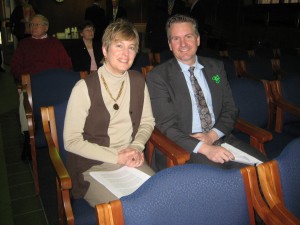 Today was the joint Senate-House hearing for legislation to better fund Michigan State Parks.
I did some live blogging during the hearing which is on the OurMichiganParks web site.
Nancy Krupiarz, the Michigan Trails and Greenways Alliance executive director joined me as seen in the photo to the right. Senator Patti Birkholz, one of the chairs of the meeting and long time supporter of Michigan State parks liked my neon green bike pin, a la Congressman Earl Blumenauer.
Unfortunately given the very large turnout to the hearing, we ran out of time before Nancy or I could speak. We did submit our written comments and will likely try again at future hearings on this critical legislation.
Tags: DNR, Funding, Senator Patricia Birkholz, state parks
Posted in Funding, Trails | No Comments »
April 1st, 2009
 This morning I expect to speak before a joint House and Senate committee hearing for a series of bills that improve funding for our Michigan state parks.
The above link provides information on how you can voice your support for this new funding proposal.
Here is my testimony —
Good Morning. My name is Todd Scott. I am a member of the Citizen’s Committee for Michigan State Parks and the Detroit Greenways Coordinator for the Michigan Trails and Greenways Alliance.
My job is to advocate for and support a citywide trail network that provides great recreational opportunities for all Metro Detroiters as well as tourists.
We envision a trail network that allows folks to bike or walk to great destinations like Tri-Centennial State Park on the Detroit River.
However, the current state park funding model based on user fees doesn’t support parks like Tri-Centennial. All of its visitors will enter the park on foot, bike, or by boat – not by car. These visitors won’t need to buy motor vehicle passes nor will the park generate funds through camping fees.
And as we continue building trails that connect Michigan communities to our state parks, fewer motor vehicle passes will be sold and DNR park revenue will continue to suffer.
The proposed change in the state park funding addresses this issue.
It will allow great parks like Tri-Centennial to flourish.
I hope you consider supporting the bills brought before the committees this morning.
Thank you.
Tags: Citizen's Committee for Michigan State Parks, DNR, Funding, state parks
Posted in Law | 2 Comments »
March 31st, 2009
 Liz from Continental Bikes asked the question “What legislation did you discuss with the representatives?”
In looking over the previous entries, it seems we never really answered that question. So here’s the list.
Complete Streets
Actually this is one topic we did cover fairly well.
Active Transportation 2010
In the current federal transportation bill, four U.S. cities received $25 million each to get more people chosing biking and walking over driving.?
The hope is to expand that pilot program to 50 cities in the next transportation bill due later this year. Three Michigan cities have applied for this program: Ann Arbor, Grand Rapids, and Detroit. We encouraged our legislators to include these Michigan cities in the future transportation bill.
Detroit’s Active Transportation proposal was briefly discussed earlier.
Transportation Enhancements
The current transportation bill (and recent stimulus package) funds Transportation Enhancements which is largely responsible for funding biking facilities and trails. We want to see this program continued and increased the next transportation budget.
This was an easy program to talk about since there many great examples of how this funding has been used within each congressional district.
Recreational Trail Program
This program captures a portion of the fuel tax used by off-road vehicles (e.g. snowmobiles) and directs to state trails, including non-motorized trails. We advocated for increased funding for this program.
Multi-Modal Commuter Credit
This legislation fixes the hastily passed bike commuter bill, which is another topic we previously discussed briefly.
Clean TEA
This legislation would take some of the funds generated through a cap-and-trade greenhouse gas program to pay for alternative transportation infrastructure, including biking and walking. Whether or not the greenhouse gas legislation makes it to the President’s desk remains to be seen, but if it does, we want to make sure it helps promote more non-polluting transportation choices.
There’s additional information on Clean TEA?at StreetsBlog.
Tags: Active Transportation 2010, Clean-TEA, commuting, complete streets, National Bike Summit, Recreational Trails Program, Transportation Enhancements
Posted in Law | 1 Comment »
 The first round of Metro Detroit’s transportation stimulus checks are in the mail and some are for major bike projects.

