West Bloomfield: Complete Streets and Safety Paths

November 23rd, 2010

The Charter Township of West Bloomfield adopted an updated master plan on September 28th.

Mike Reuter from American Cycle & Fitness and myself (Todd Scott) met with their planning department earlier this year. Our discussion was about making West Bloomfield bike friendly and how we might reflect that in the master plan.

We were successful in getting Complete Streets language added.

As the Township continues to evolve, the methods of travel will adjust to various desires andlifestyles. Environmental and cost of living issues will continue to emerge that will likely shifttravel choices away from the single-occupant automobile toward more carpooling, transitand non-motorized options. Anticipating this shift, the concept of “Complete Streets” hasemerged, which maintains equal focus on all modes of travel through both road and pathwaydesign. Complete Streets are intended to accommodate and enable safe travel for all systemusers. West Bloomfield should support the integration of complete street design into any future road projects to help promote multi-modal transportation in the Township.

One challenge with townships is they do not own any roads. The Road Commission for Oakland County does and they are this area’s biggest impediment to safe cycling.

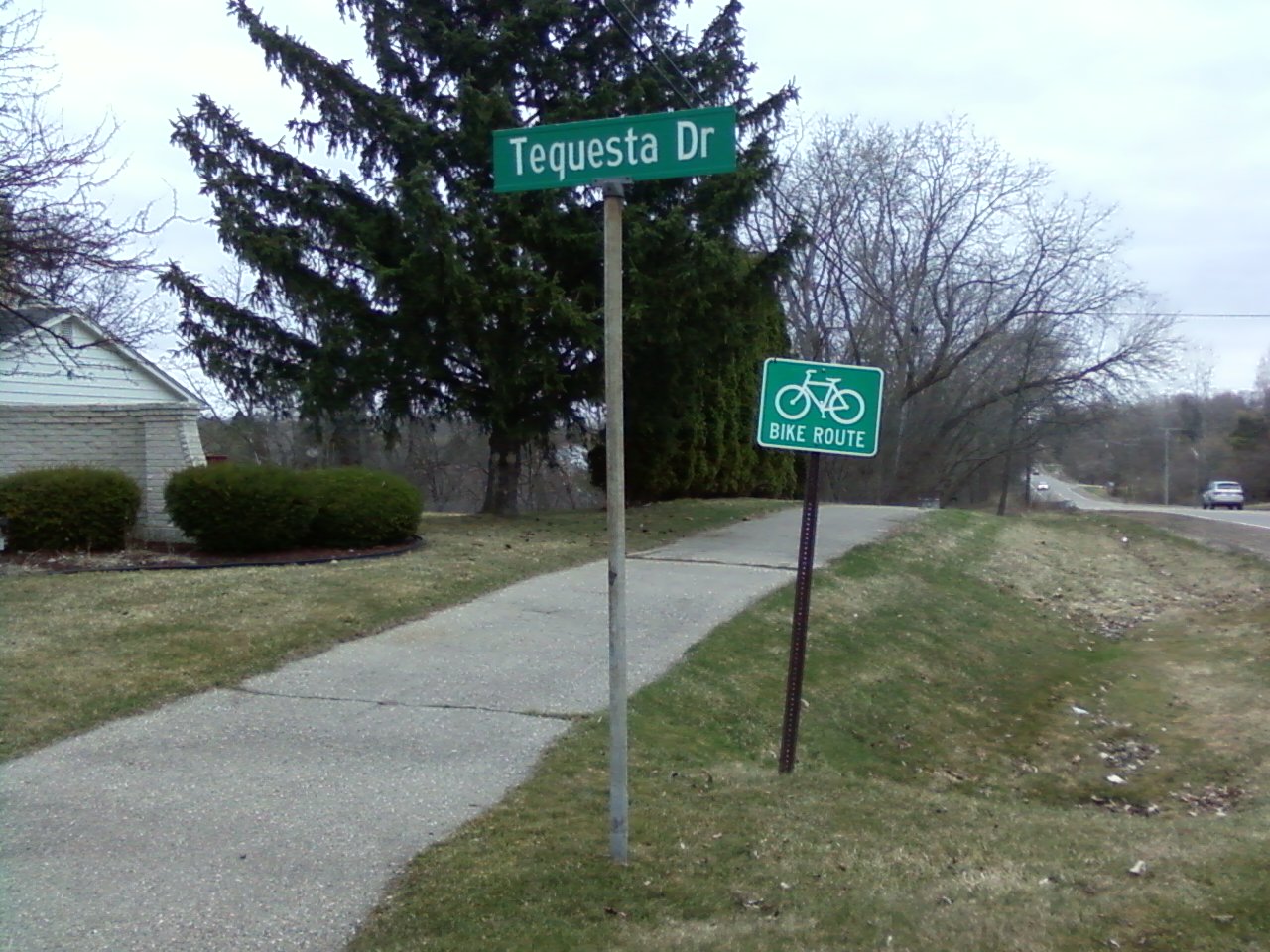
Despite referencing Complete Streets, the master plan still ignores national design guidelines (AASHTO) by promoting side paths (called safety paths in Oakland County) as bicycle facilities.  (Note that the latest draft of the forthcoming  AASHTO bicycle design guidelines devotes a couple pages to explaining why side paths are not safe for bicyclists.)

Given the political and operation momentum with side paths, one cannot expect West Bloomfield — or any similar Oakland County townships — to be a bicycle friendly community any time soon. Right now, with few exceptions, if you really want to live in a bicycle friendly community, you’re easiest, most reliable option is to move.

The Bicycle Trolley-car

November 20th, 2010

We stumbled on this interesting U.S. patent by Detroiter James H. Talbot back in 1899 for a Bicycle Trolley-car.

My invention relates to means for mounting a bicycle in a suitable frame or car suspended from an overhead trolley wire or trail, whereby the bicycle when operated by a rider becomes the motor for propelling the car along the wire.

The design allows riders to use their own bicycle within the frame.

Why not just ride on the roads? Given the bad road conditions of the time, was this an alternative to the Good Roads movement?

Or was this a way to get across the Detroit River? (Wouldn’t that be an interesting trip!)

We didn’t find any evidence on-line that this invention was ever built. There was a similar Trolley Cycle patent from 1894.

We do know a little bit about Talbot. In 1895 he was an eastsider living on Field Street just south of Kercheval. He was the secretary and treasurer for the Talbot Paving Company as well as the Universal Electric Construction Company.

And we know he was a dreamer.

So, let’s  fast forward to today. If there isn’t enough road width on Woodward to add the M1 Rail and bike lanes…

Detroit Bike Shorts

November 19th, 2010

Bikes on Buses

All SMART buses and about half of DDOT buses now have bicycle racks. DDOT expects all of their buses to have racks by the first quarter of 2011.

Weren’t they talking about possibly three-bike racks? Yes, but we were told there was an apparent design problem with those racks. When loaded, they blocked the bus left headlight. Not good. DDOT is also looking at funding bike racks near their transit stops.

DDOT’s Bikes on Buses brochure is on-line (PDF).

Lighting the viaduct

Model D is reporting on an effort by 100 Points of Light to light the W. Vernor viaduct at the Michigan Central Station.

Armed with a grant from Kresge Community Arts, the group — comprised of siblings Mary Beth and Patrick Carolan and Robert Reese — propose a series of solatubes paired with chandeliers inspired by those once found in the depot that are powered by light stored in solar panels. Eventually, excess power generated would be sold back to the grid, creating the possibility that the concept becomes not only self-sustaining, but profitable.

Over the next few months, 100 Points of Light will focus on cleaning up the underpass and replacing existing bulbs with high-efficiency LEDs while planning for installation gets underway.

A better lit viaduct will be very welcomed by cyclists. The darkness makes it difficult to see road hazard. Also, it’s difficult knowing how well motorists can see cyclists there. More light would be great.

The lack of light is one reason why the W. Vernor bike lanes (to be installed next year) end before going under the viaduct.

RiverWalk progress

A DNRE official was on the Craig Fahle show discussing the cleanup of the Uniroyal site. This site is on the Detroit River between two completed sections of the RiverWalk: Gabriel Richard Park and Mt. Elliot Park. Site cleanup could begin as early as next spring. This is a necessary step before this critical RiverWalk segment can be constructed.

And this Sunday the Detroit Riverfront Conservancy is leading a free guided tour of the RiverWalk from 10am until 11am at the Rivard Plaza. There are more details on their Facebook page. They are asking attendees to RSVP by tomorrow by sending an email to rsvp@detroitriverfront.org.

Reaching our goals together

There was a Greens Streets and Highways Conference in Denver this week. Secretary of Transportation Ray LaHood wrote about it on his blog, including this quote:

We have the tools, and are developing even more tools, to make sure that transportation doesn’t have to be a zero-sum game. Highway advocates, environmentalists, car owners, truckers, pedestrians, bicyclists, and preservationists can all reach their goals–together.

No more excuses for Metro Detroit road agencies.

We need leaders who find solutions to problems rather than continuing to find problems with solutions.
Conner Creek Greenway: new bike lanes and path

November 18th, 2010

Below are some photos taken this week of the new Conner Creek Greenway segment from Jefferson Avenue to the Detroit River at Mahera Gentry Park.

This 1.3 mile segment includes four different types of bicycle facilities! We have photos of each type.

Photo 1: Starting at Jefferson and heading south, there is a short stretch of shared, signed-roadway. It is signed as such.

Photo 2: The bike lanes begin.

Photo 3: Bayview Yacht Club needed occasional special events parking along Clairpointe about four times a year. There wasn’t enough roadway width for bike lanes and dedicated parking, so only the latter was constructed. However, since there are very rarely any cars parked here, it becomes a wide de facto bike lane. The road is signed as a bike route, too. This is a clever win-win solution that’s been used successfully in Chicago.

Photo 4: This is where approximately 2,000 (?) feet of shared-use path winds through Maheras Gentry Park and ends along the Detroit River.

“We see the bike as a solution”

November 18th, 2010

Minnesota Public Radio has an interesting article on the first national summit of Major Taylor bike clubs also known as the National Brotherhood of Cyclists.

The event was a chance to ride, give away bikes, and promote the message that bicycling has a valuable role in African-American communities despite what some may think.

Anthony Taylor, one of the festival organizers and one of the founders of the Major Taylor Bicycling Club of Minnesota, said you often hear the phrase “black people don’t swim” in the African American community.

“Of course they swim, but in America we hear it all the time. It has become the truth and so now you see kids who say black folks don’t swim. That’s a barrier to living better, living healthier,” Taylor said.

Taylor said a similar myth has developed around biking. He said many African Americans just don’t see biking as something that black people do.

“And we have to say that isn’t true, because I know the African American community is focused on improving their quality of life, improving their health, and we see the bike as a solution to that,” he said.

We think it would be quite valuable bringing this  national summit to Detroit in the near future, especially given the recent progress on the Underground Railroad bicycle routes coming to Detroit.

We’ll make that recommendation to our local Major Taylor Club, the Metro Detroit Cycling Club.

We’re not sure how much Major Taylor raced in Detroit. However, one of his biggest nemesis was Detroit Athletic Club racer and national champion Tom Cooper. And off the track, Cooper was a racist who tried banning Taylor from racing.

Cooper did race against Taylor for the 1901 American Championship held in front of 10,000 New York fans at Madison Square Gardens. Taylor wrote in his autobiography, “If ever a race was run for blood this one was.”

Cooper lost in a remarkably huge manner and refused to shake Taylor’s hand at the end.

Perhaps this result encouraged Cooper to retire from bicycle racing and jump into auto racing (eventually with Henry Ford.)