Posts Tagged ‘Detroit’

Detroit road obesity makes for easy cycling

Monday, April 25th, 2011
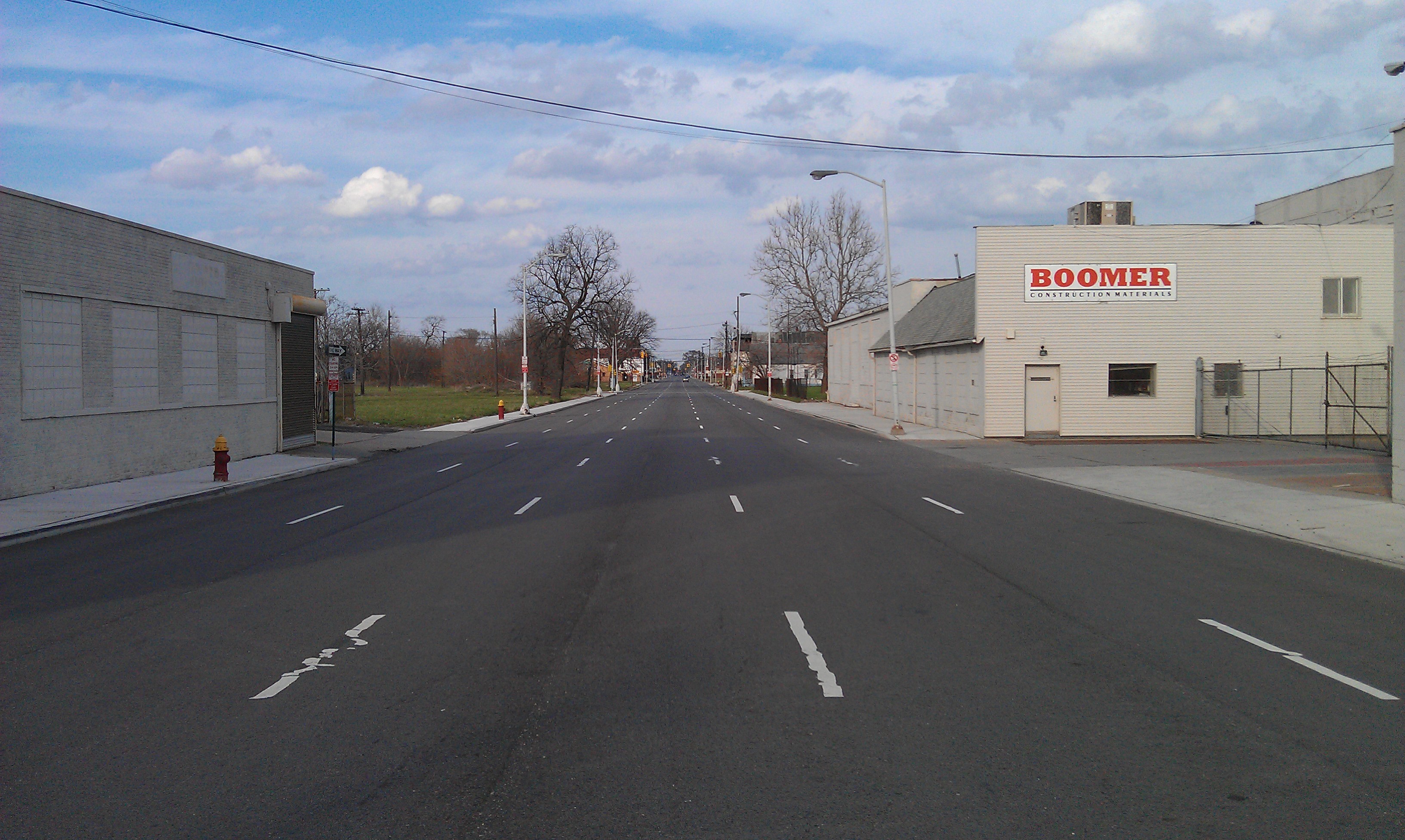
Detroit’s loss of population is well documented. No matter where the recent census counts fall, the reality is Detroit has a million fewer residents since the 1950s.

And since the 1950s, Detroit lost its streetcar network while gaining one of America’s most extensive urban expressway networks.

This has resulted in roads like Forest just east of Dequindre. Five lanes one-way with limited hours of parking.

Despite its one-way design, the road’s recent repaving and lack of traffic makes this ideal for biking.

And from 2004 to 2009, there are no reported motor vehicle crashes involving bicyclists or pedestrians on this segment of Forest from Dequindre to Gratiot.

Marked in Red

However, the MDOT and SEMCOG bicycle maps say otherwise. Both bicycle maps show this road in red, which means it’s generally unfavorable for bicycling due to the heavy traffic.

Huh?

We looked at the SEMCOG traffic counts and did not find any relevant traffic counts near this section of Forest. There was one count from June 2006 taken on Forest west of Dequindre however Forest is now closed at Dequindre. Even still, that traffic count was only 6,823 vehicles during a 24-hour period. The MDOT map says over 15,000 cars a day use this section of Forest.  SEMCOG map says there are over 10,000 vehicles per day.

Unfortunately it appears Forest is not the exception on these maps. There are other super wide, one way Detroit roads with little to no traffic that are shown in red, including Rosa Parks and 14th from Warren to I-75. Second Avenue from Forest to Temple is red on SEMCOG’s map despite its lack of traffic.

This really just reinforces the idea that Detroit needs a good bike map that is designed for cyclists and provides recommended routes — like Forest.

Road Diet?

Does road dieting a road without cars make it more bike friendly? Is a road with so few cars a Complete Street? These are questions that don’t get asked in most cities but are very relevant in Detroit.

Perhaps it makes more sense to approach this with a financial perspective. Could a road diet reduce the road maintenance costs and storm water runoff? Could we convert those outside travel lanes to half bike lane, half pervious surface. The pervious surface (perhaps as bio swales) would provide some separation between the parking/vehicle travel lanes and the bike lane while also absorbing the road’s storm water runoff. Could the city maintain (e.g. sweep) a physically-separated cycle track?

Eliminating vehicle lanes on Federal aid roads (such as Forest) affects Michigan’s federal transportation funding formulas. The state would get the same amount of funding, but less would be distributed to counties and cities like Detroit. There is a financial incentive for not losing vehicle lanes on federal aid roads, but is it enough to justify the added cost?

Hopefully the answer to these questions will emerge over time from the Detroit Works Project and more analysis.

But until then, go bike on E. Forest and enjoy the wide open road.

More on Hot Spokes: Detroit’s bike-based food delivery

Tuesday, April 19th, 2011

Pure Detroit has a real interesting interview with Shayne O’Keefe and his bike-based food delivery service called Hot Spokes.

We had mentioned this back in January but the interview provides the back story to the operation.

PD: When did cycling become a major element in your life?
O’Keefe: I got into bikes pretty recently. I’d always liked bikes, but I was just at this place in my life where I wasn’t doing anything really constructive…  I had heard about Back Alley Bikes in 2007, which is a volunteer program. You can go in there and do work trades in exchange to learn how to work on bikes. So, I started going there and I loved it. I met all of these strange, exciting people. They weren’t people that looked like they would be in my peer group. It was really great. I eventually earned a bike. I went and picked out this busted old ten speed and started learning how to work on it. It took me months to build it … but it definitely awakened something in me. My friends were all super jealous, wondering where I was and what I was doing.

And it looks like our old article is out of date. Hot Spokes now delivers from Shangri La which  has replaced the now closed Salad CreationsCass Cafe and Union Street still round out the options.

The interview does make the case that living in Detroit can be inexpensive, especially without a car. That’s certainly attracting artists, but also enabling some bike-based entrepreneurs like Hot Spokes and Mr. Bow Tie.

And we learned about Malcolm Carey and his Mr. Bow Tie business from a MetroTimes article by Detroitblogger John.

You can’t miss him because he shouts at passing traffic through a megaphone. Or he dances on the grass, whirling a sign in his hands, volunteering his skills. Sometimes he blurs by on his bicycle, pulling a wagon festooned with two banners advertising his work.

He’s offering a single service — cleaning dirty headlights. Nothing else. Regardless of how the rest of the car looks.

There are more photos of Mr. Bow Tie in action on detroitblog.

Thanks to Wheelhouse Detroit for sharing that Pure Detroit link on Facebook and giving us something to write about.

Sidewalks, bicycles, and… unicycles

Friday, April 15th, 2011

The Colbert Report has clever coverage of the unicycle issue in New York City (below).

Here in Michigan, state law allows bicyclists to ride on the sidewalk though we don’t recommend it for most cyclists, most of the time.

However, Michigan law also allows cities to prohibit them if they chose to. This has led to a lack of consistency. For example, it’s legal to ride on most Detroit sidewalks but not on any Royal Oak sidewalks.

Sometimes cities prohibit bicyclists only on sidewalks within their central business district or other specific areas.  As seen in the photo, the city of Detroit has this “Cycling” prohibition on Auditorium Drive’s sidewalk, but only for those heading uphill towards Jefferson. We did not see a similar sign for those cycling down the not-so-steep grade (and towards the fire hydrant located in the middle of the sidewalk.)

Also, the city of Detroit bans bicycles (and unicycles!) from Hart Plaza:

Sec. 40-4-7. – Wheeled vehicles prohibited.

No wheelbarrow, handcart, automobile, motorcycle, bicycle, motordriven cycle, go-cart, unicycle, moped, solex cycle or other wheeled vehicles are permitted in Hart Plaza except as approved by the civic center department or recreation department for a scheduled event. This section shall not apply to a handicapped person in a wheelchair nor to emergency or service vehicles.

Yes! Even solex cycles are banned!

Prohibitions must be posted

Michigan state law does require communities to post signs indicating any bans on sidewalk riding. Without the signs, the law is not enforceable.

So what about unicycles in Michigan? Like most other states, they are not considered bicycles under state law. (Note that some cities have their own definitions of bicycle.)

257.4 “Bicycle” defined.“Bicycle” means a device propelled by human power upon which a person may ride, having either 2 or 3 wheels in a tandem or tricycle arrangement, all of which are over 14 inches in diameter.

So it’s a gray area for unicycles with the exception of Hart Plaza. If you are the “Enemy from within”, use your best judgement.

MDOT drops the I-375 extension project

Wednesday, April 13th, 2011

Streetfilms recently posted a video on freeway removal.

It may surprise many Detroiters that MDOT’s plan to extend I-375 south to Atwater will be officially dropped this summer. Yes, I-375, the shortest signed interstate in the U.S. at 1.06 miles was going to gain a few more blocks to connect with the GM/Renaissance parking lots.

According to an old MDOT press release, “The new interchange will improve access between the interstate system and the area just east of General Motor’s World Headquarters in the Renaissance Center.”

And according to Kurumi.com:

The end of I-375 will be moved from Jefferson (where traffic continues west) to Atwater. Dyche Anderson explains the unconventional interchange design: “Heading southbound from Jefferson, there will be an exit for Franklin St Westbound, and an entrance – heading south – for Franklin Eastbound. There will be an exit for Atwater, but the freeway will do a U-turn and continue northbound. Heading north, there will be an entrance from Atwater, an exit to Franklin St Eastbound, and an entrance from Franklin St Westbound.”

Yes, a U-turn at the end of the freeway!

According to MDOT, this project was “to promote economic growth in downtown Detroit” though we’re not sure how.

They identified key community issues such as “bicyclists” and “safety for the drivers as well as the pedestrians and bicyclists.” Just imagine how having a freeway at Atwater would have affected your biking and walking experience along the RiverWalk!

Of course much has changed since this was proposed, but especially at MDOT. And as a result, they’ve asked for this project to be deleted from the Regional Transportation Plan for Southeast Michigan. That deletion should be taken up by the SEMCOG General Assembly near the end of June.

Removing the rest of I-375?

A few years ago, the Community Foundation for Southeast Michigan supported a planning exercise for Detroit’s East Riverfront area. One topic was converting I-375 from a freeway to a boulevard surface street. The same was proposed for the I-75/Gratiot freeway exit.

This effort was led by Ian Lockwood of Glatting-Jackson who said people shouldn’t have an expectation of driving 55 miles an hour through your central business district.

The benefits of making the below grade freeway into a surface street are the added real estate and greatly improved bike, pedestrian, and even motorist mobility through this area. One can easily imagine the benefits of improved connections between Eastern Market, the stadium areas, central business district, and even the future light rail line.

Perhaps this could be a return of Hastings Street, the main strip for Detroit’s prominent black community which was removed to create the expressway.

Of course that freeway removal plan is nothing more than a plan right now, but…

Windsor updates: Bikes, Trains, and Ferries

Sunday, April 10th, 2011

Bicycle Use Master Plan underfunded

The Windsor Star has a brief mention of the city of Windsor’s bicycling efforts, which according to some bicycling advocates is moving too slowly.

Members of the Windsor Bicycling Committee and the advocacy group Bike Friendly Windsor were at Wednesday’s capital budget meeting to implore council to devote more money to the Bicycle Use Master Plan (BUMP).

Drafted by the city in 2001, the 20-year plan was meant to show the city’s commitment to building an “easily accessible, safe and actively used” cycling network.

But Steve Konkle of Bike Friendly Windsor said BUMP has been the victim of “chronic underfunding.”

According to Konkle, Windsor has less than 25 miles of bike lanes.

Bike Train now daily

The Ontario Bike Train is now daily. The train makes it easy for cyclists to get between Windsor, London, Toronto, and other cities in Ontario. Bicycle racks are available for cyclists.

We spoke with Justin LaFontaine, Projects Director for Transportation Options and the founder of the Bike Train initiative. He said the big buzz among Toronto cyclists is riding in Detroit. And while they can take the bike train to Windsor, there is no option for them to get to Detroit.

They have had conversations with the Detroit/Wayne County Port Authority about ferry service across the Detroit River. The Port Authority is very interested in helping make that international connection for cyclists.

Until there is a convenient way for cyclists to cross the border, Detroit-area cyclists can drive to the Windsor train station. There’s also this interesting web site with the tag line, “Explore Ontario by bike. Stop at bicycle friendly places to eat, visit and sleep.”

What about AMTRAK?

One obvious question is what about bicycles on AMTRAK? The Pere Marquette and Blue Water lines should be getting roll-on bicycle service. However, we do not know about the Wolverine line, the line between Pontiac, Detroit, Ann Arbor, and Chicago. That line is not subsidized by MDOT and therefore is not required to have roll on service per an MDOT appropriations bill. We’re waiting to hear if AMTRAK will provide roll on service nonetheless.