Archive for the ‘General bike news’ Category

Suburban Updates: Royal Oak & Livonia

Friday, October 8th, 2010

Royal Oak Bike and Dine

A kickoff planning meeting for a progressive bike and dine event in Royal Oak is tomorrow, October 9th at 6pm.  The Bike and Dine itself would be held on Thursday, October 21st.

The brief 30-minute meeting is being held at the bar of Lily’s Seafood, 410 S. Washington in Downtown Royal Oak.

There is a Facebook event page set up for this meeting.

Livonia to look into planning

The city of Livonia is determining what is involved in creating a non-motorized transportation plan. From the Livonia City Council minutes of September 22nd.

On a motion by Brosnan, seconded by Toy, and unanimously adopted, it was:

#322-10 RESOLVED, that having considered the report and recommendation of the Infrastructure and Community Transit Committee, dated September 1, 2010, submitted pursuant to Council Resolution 20-10, regarding the City developing a connectivity plan for non-motorized transportation, the Council does hereby refer the subject of outlining the elements necessary to create a master plan for non-motorized transportation, including the estimated costs of engaging in the process, to the Administration for its report and recommendation.

This is very promising step for Livonia. Of course estimating the costs is perhaps an easier task than finding the funding.

Large cities like Livonia receive enough state road funding allocated to non-motorized transportation to pay for such plans. However, it’s fairly safe to assume that this allocated money is being spent on sidewalks and crosswalks.

Windsor to pursue Bicycle Friendly Community status

Friday, October 1st, 2010

The Windsor Star is reporting that Windsor City Councillors “voted unanimously to pursue Windsor’s designation as Canada’s first Bicycle Friendly Community.”

“There’s a growing respect and enthusiasm for cycling in cities, it’s the wave of the future,” said Coun. Alan Halberstadt, a member of the city’s bicycling committee.

Cycling tourism, already big in Europe, represents “a huge opportunity” for Windsor, said [Eleanor] McMahon, who grew up cycling in Windsor and was once press secretary to Prime Minister Jean Chretien.

While it will still be “a big leap from the motor city to the bike city,” Halberstadt said council’s unanimous vote shows Windsor is keen on going further in that direction.

Yep, Windsor is Canada’s Motor City.

Go Windsor!

How parking policies determine mode choice

Friday, September 24th, 2010

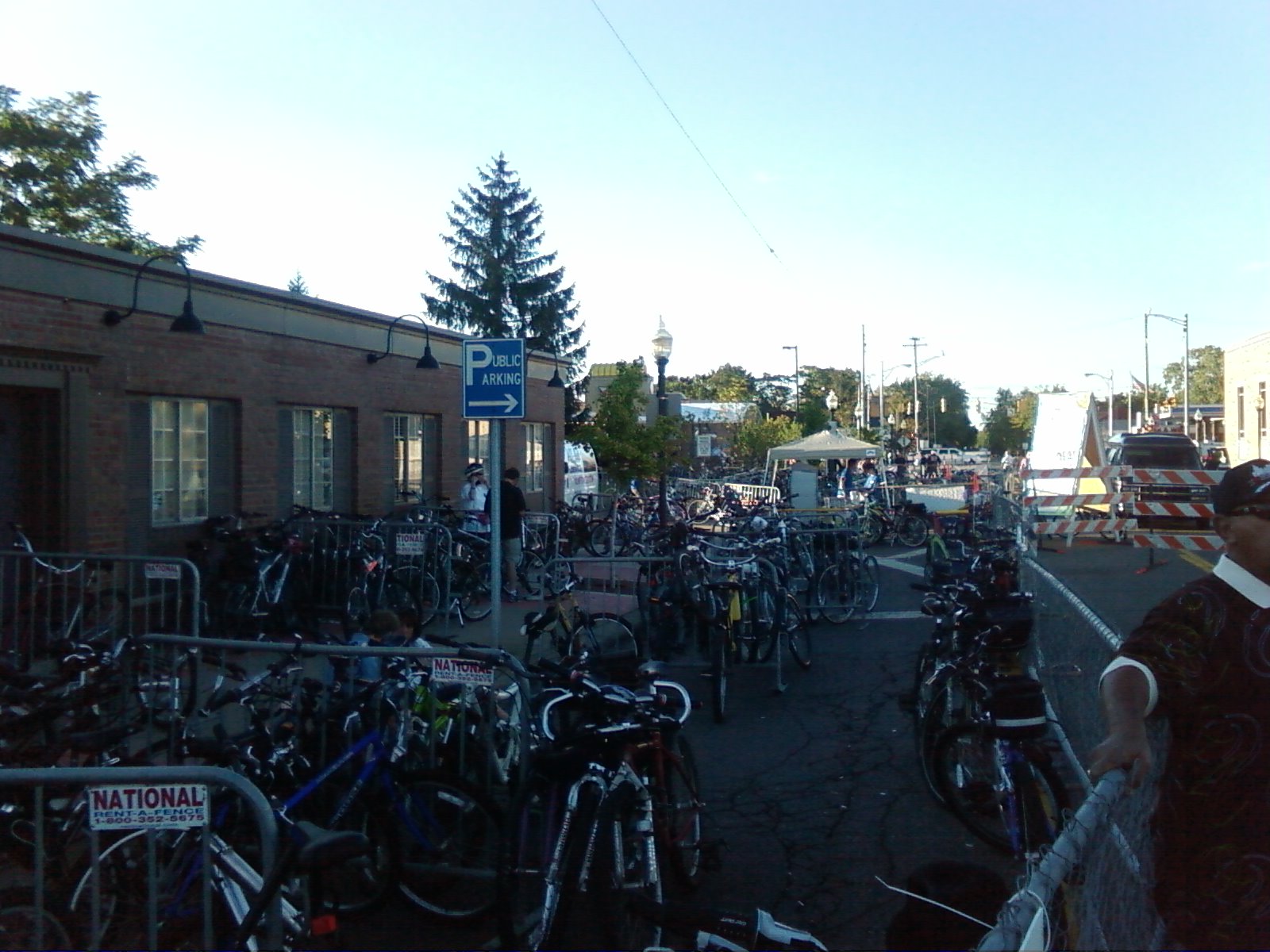
Free bike parking at the 2010 Arts, Beats and Eats in Royal Oak

“Parking policy exerts great influence on mode choice and urban design.”
U.S. Parking Policies: An Overview of Management Strategies, Institute for Transportation and Development Policy.

“The widespread practice of employer-subsidized parking is a significant but often overlooked determinant of mode choice for the journey to work.”
Employer-subsidized Parking and Work-trip Mode Choice, Pickrell, D. H. and Shoup, D. C.

Mode choice — whether someone choices to drive solo, carpool, take transit, bike, or walk is often determined by cost to park ones car.

Recently. this was proven very vividly in the city of Royal Oak.

With the Arts, Beats, and Eats festival moving to Royal Oak, the city looked to recover some city costs by charging for all parking around the event. The $15 parking price was high enough to prompt locals to keep their cars in their driveways and walk or bike.

And fortunately the event organizers partnered with KLM bike shops to offer free valet bike parking. There were two parking lots and both were quite full as the photo shows. In addition, bikes were parked all around the event perimeter.

Clearly, vehicle parking policy is a major determining factor in whether people drive, bike, or walk to downtown. If you provide below market pricing (including free) vehicle parking, don’t expect a lot of people to doing anything but drive solo downtown – especially downtown workers.

Recently the city of Royal Oak announced increasing the downtown parking fees a small amount – not to $15. This should help encourage biking and walking downtown, as well as ride sharing.

And according to “parking guru” Shoup, parking rates should be raised until there is a 15% parking vacancy rate. This reduces traffic levels by helping motorists find parking more quickly and it will likely encourage other modes of travel.

The key, however, is to re-invest those parking fees into the downtown.

Detroit biking in the news

Wednesday, September 22nd, 2010

Just catching up on some Detroit biking stories in the news on World Car Free Day

Critical Mass Detroit

Last month, Real Detroit Weekly had some coverage on Detroit’s Critical Mass ride.

Biking in from the suburbs may not be an easy task, but once you make it down to Detroit you realize how friendly the city can be on two wheels. Every last Friday of the month, an ever-growing group of bikers take back the streets for a little ride called Critical Mass.

This first paragraph highlights one major point. Detroit’s Critical Mass ride is fun and is becoming hugely popular — but it’s not about taking back the streets. Detroit bicyclists already have it quite good on the streets.

If this Critical Mass were about making a statement for cyclists rights, it would be in the suburbs during rush hour. It would be in Rochester Hills, Canton, and Sterling Heights.

The ride is more like a mini-Tour de Troit without the food and T-shirt — and there’s nothing wrong with that.

Conner Creek Greenway Update

Model D has a brief greenway construction update from Detroit’s east side.

The Riverfront Terminus of the Conner Creek Greenway is currently being built. This segment follows Clairpointe from Jefferson south to Maheras Gentry Park and includes bike lanes and landscaping along Clairpointe and a new trail and landscaping on the west side of the park. Construction is slated to be complete by end of October.

This summer, another segment of the greenway, one mile of bike lanes along St. Jean between Jefferson and Mack, was completed. The next stretch will run alongside Mt. Olivet Cemetery on Conner. The entire trail system is slated to be complete in 2013.

Motor City Road Diets

The Free Press has been publishing excerpts from John Gallagher’s new book, Reimagining Detroit. Gallagher discusses road diets and how they can lead to more bike lanes and improved pedestrian safety.

We almost never focus on the wide-open spaces of our main streets. Making Woodward, Jefferson, Gratiot, and the other spoke streets nine lanes wide (three lanes for traffic in each direction, one in the middle for turning, and a lane along either curb for parking) may have made sense in the 1950s when the city boasted a population near two million people.

But with Detroit’s population less than half its 1950s-era peak, these main streets now are absurdly overbuilt for the amount of traffic they carry.

Pedestrians, particularly seniors or parents with children in tow, find it all but impossible to cross one of these nine-line gulfs before the light changes. By narrowing the streets from three traffic lanes in each direction to two — by putting many of Detroit’s streets on a road diet — the city could make it easier for pedestrians to cross.

Since the 1950’s, Detroit’s urban freeway network also pulled many cars off these main roads as well, hence the great biking conditions.

Biking: a central theme

The Hamilton Spectator reported on this year’s Ontario Bike Summit. Jeff Olson from Alta Planning gave a little plug for Detroit.

A biking ‘guru’ who helped transform Portland into a cycling oasis has offered his expertise to Hamilton, a city he believes has “progressive potential.”

Jeff Olson, partner at Alta Planning and Design and a speaker at yesterday’s Ontario Bike Summit 2010 in Burlington, said a number of U.S. cities are using bicycles as a central theme in their shift from manufacturing hubs to modern urban centres. Included in that list are Buffalo, Dayton, Detroit and Cleveland.

Olson did some consulting on Detroit greenways last year and was truly awestruck by the biking potential.

Support PEAC, ride the Celebration of Cycling

Tuesday, September 14th, 2010

This Saturday is PEAC’s Celebration of Cycling ride in Metro Detroit.

The Eighteenth Annual Celebration of Cycling Ride will be held on September 18th, 2010 starting at Warrendale Shelter in Hines Park. Routes range from a traffic-free 12-mile course to a challenging century ride. This ride is truly for everybody, including competitive cyclists and families.

PEAC is a great organization that not only helps cyclists with disabilities, they were instrumental in getting the Complete Streets legislation passed in Lansing.

From PEAC’s John Waterman:

Three youth with disabilities (Conor Waterman 9 , Katie Birchmeier 9, and James Kleimola 17) stood up for all cyclists in Michigan to help pass Complete Streets Legislation.

Conor, Katie and James wrote their own speeches and testified in front of the House Transportation Committee, Senate Transportation Committee and The Disability Caucus.  Their testimony and hard work was instrumental in the passage of Complete Streets and Senator Basham stated, “Conor, Katie, and James helped me make up my mind.”  After their presentation the Senate immediately moved it out of committee.

Now you can help these students by riding in the Celebration of Cycling Ride on September 18, 2010.  Join hundreds of people grabbing their bikes to help individuals with learn to ride.  If you cannot ride please sponsor a cyclist with disabilities for $20.00, so Everyone Can Ride.  Thank you for helping individuals with disabilities improve cycling for everyone.