Archive for the ‘On-road bicycling’ Category

Putting Bike Safety on the Front Page

Wednesday, October 8th, 2008

There’s been plenty of debate about the value of two Southeast Michigan ghost bikes.

One positive thing they have resulted in is front page media coverage.  The October 1st Royal Oak Review put the story on page one with a photo.  The October 5th Mirror Newspaper just did the same.

For many, the incident, and the stark reminder of it, have heightened the awareness for bike safety in what is still largely a car-dominant metro area.

It was great to read informed public officials talking about bike lanes as an option for safer cycling in Metro Detroit.  Cullen Watkins, store manager for American Cycle & Fitness also said the same.

He thinks bike lanes would go far to protecting bicyclists. “When all is said and done, every community can put in bike lanes. People are walking on the sidewalks; we don’t belong on the sidewalks.”

So at this point is remains to be seen if this recent media attention will help put this issue on the City of Royal Oak and the City Commission agendas’ — something we have not been able to achieve to date.
Hines: Bike Path vs. On-Road

Saturday, October 4th, 2008

We recently received an email from an active cyclist in California.  Their relatives in Southeast Michigan could not understand why Hines Drive bicyclists were on the road shoulder instead of the parallel bike path.  She wondered if we could provide an answer.

[geo_mashup_map height="200"]

To an experienced cyclist, the reasons seem quite apparent.  Riding on the Hines Drive’s wide paved shoulder is:

  • Faster and more direct
  • Much safer at the intersections
  • Free of pedestrians (which you must yield to on the bike path)
  • Better lit at night
  • Plowed of snow and ice in the winter
  • Less flooded after a rain
  • Has less debris (e.g. rocks) that can cause flat tires

Besides, the road lanes are wide, the paved shoulders are generous, and the speed limit is low.  And due to the lack of commercial/residential access along the road, it is absolutely an ideal place to ride a bike.

If motorists can’t safely share this roadway with cyclists then they probably shouldn’t be driving.

Coincidentally in 2004 I was asked a similar question while giving testimony before the House Transportation Committee in Lansing.  Hines Drive passed through one of the committee member’s districts.

We should also mention that Edward Hines, whom the road is named after, was Chief Consul of the League of American Wheelmen in Michigan (forerunner of the League of American Bicyclists), as well as a major “Good Roads” advocate.  Hines invented the double-yellow center line, pioneered snowplowing roads, and created the first mile of concrete pavement.  Hines is just another famous Michigan bicyclist that all road users can thank.

A Hard-working mother of two — and a Cyclist

Tuesday, September 30th, 2008
The insignificant traffic levels on Woodward during the early morning make it an ideal choice for bicyclists

The insignificant traffic levels on Woodward during the early morning (left) make it an ideal choice for bicyclists

The Detroit Free Press ran a followup article on the bicyclist who was recently hit and killed in Royal Oak:

Who rides a bike along Woodward Avenue near 12 Mile at 1:30 a.m.?

The answer: a single mom raising two kids. With no car, she commuted by bike from southwest Detroit to Royal Oak to care for a 92-year-old man.

Friends and family members describe Jackie Robinson as a fighter who had battled adversity and was working hard for her two boys, Bruce, 13, and Keith, 11.

“She was a good person,” said Heather Weeks, a cousin. “She would give you the shirt off her back.”

You can read the entire article here.

As much as I enjoy and respect Bill McGraw, the article’s author, he does make one significant mistake.  He implies Woodward is always busy and perhaps not ideal for biking:

Riding a bike on multilane Woodward north of 8 Mile can be harrowing: The speed limit in Royal Oak is 45, and an average of about 75,000 vehicles pass 12 Mile every day.

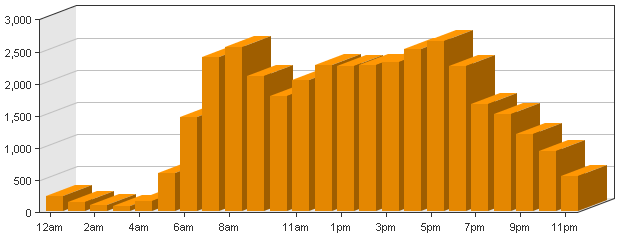
Woodward Avenue south of 12 Mile at 1:30 AM is not harrowing.  The latest SEMCOG traffic count for this northbound stretch of road shows only 140 vehicles per hour on this well-lit, four-lane road.

That’s just one car going past every 26 seconds across four lanes of traffic.  Harrowing?  That’s an ideal road choice for a cyclist.  There’s plenty of room for vehicles and bicycles to share Woodward in the early morning hours.

And the frosting on the cake is according to MDOT, traffic levels have been declining on Woodward Avenue.

Don’t Forget:  Anyone with information about this hit-and-run is strongly urged to call the Royal Oak Police at 248.246.3515 anytime.

Ghost Bike memorializes Royal Oak Cyclist

Friday, September 26th, 2008

As reported earlier, a Royal Oak bicyclist was recently killed in a hit and run on Woodward. There had been discussion on Detroits Critical Mass discussion list about adding a ghost bike at the crash scene.

Ghost Bikes are small and somber memorials for bicyclists who are killed or hit on the street. A bicycle is painted all white and locked to a street sign near the crash site, accompanied by a small plaque. They serve as reminders of the tragedy that took place on an otherwise anonymous street corner, and as quiet statements in support of cyclists’ right to safe travel.

Apparently that discussion turned to reality.

Bill McGraw of the Free Press reported on it in today’s paper: A hit-and-run death in Royal Oak brings a ghost bike for all to see.

No one has taken credit for the Royal Oak ghost bike, though someone faxed an anonymous, handwritten press release to the Free Press.

“Our roads are meant to be shared,” it said.

Detroit City Council Approves Non-Motorized Plan

Sunday, September 21st, 2008

Last Tuesday, the full Detroit City Council approved two resolutions relating to the Non-Motorized Transportation Master Plan.

Why a Master Plan?

Municipalities develop non-motorized master plans to look at their entire area and creates a vision for improved biking and walking facilities based on public input and various data sources.  Typically the plan calls for modifying existing road right-of-ways to better and more safely accommodate bicyclists and pedestrians.  It would also consider non-motorized trails needs as well as related amenities, such as bike racks.

And of course, a good plan would make recommendations on how to change city policies in order to make the planning vision a reality.

Having a good non-motorized plan helps municipalities implement them as road construction projects are planned.  Similarly, it obligates other road agencies (e.g. MDOT) to implement the plan on roads they own within the municipality.

And finally, having system-wide plans such as these improves the chances for grant funding to help implement the plan.

Detroit’s Plan

MDOT funded a non-motorized plan for Detroit.  Giffels-Webster along with other firms and the City of Detroit developed the plan.   The plan calls for various improvements for walking and biking in Detroit, including nearly 400 miles of bike lanes.

Link to Detroit Non-motorized Transportation Master Plan

City Council Resolutions

The plan was first presented to Council President Ken Cockrel Jr.’s Green Task Force.  We received a very favorable response and Mr. Cockrel got this on a council committee agenda.  With a solid showing of public support, the committee created resolutions to approve it.

Both resolutions are shown below: (more…)