The recent Cleveland protests over the Ohio Department of Transportation ignoring cycling certain echoes recent experiences with MDOT. From their Fort Street project to a Michigan Avenue repaving to the I-94 expansion, MDOT is ignoring Detroit’s non-motorized transportation master plan — a topic on the agenda for the next MDOT Metro Region non-motorized meeting in March.
But back to Cleveland, their protest has a cool video and song. Maybe that’s what we need to better get our basic message out.
We don’t need non-credible excuses or a willingness to listen. We need a consistent commitment to make Detroit a better place to walk and bike.
The Free Press is reporting that Harper Woods is considering blocking some roads with the thought that it may decrease crime.
Harper Woods has several major roads and sits along I-94. City officials said blocking off some streets might make escape more difficult for those who commit crimes in the city.
It might make it more difficult to bike around the city, too.
And while it likely isn’t anyones intention to block bicycle traffic flow, that’s certainly what an improperly design road closure does.
We shared those concerns with the city manager. A full road closure, as the example photo shows, forces bicycles onto sidewalks. In some places, like Catalpa between Southfield and Lathrup Village, there are no sidewalk connections.
Here is some of our letter to the Jim Leidlein, the Harper Woods City Manager (Admin@harperwoodsmi.net).
If you do decide to close roads, I would suggest you maintain an opening in the barrier to allow bicycles to pass through. The AASHTO bicycle facilities guidelines suggest a 10 foot opening with a single bollard to prevent motor vehicle access (attached). Having a removable bollard would also allow emergency vehicle access if needed. Also per AASHTO, it would not be appropriate routing bicycles to a sidewalk in order to get around the road closure.
You might also consider your snow removal policy. You would not want to pile snow in this barrier opening and block non-motorized travel through it.
These same suggestions have been shared with Detroit’s Traffic Engineering division for Palmer Wood’s proposed barriers.
If you haven’t heard of or yet signed on the We Declare, now is the time.
What is We Declare? The preamble and principles listed on their website explain it best along with a video.
One principle we can easily embrace is:
Demand transportation alternatives. Invest in an integrated regional transportation system that links communities and provides citizens with access to the jobs, health care, and education they need.
Here’s an exciting Journey to Detroit video that explores the types of transportation choices we could have in this area.
Sometime in the not too distant future, John wakes up in suburban Chicago on a Saturday morning and heads to a White Sox game…in Detroit. Join him on a 300 mile journey to Detroit’s Comerica Park as he experiences the transportation options of the future: a neighborhood electric car share program, smart phone ticketing, high-speed rail, and connecting light rail. This clip is brought to you by America 2050 as part of its “A Better Tomorrow” project to visualize America’s future communities and transportation systems.
Notice that bike sharing systems at transit stops and hubs are among the transportation choices. There have been some preliminary discussion of bringing a bike sharing system to Detroit much like other big cities are currently doing. In speaking with NYC DOT Commissioner, she said she believes bike sharing systems will transform America’s large cities.
But what can make bike sharing systems work well is a connection to public transportation. For example, bike sharing could greatly improve the usability of the proposed M1 Rail on Woodward. Bike sharing could connect the M1 Rail to places like Corktown and Eastern Market.
Minneapolis, Minnesota recently studied public bike sharing an developed a non-profit business plan. It seems this plan could possibly be applied to Detroit.
Minneapolis will launch their “Nice Ride” bike sharing program this summer. They recently chose a vendor and will have 1,000 bikes in 80 kiosks — 65 of those kiosks by this June. It’ll be interesting to see how well their system works and how it could be replicated in Detroit.
Volume 13 Issue 1 of Libery Mutual’s Liberty Lines magazine includes a timeline called “Model T to Infiniti: 100 Years of Safety Innovations.”
The timeline’s introduction states that “…because of ever-increasing safety innovations, the rate of fatalities has decreased.”
That’s a pretty misleading if not dishonest statement.
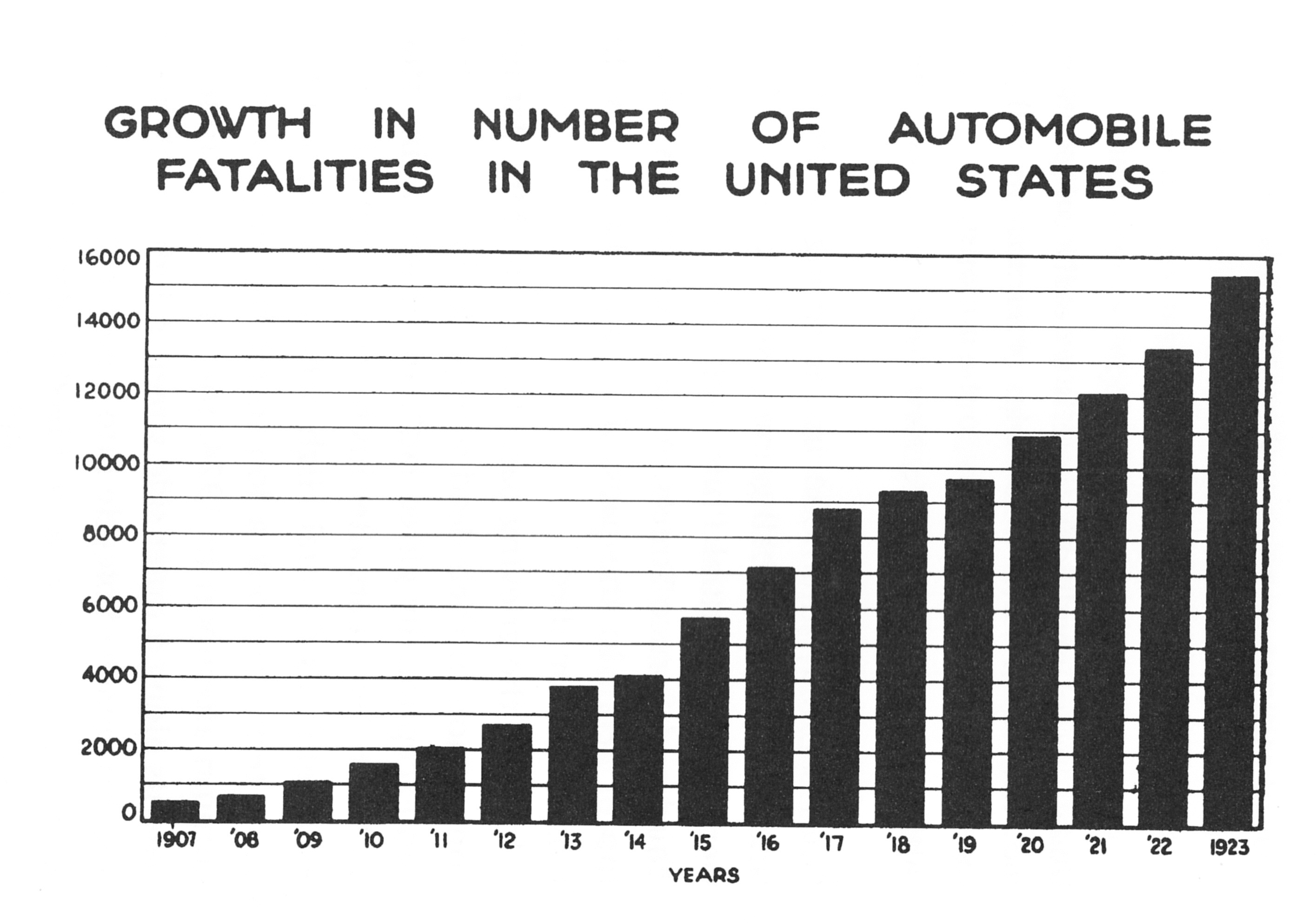
Liberty Mutual’s timeline begins in 1900 when fatalities due to automobiles was a rarity nationwide. By 1907 there were roughly 500 fatalities (fewer than 6 fatalities per million Americans) which grew sharply over time.
There were over 37,000 people killed in 2008 (more than 120 fatalities per million Americans.)
That’s not a lower rate.
Perhaps the fatality rate per 100 million vehicle miles travel has dropped with people driving more, but that’s hardly something to celebrate when we lose the equivalent of a medium-sized U.S. city of people every year.
And about 14% of those fatalities are pedestrians and bicyclists. Looking at a rate based on vehicle miles travel only serves to hide these fatalities.
[The road fatality chart was published in Peter Norton’s excellent book, Fighting Traffic.]