A cycling perspective on the Detroit Consent Agreement

April 11th, 2012

With a 5-4 City Council vote, it appears the City has at least temporarily kept Governor Rick Snyder from appointing an emergency finance manager.

That vote was for a “historic” consent agreement, according to the Detroit Free Press:

In the historic consent agreement between the city and state over the management of Detroit, the city agreed to give up — at least temporarily — a good deal of sovereignty over its financial affairs.

So aside from the hope of future solvency, what does Detroit get in return?

A modest amount of increased state spending — and an array of promises.

The 53-page agreement does keep City Council in charge of policy, which is a positive for our Complete Streets efforts. Detroit’s road money is separate from the general budget. We’ve argued that our Complete Streets ordinance wouldn’t add to the city deficit. It just divides up the road funding pie in a slightly different way.

The agreement also contains some state promises which affect Detroit cyclists to varying degrees.

The Positives

The state vows to:

  • Improve public lighting by working with the city to create a separate authority to manage and finance streetlights.” Working street lights can reduce crashes.
  • “Move ahead with the New International Trade Crossing project.” The bridge plans do include a bicycle pathway.
  • “Invest in a regional, multi-modal system including BRT, bike paths and walkability.” We’re not sure if this means more state investment or just continued funding.
  • “Assist the market in applying for a federal TIGER grant to create a seamless trail system from the Riverfront through the Eastern Market, Brush Park, and Wayne State University areas.” It’s a little late. Detroit already applied.
  • Riverfront – Develop the Globe Building, expand Milliken State Park, dedicate a new launch for citizens near Riverfront Park and assist DEGC with resources and talent to transform Hart Plaza.” The latter likely refers to an expansion of Hart Plaza over land that was previously used for the Ford Auditorium.
  • Belle Isle – Create park funding for Belle Isle while ensuring continued City ownership by designating Belle Isle as a part of a cooperative relationship with Milliken State Park. This would include a long-term lease that would accrue the cost of the park’s maintenance and improvements out of the Park Endowment Fund. We will partner with Belle Isle Conservancy and the City to implement a master plan for the Island.”

The Belle Isle item is among the more interesting. Unfortunately the Free Press already got it wrong with an article titled, “Belle Isle likely won’t be free anymore.

If the island is managed like other Michigan State Parks, there will only be an annual $10 fee for arriving by motor vehicle. One can walk or bike into state parks for free and the same would likely be true with Belle Isle.

While some cheer that this small fee will keep out the less desirable elements, those elements won’t disappear. They’ll find another location, just like they do now when the island closes at 10pm. A fee is not a total solution.

The Big Negative

It can’t all be positive for Detroit cyclists, right? The state vows to:

  • “Accelerate a capacity improvement project for I-94 from I-96 to Conner Avenue, supporting more than 13,000 jobs between 2012 and 2020.”

This outdated, mostly unnecessary MDOT project will wipe out 9 bridges over the expressways, including some pedestrian bridges, Third Street, and John R. It effectively widens the I-94 scar through the community.

The Governor needs to get involved in this project since the cost/benefit numbers just don’t add up. It’s “benefit” is from a 1980’s frame of reference that put a priority on reducing rush hour congestion irregardless of the effects on the local community.

Fortunately some local activists are started to pull together some project opposition.

Detroit: There are no accurate bike counts

April 10th, 2012

How many people in Detroit bike? How has this changed over time?

They’re very popular questions. The truth is we don’t know. Nobody does.

And that same answer is true for most American cities – accurate bicycling data does not exist.

That hasn’t stopped some groups from pretending that it does.

If you read the recent Huffington Post article on Detroit, you may have seen this.

A 2012 report by the Alliance for Biking & Walking found the number of bicycle commuters in Detroit rose 258 percent over the last two decades.

Sounds good, right? The Alliance report says Detroit had 340 daily bicycle commuters in 1990 and 1,217 in 2009.

What the Alliance report fails to tell you are the margins of error, which really give you an idea how inaccurate these numbers are.

That 2009 number is 1,217 plus or minus 803. Yep, the Census says the actual 2009 number could be as low as 414, likely within the 1990 number’s margin of error.

Another thing to consider: The 2009 numbers are based on a Detroit population of over 900,000, which is off by couple hundred thousand people.

And while everyone acknowledges Detroit’s notable increase in cycling activity last year, the 2010 Census numbers show bicycle commuting dropped nearly in half to 651 plus or minus 424.

If this hasn’t convinced you these numbers are quite worthless, there’s more.

The Census numbers only includes those who are working and 16 years or older. The Census doesn’t count most people who combine modes (e.g. use the bus bike racks) or who bike only a couple times a week.

The Alliance for Biking and Walking were made aware of these Census discrepancies for Detroit, but for the most part they did not address them. That’s why Detroit chose not to participate in the most recent report.

Other cities

Other cities are making big strides in understanding bicycling trends and counts. They’re doing travel surveys and bicycle counts — both automatically and manually — at key bridges and intersections.

And in cities like New York, they’ve found their counts don’t match the Census numbers either.

Detroit’s done some bicycle counts around Woodward, in Southwest Detroit, and on the RiverWalk, but not enough to draw any major conclusions. It would great if some future bike lane projects (looking at you, E. Jefferson!) could get some automated counters.

Until then, there just aren’t any good answers.


Improving the Google Maps bicycling layer

April 7th, 2012

Last week was the Google Map Maker North American Conference in Montreal.

What is Map Maker? It’s a web-based tool that lets you modify and add to Google Maps.

However, unlike Wikipedia, there is a change review process. New users can expect all of their changes to require a review while more experienced users can get some changes published immediately.

What changes can made? The Michigan Trails and Greenways Alliance has added missing pathways for the Detroit RiverWalk, Conner Creek Greenway, and Midtown Loop. All of the City’s bike lanes were added. There were also a number of trails shown for Detroit that simply don’t exist or are sidewalks. Those were removed.

The Google bicycling layer, which is selectable in Google Maps is now looking fairly accurate. We’re using it on this site with an overlay of bike parking locations.

Nonetheless, there are some improvements Google could make to improve their bicycle and trail data.

Here are some suggestions that were shared with their development team at the Montreal Conference.

  • Show unpaved roads differently – This would make it easier for road bikers to determine their routes.
  • Bicycle routing – Similarly, it would be useful if bicyclists could get biking directions using only paved surfaces if they prefer. This would be similar to the motorist directions which let you avoid expressways.
  • Add more trail surface descriptions – The popular crushed limestone surface seen on trails like the Paint Creek isn’t an option when describing a trail surface.
  • Add paved shoulders – Google Maps lets you describe bike lanes on a road, but not paved shoulders that make biking more desirable. For example, Edward Hines Drive should not be shown with bike lanes based on Google’s map policies.
  • Add bike racks – Points of interest can be added to Google Maps, but there’s not a category for bike racks. We heard that it will be available in the future.
  • Add abandoned rail corridors – There isn’t a way of properly showing abandoned rail corridors on the map. This is perhaps more useful for planners than riders, but it would be useful to add.
  • Exporting data – If we put all the bike rack locations in Google Maps, we want to be able to pull it back out. That information is needed for Bicycle Friendly Community applications. It would also be useful if we Google Maps could tell us the miles of bike lanes or trail within a city.

The U.S. Bicycle Routes were discussed. Those can be added now. For example, we’ve added the Conner Creek Greenway name to its on-road segments, e.g. ?St. Jean.

There was also a question of bicycles using ferry service. At the time, it was unclear if that was integrated into Google’s bicycle routing software. A different Google development team is responsible for routing (as well as rendering.)

However, getting bike directions from Detroit to Windsor does take you to the ferry in Algonac. City hall to city hall is 127 miles by bike — or 2 by car.

Mapping delays

One word of warning. There is a delay from the time your change is published in Map Maker to the time it shows up on Google Maps. That delay is dependent on many factors, including the size of the change and where the change is made.

There’s also a delay before changes affect the routing. Google’s bike routing tries taking advantage of trails, bike lanes, and preferred bicycle routes. If you add these features in Map Maker, it can take up to a couple months before the routing routines know about them. The Google engineers said there were working on reducing this delay.


Bicycles are not vehicles in Michigan

April 5th, 2012

The city of Ann Arbor web site says, “Ann Arbor and Michigan laws classify bicycles as vehicles and requires them to follow the rules of the road.”

That’s not correct.

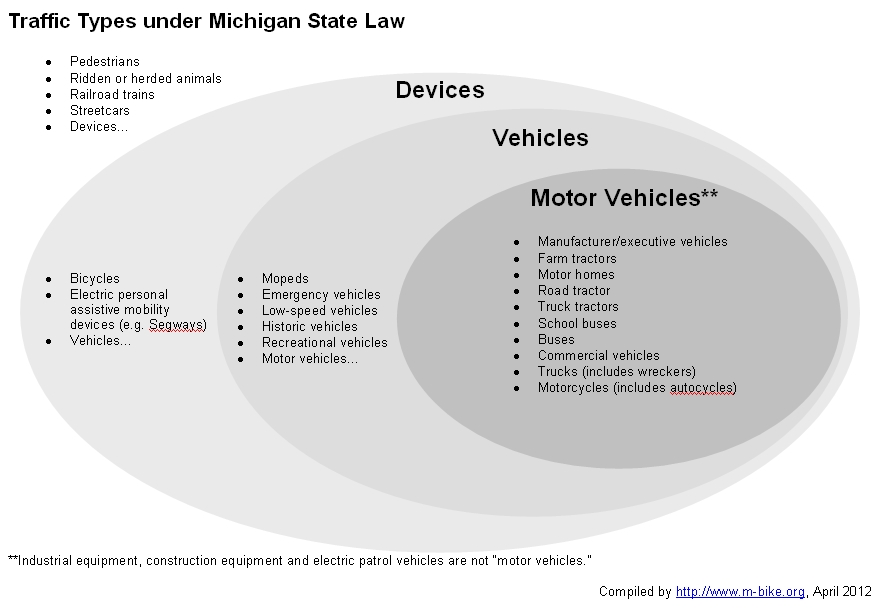
Despite what you may read or hear, under state law bicycles are not vehicles in Michigan. Yes, this differs from some other states, but that is what Michigan law says.

And cities such as Ann Arbor adopt the state law definitions for vehicles and bicycles.

Not convinced? Here’s the state law:

257.79 “Vehicle” defined.

“Vehicle” means every device in, upon, or by which any person or property is or may be transported or drawn upon a highway, except devices exclusively moved by human power or used exclusively upon stationary rails or tracks and except, only for the purpose of titling and registration under this act, a mobile home as defined in section 2 of the mobile home commission act, Act No. 96 of the Public Acts of 1987, being section 125.2302 of the Michigan Compiled Laws.

We’ve highlighted the key point. If you’re human powered, you’re not a vehicle in Michigan.

There are many traffic types defined by state law. We’ve put together this graphic which shows the relationships between them.

Bicyclist rights to the road

If bicycles aren’t vehicles in Michigan, how are we granted access to most of the roads?

That’s handled by this state law:

257.657 Rights and duties of persons riding bicycle, electric personal assistive mobility device, or moped or operating low-speed vehicle.

Each person riding a bicycle, electric personal assistive mobility device, or moped or operating a low-speed vehicle upon a roadway has all of the rights and is subject to all of the duties applicable to the driver of a vehicle by this chapter, except as to special regulations in this article and except as to the provisions of this chapter which by their nature do not have application.

Again, we’ve highlighted the key point. A driver is a person “in actual physical control of a vehicle.”

Bicyclists are do not have the same duties as an vehicle owner. We don’t need to register and license our bicycles with the state.

And as the definition shows, there are exceptions. As we’ve said before, those “same roads, same rights, same rules” stickers are simply wrong.

Why can bicycles ride on sidewalks?

It is against most Michigan municipal ordinances to drive vehicles on sidewalks under the Uniform Traffic Codes. So why isn’t bicycling always illegal on sidewalks?

State law makes an exception:

257.660c Operation of bicycle upon sidewalk or pedestrian crosswalk.

(1) An individual operating a bicycle upon a sidewalk or a pedestrian crosswalk shall yield the right-of-way to pedestrians and shall give an audible signal before overtaking and passing a pedestrian.

(2) An individual shall not operate a bicycle upon a sidewalk or a pedestrian crosswalk if that operation is prohibited by an official traffic control device.

(3) An individual lawfully operating a bicycle upon a sidewalk or a pedestrian crosswalk has all of the rights and responsibilities applicable to a pedestrian using that sidewalk or crosswalk.

Of course municipalities can locally prohibit bicycles from sidewalks.

This leads into another subject. The false notion that bicycles can impede traffic while operating legally.

That’s something we’ll cover in a future post.

Legislation would eliminate 1% bike/walk funding

April 2nd, 2012

A group of bills were introduced in Lansing earlier this year that change how Michigan generates and distributes road funding.

These bills as written have many opponents. Bicyclists, pedestrians, trail users, and Complete Street supporters should be among them.

Here are three reasons.

Eliminates bike funding requirement

First, House Bill 5300 would transfer funding from the current Michigan Transportation Fund (MTF) to the Commercial Corridor Fund (CCF) over an 8 year period. The MTF and CCF distribute funds to counties, cities, and villages. The MTF requires 1% of the funding to be spent on non-motorized facilities like bike lanes and sidewalks. The CCF has no such requirement.

So rather than remove the 1% requirement in law, legislators are simply creating a new fund without the requirement and shifting the money. We’re not sure how intentional this change was, but it has been a long standing goal of the County Road Association of Michigan to remove this requirement.

Increases funding for sprawl

The current road funding is generally distributed based on the miles of roads. House Bill 5303 would change that to distribute funding based on motor vehicle miles traveled or VMT.

Counties and cities that require people to drive more and longer distances will be rewarded. There will be a financial disincentive for counties and cities to promote public transit, biking and walking as they’ll receive less money.

Forecasts from MDOT show the city of Detroit would see some devastating funding cuts as a result. Even if the fuel taxes and vehicle registration fees are raised significantly, the City will still lose 8% of their road funding. And since those tax and fee increases may not even occur, the loss will be even greater. The City has already testified against this change.

Ironically enough, the bill’s sponsor is former City Councilwoman Alberta Tinsley-Talabi.

Promotes speeding

Granted this is the weaker of the three sins, but it deserves a mention for its sheer stupidity.

House Bills 5301 and 5302 require counties, cities, and villages to time traffic lights but not for the speed limit. On a road that has enough speeding cars, this legislation requires road agencies to time the traffic lights for them, which will likely induce more speeding.

We’ve already heard of MDOT doing this on a local state trunkline. Now this practice will be enshrined in law.

Recommended action

We recommend you contact your state representative and state senator to let them know you oppose removing the 1% requirement and oppose distributing road funds according to vehicle miles traveled.

These bills have been out for more than a couple months now. We can’t afford to keep sitting on the sidelines.

With ever rising fuel prices and increasing public interest in Complete Streets, it is unacceptable that we change road funding that takes us back to the 1970s mind set.