Posts Tagged ‘complete streets’

CDC: Build bike lanes, lose weight

Thursday, July 30th, 2009

Centers for Disease Control and Prevention (CDC)This week the Centers for Disease Control and Prevention (CDC) released a report called Recommended Community Strategies and Measurements to Prevent Obesity in the United States.

In the report, they recommend the following strategies:

Communities Should Enhance Infrastructure Supporting Bicycling

Enhancing infrastructure supporting bicycling includes creating bike lanes, shared-use paths, and routes on existing and new roads; and providing bike racks in the vicinity of commercial and other public spaces. Improving bicycling infrastructure can be effective in increasing frequency of cycling for utilitarian purposes (e.g., commuting to work and school, bicycling for errands). Research demonstrates a strong association between bicycling infrastructure and frequency of bicycling.

The report also cites evidence that “improving bicycling infrastructure is associated with increased frequency of bicycling.” In other words, if you build it, they will bike it.

Also their suggested means for measuring success is the “total miles of designated shared-use paths and bike lanes relative to the total street miles (excluding limited access highways).”

Note that shared-used paths are trails that are nearly always within their own right-of-way (e.g. rail trails.) They should not be confused with side paths or sidewalks, often called safety paths within Oakland County, which should not be designated bicycle facilities according to national guidelines.

Other related suggested strategies include:

  • Enhance infrastructure supporting walking.
  • Improve access to public transportation.
  • Zone for mixed-use development.
  • Support locating schools within easy walking distance of residential areas.

If this sounds like the CDC is promoting Complete Streets then you’re certainly in agreement with Barbara McCann from the National Complete Streets Coalition.

And if you’re interested in staying on top of the Complete Streets movement within Michigan, visit the relatively new Michigan Complete Streets web site.

(via Streetsblog)

Promoting Livability and Livable Communities

Thursday, June 25th, 2009

Transportation Secretary Ray LaHood at the National Bike SummitBack in January, we reported on one of President Obama’s urban policy goals, which should push our local road agencies and elected officials to build more bike-friendly communities:

Build More Livable and Sustainable Communities: Our communities will better serve all of their residents if we are able to leave our cars to walk, bicycle and access other transportation alternatives.

In March, the Secretary of Transportation Ray LaHood further addressed livable communities in his blog by saying, “One of my highest priorities is … to help promote more livable communities through sustainable surface transportation programs.”

LaHood reiterated that message at the National Bike Summit since livable communties are bikeable communities and Complete Streets.

Again from his blog:

The upcoming reauthorization of DOT’s surface transportation programs provides an opportunity for us to feature bicycling as part of a new American mobility within livable communities.

Now more recently, LaHood outlined six livibility principles that “help us coordinate federal transportation, environmental protection, and housing investments at our respective agencies.”

  1. Providing more transportation choices;
  2. Expanding access to affordable housing, particularly housing located close to transit;
  3. Enhancing economic competitiveness, giving people access to jobs, education and services as well as giving businesses access to markets;
  4. Targeting federal funds toward existing communities to spur revitalization and protect rural landscapes;
  5. Increasing collaboration among federal, state, and local governments to better target investments and improve accountability;
  6. Valuing the unique qualities of all communities–whether urban, suburban, or rural.

Clearly, at least for most of Metro Detroit, the federal government is taking the lead promoting livable communties. How that filters down to our local level remains to be seen, but certainly transportation funding will play a major role.

And for now, it seems bicycle advocates need to start using the terms “livability” and “livable communities” when we push for Complete Streets, bike lanes, etc.

We have friends and support in Washington D.C.

We need to take advantage of that as we try bringing Metro Detroit’s transportation priorities into the 21st century.

Great Lakes Metro Summit in Buffalo

Monday, June 22nd, 2009

img_2735Last week the Great Lakes Metros Summit was held in Buffalo, New York.

And to quote Artvoice, this event was where “activists and policymakers from around the Great Lakes gathered to share homegrown solutions to Rust Belt problems.”

At the Summit, I moderated a panel on Complete Streets and Transit while also providing a brief overview status of Detroit’s greenways and non-motorized transportation based on my work for the Michigan Trails and Greenways Alliance (MTGA).

Our panel included Rory Neuner from the Michigan Environmetnal Council and a League of Michigan Bicyclists director. Rory is very active with the Walk and Bike Lansing campaign. They are working on a Complete Streets policy for Lansing.

If you are a Lansing resident, please visit their web site to learn how you can help make Lansing “accessible and walk & bike friendly!”

Next on the panel was Dom Nozzi of Richmond, Virginia. Dom has an invaluable web site devoted to making cities more bikeable and walkable. His four-part speech from Bloomington, Indiana really defines a vision for how we need to prioritize transportation for people first rather than cars.

After the summit, I had a chance to talk with Dom. One interesting point he made is that many people are stuck with outdated transportation paradigms, primarily that mobility — high speeds, wide roads — is the primary goal. They’ve committed themselves to this paradigm and cannot step back to view the bigger picture. They are often unconvinceable. An advocates best hope is they will be replaced or retire.

And also on the panel was Justin Booth, who certainly plays a major role in all the good things happening in Buffalo with respect to biking.

Justin created Buffalo’s Blue Bicycle program, a low-cost, simple, innovative means for sharing bikes across town.

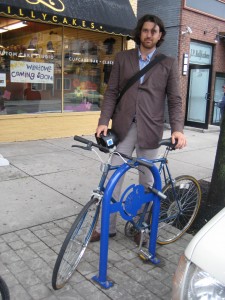
Also, Justin helped create the Rusty Chain beer program here a portion of sales from a custom locally-brewed beer go towards bike racks — an example of which is shown next to Justin in the above photo. To date the program has generated $10,000, which has been matched with city and federal funding (CMAQ). As a result, businesses within Buffalo’s Central Business District can request bicycle racks which are installed for free.

Buffalo recently installed 110 bicycle racks! Justin noted that the racks are custom designed and made locally.

That’s something worth raising a glass to.

National Bike Summit “Asks”

Tuesday, March 31st, 2009

img_2187Liz from Continental Bikes asked the question “What legislation did you discuss with the representatives?”

In looking over the previous entries, it seems we never really answered that question. So here’s the list.

Complete Streets

Actually this is one topic we did cover fairly well.

Active Transportation 2010

In the current federal transportation bill, four U.S. cities received $25 million each to get more people chosing biking and walking over driving.?

The hope is to expand that pilot program to 50 cities in the next transportation bill due later this year. Three Michigan cities have applied for this program: Ann Arbor, Grand Rapids, and Detroit. We encouraged our legislators to include these Michigan cities in the future transportation bill.

Detroit’s Active Transportation proposal was briefly discussed earlier.

Transportation Enhancements

The current transportation bill (and recent stimulus package) funds Transportation Enhancements which is largely responsible for funding biking facilities and trails. We want to see this program continued and increased the next transportation budget.

This was an easy program to talk about since there many great examples of how this funding has been used within each congressional district.

Recreational Trail Program

This program captures a portion of the fuel tax used by off-road vehicles (e.g. snowmobiles) and directs to state trails, including non-motorized trails. We advocated for increased funding for this program.

Multi-Modal Commuter Credit

This legislation fixes the hastily passed bike commuter bill, which is another topic we previously discussed briefly.

Clean TEA

This legislation would take some of the funds generated through a cap-and-trade greenhouse gas program to pay for alternative transportation infrastructure, including biking and walking. Whether or not the greenhouse gas legislation makes it to the President’s desk remains to be seen, but if it does, we want to make sure it helps promote more non-polluting transportation choices.

There’s additional information on Clean TEA?at StreetsBlog.

Complete Streets Bills Re-Introduced

Monday, March 16th, 2009
Photo courtesy of Dan Burden

Photo courtesy of Dan Burden

While meeting with members of Congress at the National Bike Summit, Complete Streets legislation was re-introduced. The same bill was introduced in the Senate in 2008 but died in committee.

The basic premise is road agencies should adopt a policy that ensures all transportation modes are reasonably accomodated, includinng biking and walking.

According to bill sponsor Senator Tom Harkin:

When Americans choose to leave their car at home and walk or ride a bike to school or work, they are making a healthy decision. We need to ensure streets, intersections and trails are designed to make them easier to use and maximize their safety.

This legislation will encourage Americans to be more active, while also providing more travel options and cutting down on traffic congestion.

Everyone is encouraged to use this quick online form letter to ask your Senator and Representative to support this legislation.

We typically got receptive but uncommitted support while in Washington DC, perhaps in large part because the bills were only recently introduced.

More details from the Complete Streets web site: (more…)