Posts Tagged ‘complete streets’

Woodward Corridor lands huge Complete Streets grant

Thursday, August 18th, 2011

Here’s some exciting news about Woodward that has nothing to do with the Dream Cruise.

Senator Carl Levin’s office and the Federal Highway Administration just announced a $752,880 grant for “developing a Complete Streets plan for Michigan’s 27-mile Woodward Avenue corridor that connects 11 communities and two Southeast Michigan Counties.”

“Transportation investments like these will create jobs and improve the quality of life for Michigan residents as well as strengthen the state’s economy,” said Secretary [U.S. DOT Secretary Ray] LaHood. “The demand from the states for these funds shows just how critical the need is for infrastructure investment.”

The funding is being awarded to the Woodward Avenue Action Association (WA3) who will be releasing more details soon.

WA3 has been a big supporter of Complete Streets and they are members of the Detroit Complete Streets Workgroup.

It will be interesting to see how this new planning effort fits with some prior Woodward bike/walk plans, the forthcoming Royal Oak non-motorized plan, and the Woodward Light Rail project.

But as for the Dream Cruise, there is a Complete Streets connection. The best way to move within the Woodward Corridor during the Cruise is on foot or by bike. Making Woodwared a Complete Street could give better, safer, and faster transportation options during the event.

Complete Streets Resolution passes

And in related news, Oakland County Commissioners passed a Complete Streets resolution for the county.

Special thanks to everyone who contacted their commissioner. It worked.


ACTION ALERT: Oakland County Complete Streets

Monday, August 15th, 2011

As we mentioned last week, Oakland County Commissioners Dave Woodward (Royal Oak) and Craig Covey (Ferndale) were introducing a Complete Streets resolution. That resolution was passed out of committee on a 5-4 vote and now goes before the entire commission for a vote this Thursday.

The entire resolution is on Commissioner Covey’s web site, but the resolution’s actions are:

THEREFORE, BE IT RESOLVED that the Oakland County Board of Commissioners hereby declares its support for Complete Streets and requests the Road Commission of Oakland County (RCOC) adopt a Complete Streets into its strategic planning process.

BE IT FURTHER RESOLVED that the Oakland County Board of Commissioners hereby requests the Road Commission of Oakland County to develop a Non-motorized Transportation Plan that will include, at a minimum, accommodations for accessibility, sidewalks, curb ramps and cuts, trails and pathways, signage, bike lanes, and shall incorporate principles of Complete Streets and maximize walkable and bikeable streets within Oakland County.

BE IT FURTHER RESOLVED that the Oakland County Board of Commissioners hereby requests the Road Commission for Oakland County plan for, design, and construct all transportation improvement projects, both new and retrofit activities, to provide appropriate accommodations for bicyclists,

Oakland County residents take action

While there is some optimism this resolution will pass with all Democrats and a handful of Republicans on board. However, those R votes could disappear. We need to make sure they don’t.

We need residents to contact their commissioner and voice your support for the Complete Streets resolution before the Thursday vote. This is especially important for those with Republican commissioners.

Also, in case you missed it, the Ferndale Patch ran an article on Complete Streets last week.


Oakland County Complete Streets resolution & meeting

Sunday, August 7th, 2011

** Note that the Complete Streets meeting is Tuesday, August 9th **

Oakland County Commissioners David Woodward and Craig Covey are introducing a Complete Streets resolution tomorrow, Monday, August 8th.

From the resolution:

“…increasing active transportation (e.g. walking, bicycling, public transportation) offers the potential for improved public health, economic development, a cleaner environment, reduced transportation costs, enhanced community connections, social equity, and more livable communities. ‘Complete Streets’ can also reduce traffic congestion and reliance on foreign oil.”

No, Oakland County Government does not own, build or manage roads. That is done by the Road Commission for Oakland County (RCOC), a completely separate county government operation for just roads.

(In Michigan, county governments by default can have health departments, cemeteries, courts, airports, parks and more – but they can’t have a road department. Roads are handled by a separate county government called a road commission. In order to consolidate these two county governments, state law needs to be changed and a county needs to become chartered — neither are easy.)

However, Oakland County government does have some pull over the RCOC. They do give them money and every two years they appoint a road commissioner.

We’ve had discussions with Commissioner Woodward over the past few years about a Complete Streets resolution, including making it a prerequisite for those county funds.

We’ve also brought up Complete Streets during the most recent road commissioner appointment process. That seemed to gain traction among the Democratic minority. It will be interesting to see whether Monday’s resolution gets votes from the Republican majority. There’s some discussion that it will.

It also is worth mentioning that we’ve been meeting with the RCOC regarding Complete Streets issues, including bike accommodations. It’s too early to say how that will play out. Current RCOC policy is to not accommodate bicycles on county roads, i.e. no bike lanes, no sharrows, no four-foot paved shoulders.

Complete Streets public meeting in Ferndale

On Tuesday, August 9th both Woodward and Covey are speaking in Ferndale about their resolution. This free meeting is at 6:30 PM at the Ferndale Public Library.

There more event information on Facebook.

More talk of Complete Streets around Metro Detroit

Saturday, July 16th, 2011

It’s easy getting caught up in the excitement of Complete Street resolutions, but from what we’ve seen so far, it doesn’t mean much — at least not yet.

What is the likelihood that so many Metro Detroit communities have suddenly discovered their poor road designs and are committed to fixing them? What are the odds that communities which have virtually ignored bicycles as a transportation mode are now ready to embrace them?

There’s just not that much “power” in the standard Complete Streets PowerPoint presentation which has been making its way around local councils and commissions.

And from some examples we’ve seen, communities are jumping on the Complete Streets bandwagon because others are doing it and there’s a promise of more MDOT transportation funding. Who is going to hold them accountable if they don’t follow through with actually building Complete Streets?

That said, the below Complete Street information is a mixed bag. It might result in better conditions for bicycle transportation or it might not. The truth is in the road construction (and maintenance.)

Complete Streets in Birmingham

The city of Birmingham passed a Complete Streets resolution. They have members of their staff and planning commission with significant experience in non-motorized transportation and planning. For example, the planning commission has Scott Clein, an engineer with Giffels-Webster who developed non-motorized plans for Corktown/Mexicantown, New Center, and the entire city of Detroit.

We have a good of level confidence that they’ll be able to make Birmingham more bike friendly in the near future.

Complete Streets in Northville

The city of Northville also passed a Complete Streets resolution but we’re much less confident they’re heading in the best direction by having their staff develop a non-motorized plan. There are only a handful of planning firms in Michigan qualified to produced a quality plan for biking and walking. To think that city staff could pull it off sounds either overly optimistic or they are underestimating the work required. The latter is why most cities hire consultants do develop their recreation plans and master plans.

It’s also been our experience that city staff do not engage the community in the planning process as well as consultants.

And these are some reasons why the city of Royal Oak hired the Active Transportation Alliance (ATA) to create their plan. The ATA has developed over 20 non-motorized plans including Chicago’s. Planners such as ATA and others have the experience. Is Northville going to invest in training their planner(s) on how develop a solid plan?

Plan update in Royal Oak

Speaking of Royal Oak, the Observer and Eccentric recently published this article which gives an update on the plan.

The consultant, Active Transportation Alliance, submitted a rough draft of the plan to the planning department in May, according to Ethan Spotts, marketing and communications director for the Chicago nonprofit company.

Regan looks forward to having the topic as an agenda item for a future Planning Commission meeting. He said roads with bike lanes, like the re-designed Hilton Road, south of I-696 in Ferndale, are sorely needed in Royal Oak. He said encouraging more bike and pedestrian traffic would also free up more parking spaces for vehicles in downtown parking garages, especially with the recent opening of Emagine Theatre and Star Lanes. He said pedestrian friendly designs also means more federal funding for road projects.

We have not seen the plan, but are looking forward to it.

Incomplete Streets in Lathrup Village?

Only a couple pages from a draft Complete Streets plan in Lathrup Village?by Birchler Arroyo appear to be on-line. They show a couple street cross sections, neither of which are Complete Streets. They clearly lack bicycle accommodations.

Their example “principal arterial – village” cross section is a 156 foot (76 feet between the curbs) public right-of-way with speeds of 35 MPH or less yet no bike lanes. The plan also says that these streets are “generally used for vehicular travel; automobile parking, and sometimes bicycling as appropriate.” This sounds like the same streets that exist today.

We brought this up to Birchler Arroyo Associates who is developing this plan. They invited us to see the entire plan, but they never responded when we asked them how. We have not seen this plan on their web site nor Lathrup Village’s.

North Carolina Complete Streets

And while on the topic of Complete Streets, North Carolina’s Department of Transportation has this excellent design guideline framework. They have interesting information on how Complete Streets are designed for various contexts, e.g. suburban, urban, etc.

We’d appreciate seeing something similar produced by Michigan’s Complete Streets Advisory Committee.

It might be helpful in ensuring that Complete Street designs in Michigan are truly Complete Streets.

Detroit Complete Streets: Resolution or ordinance?

Tuesday, June 28th, 2011

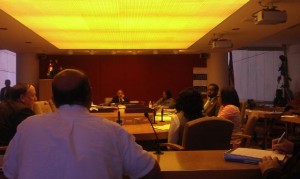
There was a discussion of a Complete Streets ordinance at yesterday’s Detroit City Council Public Health and Safety committee. It seems the debate is whether or not city council should pass a Complete Streets resolution or ordinance. The latter is more binding and permanent. A resolution would likely call for the city to have a Complete Streets policy, but there would not be much teeth in making sure the policy is followed.

Four city departments spoke on the topic. The Department of Health and Wellness Promotion (aka the health department) has received grant funding that requires that a Complete Street ordinance be passed. They also spoke about the connection between Complete Streets and public health.

Next, the Department of Public Works (DPW) listed their current non-motorized efforts. One highlight: They’ve spent $38 million during the past 10 years on non-motorized facilities, which includes 20,000 ADA sidewalk ramps, 400 pedestrian countdown timers, and (by the end of this year) 73 miles of bike lanes. They said a resolution would suffice.

Next, the City Planning Commission voiced their support for an ordinance, saying it was “warranted.”

And finally the Law Department was neutral but would look into the health department’s grant language to make sure an ordinance is required rather than just a resolution. They also asked to see the proposed ordinance language which the Detroit Complete Streets work group has been developing.

Councilmember James Tate said he “support Complete Streets wholeheartedly” but would like to know what strings might be attached to the grant funding.

Councilmember Brenda Jones also voiced her support for Complete Streets as well.

During the public comment, two physically-challenged residents spoke in support of Complete Streets, though they were at the meeting to discuss other issues.

One sight-impaired woman spoke of the difficulty in getting on DDOT buses when they cannot pull up to the curb due to on-street parking. Although she didn’t mention it, having a bump out at transit stops around on-street parking would alleviate her concern. This demonstrates that Complete Streets affects more than just DPW.