Posts Tagged ‘complete streets’

Detroit Complete Streets discussion on Complete Streets

Sunday, June 26th, 2011

On Monday, June 27th at 11AM, Detroit City Council’s Public Health and Safety committee is having a discussion on a Complete Streets ordinance.

11:00 A.M. – DISCUSSION – RE: Status of Complete Streets Ordinance. (City Planning Commission; Health and Wellness Promotion, Public Works and Law Departments)

The discussion is at the Coleman A. Young Municipal Center on the 13th floor at 2 Woodward. This meeting is open to the public.

In late May, the Detroit Free Press published a couple editorials in support of Complete Streets: Caution: Walking may be hazardous to your health and Watch your steps — Without policy changes, expect more pedestrian fatalities.

Both pieces were inspired by the recent national report called Dangerous by Design. This report ranked Metro Detroit as a the 12th most hazardous for pedestrians. Given the city’s larger shared of pedestrians, Detroit helped push that rank up.
From the first Free Press editorial:

Designing walkable streets and public places is important to building healthy, livable cities that attract talented employees, innovative businesses and creative entrepreneurs. They don’t necessarily require spending more money, but they do require fresh thinking.

Balanced transportation policies mean designing roadways to include the needs of pedestrians and bicyclists, not just cars. That will save lives and encourage people to become more physically active.

We agree. And perhaps the biggest concern raised is how much more money Complete Streets will cost. But Complete Streets aren’t expensive says Scott Clein of Giffels-Webster. He wrote this article, Complete Streets Myths Debunked.

Designs in line with Complete Streets philosophies don’t have to cost a lot, especially when included in annual capital improvement projects. Most communities have existing funding for road maintenance and related upgrades. When resurfacing a roadway, for example, implement bike lanes for little to no added cost.

This piece-by-piece approach may seem out of place when attempting to promote connectivity, but it mimics road maintenance approaches and allows the largest benefits from shrinking budgets.

We’ll end with this interesting Complete Streets video from some MSU students. (Note that Detroit does have HAWK signals, Safe Routes to School, and is building some Complete Streets.)

Complete Streets in Oakland County

Wednesday, June 8th, 2011

We just sent the following letter to Congressman Gary Peters asking his support for continued bike and pedestrian funding and HR 1780 — the federal Complete Streets bill.

The fatality numbers for Oakland County, which Peters represents a portion of, are quite compelling. There have been reductions in road fatalities among motor vehicle operators, but far less so for pedestrians and bicyclists.

For that reason, 29% of all road fatalities in Oakland County in 2010 are now pedestrians and bicyclists. This is an increase from 25% in 2009. The national average? Only 14% in 2009.

And for 2010 Oakland County’s bike and pedestrian fatality percentage is higher than Wayne and Macomb County’s.

Clearly something needs to be done to reduce bicycle and pedestrian deaths in Oakland County. Building Complete Streets needs to be a priority.

[Data sources: Michigan Office of Highway Safety Planning and National Highway Traffic Safety Administration]

Here is our letter to Congressman Peters:

(more…)

Detroit road obesity makes for easy cycling

Monday, April 25th, 2011

Detroit’s loss of population is well documented. No matter where the recent census counts fall, the reality is Detroit has a million fewer residents since the 1950s.

And since the 1950s, Detroit lost its streetcar network while gaining one of America’s most extensive urban expressway networks.

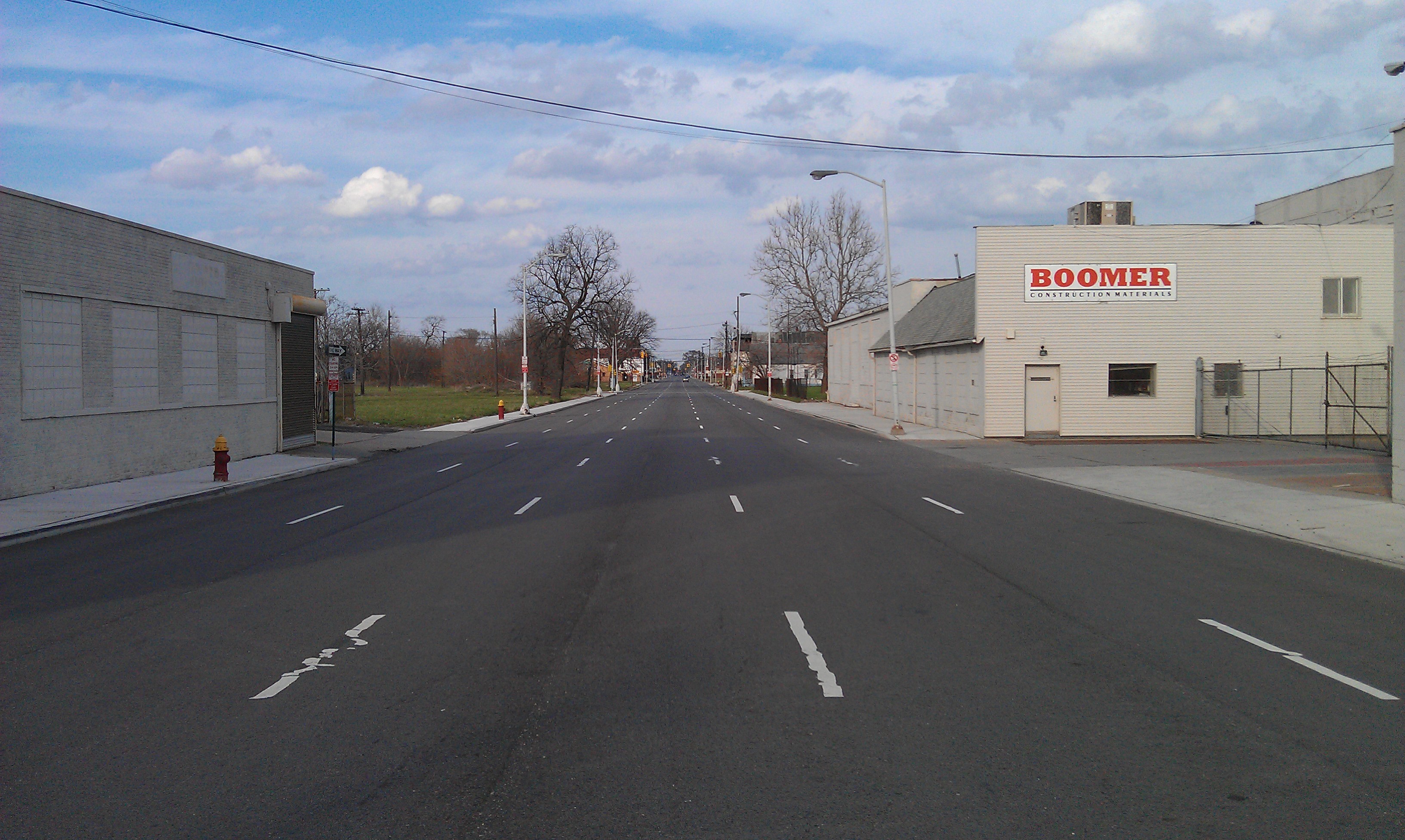
This has resulted in roads like Forest just east of Dequindre. Five lanes one-way with limited hours of parking.

Despite its one-way design, the road’s recent repaving and lack of traffic makes this ideal for biking.

And from 2004 to 2009, there are no reported motor vehicle crashes involving bicyclists or pedestrians on this segment of Forest from Dequindre to Gratiot.

Marked in Red

However, the MDOT and SEMCOG bicycle maps say otherwise. Both bicycle maps show this road in red, which means it’s generally unfavorable for bicycling due to the heavy traffic.

Huh?

We looked at the SEMCOG traffic counts and did not find any relevant traffic counts near this section of Forest. There was one count from June 2006 taken on Forest west of Dequindre however Forest is now closed at Dequindre. Even still, that traffic count was only 6,823 vehicles during a 24-hour period. The MDOT map says over 15,000 cars a day use this section of Forest.  SEMCOG map says there are over 10,000 vehicles per day.

Unfortunately it appears Forest is not the exception on these maps. There are other super wide, one way Detroit roads with little to no traffic that are shown in red, including Rosa Parks and 14th from Warren to I-75. Second Avenue from Forest to Temple is red on SEMCOG’s map despite its lack of traffic.

This really just reinforces the idea that Detroit needs a good bike map that is designed for cyclists and provides recommended routes — like Forest.

Road Diet?

Does road dieting a road without cars make it more bike friendly? Is a road with so few cars a Complete Street? These are questions that don’t get asked in most cities but are very relevant in Detroit.

Perhaps it makes more sense to approach this with a financial perspective. Could a road diet reduce the road maintenance costs and storm water runoff? Could we convert those outside travel lanes to half bike lane, half pervious surface. The pervious surface (perhaps as bio swales) would provide some separation between the parking/vehicle travel lanes and the bike lane while also absorbing the road’s storm water runoff. Could the city maintain (e.g. sweep) a physically-separated cycle track?

Eliminating vehicle lanes on Federal aid roads (such as Forest) affects Michigan’s federal transportation funding formulas. The state would get the same amount of funding, but less would be distributed to counties and cities like Detroit. There is a financial incentive for not losing vehicle lanes on federal aid roads, but is it enough to justify the added cost?

Hopefully the answer to these questions will emerge over time from the Detroit Works Project and more analysis.

But until then, go bike on E. Forest and enjoy the wide open road.

Oakland Township passes Complete Streets resolution

Wednesday, April 13th, 2011

Congratulations to Oakland Township. Just yesterday they became the second Oakland County township (after Milford) to pass a Complete Streets resolution.

The vote was unanimous.

As with Milford Township, Oakland does not own, build, nor maintain their roads. The Road Commission for Oakland County does. However, under the Complete Streets state law passed last year, “county road agency shall consult with the municipality and agree on how to address the respective complete streets policies.”

The Oakland Township Patch has additional coverage.


Complete Streets: Detroit and more

Thursday, April 7th, 2011

The Complete Streets Community Workshop held on March 31st was an absolute success. While it was hoped to attract perhaps 100 attendees, about 160 showed up. There is a brief write up on the MTGA web site:

Prior to the event, DHWP Director and Public Health Officer Dr. Yvonne E. Anthony said, “With this workshop, we hope to engage the community and garner support to make our streets safer in order to promote healthy lifestyles and activities such as walking, running and biking. We encourage Detroit residents to join in the conversation.

And they did.

After the [Richard] Wooten presentation, the attendees submitted questions ranging from the impact of light rail, truck traffic, and bike lanes.

In speaking with some city officials afterwards, they were very impressed with the turnout and interest in Complete Streets. In many ways this reaffirms their recent efforts.

On the radio

On March 29th, I joined Myra Tetteh from the Detroit Health and Wellness Promotion Department on the WDET’s Craig Fahle Show. If you missed the broadcast, the podcast is on-line. The Complete Streets conversation begins 54 minutes into the podcast.

A new web address

In order to simplify things, a new web address and basic web page has been created for the Complete Streets efforts in Detroit. That address is www.DetroitCompleteStreets.org.

Michigan Municipal League

The Michigan Municipal League has a helpful Complete Streets web page. The page is especially useful for government officials looking to pursue Complete Street policies. The web page includes example ordinances and resolutions from various Michigan governments. And if you’re just a motivated Complete Streets advocate, this is a good link to email to your elected government officials.

— Todd Scott