Archive for the ‘Detroit’ Category

1896: Detroit Wheelmen gathered at their new club house

Wednesday, September 7th, 2011

This article was originally published on page 6 0f the Detroit Free Press , March 8, 1896. Whatever happened to that little tin box they put in the clubhouse cornerstone? More information and photos of the Wheelman’s clubhouse:

Corner Stone is Laid: The Detroit Wheelmen gathered at their new home.

With a club yell and cheer, the little tin box containing records pertinent to the occasion was placed in the corner stone of the Detroit Wheelmen’s club house yesterday afternoon, and the band ———— [sic]. It was the red-letter occasion in the history of the organization, and now the members are feeling happy because they know they will soon have a home.

The members of the club formed at the house on Randolph street and marched to Monroe Avenue, thence to Woodward and north to Adams avenue, where the building is being erected. They were headed by the Parke, Davis & Co. band, and all wore the yellow and black of the organization. J. H. Gould, chairman of the building committee told the assembled hundreds of the hard work in marking a start, and of the progress of the fund since it was announced that there would surely be a club house. President Ed N. Hines recited the history of the club, which dates back to 1879 when the Detroit Bicycle Club was formed. Following this came the Star Club and the Ramblers and in 1890 the Detroit Wheelmen organize on Clifford street, moving to Miami Avenue [later renamed Broadway], thence into more commodious quarters on Washington avenue. From there the club made another move into the old dancing academy on Randolph street, and the next one will be into the handsome home of its own on Adams avenue, just east of the [Grand Circus] park.

In the box were the files of the Phonograph, the club’s paper, the constitution and list of members of both the Detroit Wheelmen and Unique Cycle Club, club colors and buttons and copies of the daily papers.

Behind the group of members at the front of the building was a sign in yellow and black, “D.W. 1879-1896.” After a photograph had been taken the members marched back to the club.

The Detroit Wheelmen promises to be one of the most popular clubs in Detroit and its membership will be very large by the time the club house is ready for occupancy on August 1. The spirit of good fellowship has brought many in and the acquirement of property will help more than anything else. The building committee, consisting of J. H. Gould, C. W. Lloyd, E. N. Hines, Theo. Osius, E. S. Anderson, L. Vineberg, and Harry E. Dennis, has worked long and hard for the house and the handsome structure will be a reward for the labor spent. The officers of the club at present are as follows:
(more…)

Detroiter’s concept city bike: “Ice Cream”

Sunday, September 4th, 2011

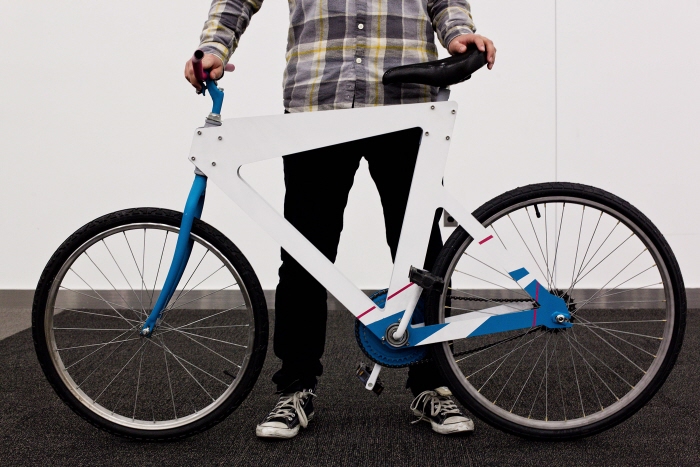
Here’s an interesting conceptual bike design from Jose Rivera at the College for Creative Studies (CCS) in Detroit.

The goal of this project was to construct an easily customizable bike from recycled parts and materials. The bolted construction allows for the frame to be built at a fraction of the time and cost of a conventional bike. It also allows the user to easily customize the frame to his/her needs, or break the bike down for storage with simple hand tools.

One commenter on the web site questioned the frame strength to which Rivera replied:

As for the strength It holds up to a commute around Detroit. But some support spacers between the two halves would probably be useful to make it stronger over time.

Larry Parker also worked with Rivera and employed the same construction principles for his flat-frame bike concept.

The Core77 site also has additional coverage.

Have you seen these bikes being ridden around Detroit?

Catching up with recent Detroit bike videos

Friday, September 2nd, 2011

There’s been an uptick in bike-related video in Detroit lately. Here are four from the past week.

Ballpark bicyclist makes Comerica Park stop

First is the story of Darren O’Donnell from Washington who’s riding to all 30 Major League Baseball stadiums. This video interview is from Comerica Park:
<a href='http://www.foxsportsdetroit.com/pages/video?UUID=2f1bbcdb-69aa-4591-83d6-ceab5ecd335a' target='_new' title='Baseball bicycle tour' >Video: Baseball bicycle tour</a>

Suburban Businessman Biking Streets Of Detroit

Next is a ClickonDetroit news video of a cyclist who is riding every single street in Detroit. The city owns about 2,500 miles of streets. Throw in the county and state roads and it’s clear what a commitment this is.

Detroit’s Breezee One and Bike Chase

This is a fun video to start your weekend. It looks like it was shot before all the bike lanes were installed in Southwest Detroit this summer.

BREEZEE ONE – BIKE CHASE (Directed by GAREN.) from BREEZEE ONE on Vimeo.

Detroit man’s “Car-bike”

This is real interesting video of a custom bike with an enclosed cab. It includes a radio, rear storage, lights, and a windshield wiper. One thing that’s not clear is how the rider gets inside the cab.

Public bike sharing in Detroit

Tuesday, August 30th, 2011

A couple years ago, NYC’s Transportation Commissioner Janette Sadik-Khan said public bike sharing would transform urban transportation.

Given the number of cities investing in such systems, that seems to be coming true.

There have been a number of discussions about a Detroit system over the past years. Such a system would complement the Woodward light rail investment by expanding its reach into the surrounding neighborhoods and connecting with places such as Corktown, Eastern Market, and Hamtramck.

Typically, bike share systems are city-led efforts. However, that’s not typical of successful Detroit projects which are collaborative public-private partnerships.

One exception is the Twin Cities Nice Ride system. This seems to be the public bike share model that best fits Detroit.

Nice Ride Minnesota was formed through the Twin Cities Bike Share Project, an initiative started by Minneapolis Mayor R.T. Rybak and the City of Lakes Nordic Ski Foundation in July 2008. After meeting with stakeholder groups and evaluating bike share systems, the Project prepared a non-profit business plan and sought public and private funding. Bike/Walk Twin Cities (a program of Transit for Livable Communities funded through the Federal Highway Administration) announced its financial support in March of 2009, responding to a major funding commitment by the Blue Cross and Blue Shield of Minnesota Center for Prevention (funded through the historic tobacco litigation settlement).

One likely reason for their success — over 100,000 rides in 2010 — was their impressively detailed business plan. The plan’s Phase I estimated the system startup costs at $3.4 million with $680K of in-kind donations and an annual operating budget of $1.6m. Modern public bike share systems are not cheap!

This Phase I plan was for 75 kiosks and 1,000 bikes over the 7.75 square mile service area. (Their actual installation was lower.) This provides 9.7 stations per square mile, which is a somewhat lower density than other systems.

Nice Ride is now expanding with help from the McKnight Foundation to 116 stations throughout Minneapolis and St. Paul.

The city of Portland is also beginning a bike share and they’ve reviewed other systems. They note that station density is a key to success.

Dense systems tend to increase bike utilization rates, whether the systems are large (e.g., Montreal 500 stations at 27 stations/sq mile with 2.5 trips/bike/day) or Dublin 37 stations at 15 stations/sq mile w/ 10 trips/bike/day). Conversely, Minneapolis system has about 9 stations/sq mile which allows more districts/neighborhoods access to the system but has a much lower utilization rate at roughly 1 trip/bike/day. Portland plans to mirror Montreal in station density. Effective utilization not only requires a density of station but a high density of uses within the service area to be successful. Portland has chosen to locate the vast majority of stations in the city’s highest density districts related to employment, residential, commercial activity and tourist destinations.

Given Detroit’s greatly varying density, some analysis would be required to help determine optimal station placement.

Funding a Detroit System

Where could Detroit get the funding to build a Nice Ride system in the Motor City?

One likely target is Congestion Mitigation and Air Quality (CMAQ) funding, which is sub-allocated to SEMCOG. Those federal dollars require applicants to show how their respective projects improve air quality. A Nice Ride system can do that by reporting on the number of bike trips taken, many of which would be replacing car trips.

With CMAQ funds only paying up to 80% of the total costs, private funding would likely be required. Finding private funding might not be too difficult if the bike share connects downtown employers to the light rail and elsewhere. For example, imagine the value of having bike share stations at the Blue Cross Blue Shield campus and their other offices at the Renaissance Center.

Other Federal Transit Authority (FTA) grant funding may also be a possibility. The FTA recently announced that “all bicycle improvements located within three miles of a public transportation stop or station shall have a de facto physical and functional relationship to public transportation.” It’s likely that nearly all of the bike stations in Detroit would be within 3 miles of the Woodward Light Rail.

Bike Share Detroit

A Detroit bike sharing web site and proposal has been recently proposed. While we applaud their enthusiasm, we don’t see enough details or funding to have a working system like the Nice Ride. A proposal of this scale might work on a much smaller service area (e.g. a college campus) rather than Downtown and Midtown.

The stations density appears to be about 1.5 stations per square mile — a fraction of what others consider as the minimum. Phase 2 expands north along the Woodward corridor to 11 Mile with an even lower station density.

Our preference is to take advantage of the Twin Cities’ experience, learn from their mistakes, and through a collaborative effort, invest in a system that gets more people in Detroit on bikes more often.

More bike parking along Corktown’s Michigan Avenue

Tuesday, August 30th, 2011

There are plenty of bike infrastructure investments in Corktown these days. Here’s one more.

MDOT is doing streetscaping along Michigan Avenue between 14th and Rosa Parks (12th). Streetscaping is a big word for enhancing the sidewalks. Included in that streetscaping is much needed bike parking — a nice complement to the bike lanes installed last fall.

M-Live has more coverage:

MDOT is fully funding the project, which will benefit the up-and-coming retail strip that includes Slows Bar B Q and the newly-opened Astro Coffee.

“There’s a lot of activity going on there,” MDOT’s Vince Ranger told MLive.com. “It doesn’t look good to have these businesses renovating fronts with bad sidewalks. So we’re just trying to clean that up for them.”

To learn more about this project, MDOT is hosting an open house at the Gaelic League on September 7th from 4pm until 6pm.