Here is an amazing video on biking in Detroit from Alex Gallegos.
Detroit Bike CIty from Alex Gallegos on Vimeo.
News and events happening within the City of Detroit
Here is an amazing video on biking in Detroit from Alex Gallegos.
Detroit Bike CIty from Alex Gallegos on Vimeo.
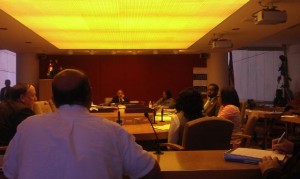 There was a discussion of a Complete Streets ordinance at yesterday’s Detroit City Council Public Health and Safety committee. It seems the debate is whether or not city council should pass a Complete Streets resolution or ordinance. The latter is more binding and permanent. A resolution would likely call for the city to have a Complete Streets policy, but there would not be much teeth in making sure the policy is followed.
Four city departments spoke on the topic. The Department of Health and Wellness Promotion (aka the health department) has received grant funding that requires that a Complete Street ordinance be passed. They also spoke about the connection between Complete Streets and public health.
Next, the Department of Public Works (DPW) listed their current non-motorized efforts. One highlight: They’ve spent $38 million during the past 10 years on non-motorized facilities, which includes 20,000 ADA sidewalk ramps, 400 pedestrian countdown timers, and (by the end of this year) 73 miles of bike lanes. They said a resolution would suffice.
Next, the City Planning Commission voiced their support for an ordinance, saying it was “warranted.”
And finally the Law Department was neutral but would look into the health department’s grant language to make sure an ordinance is required rather than just a resolution. They also asked to see the proposed ordinance language which the Detroit Complete Streets work group has been developing.
Councilmember James Tate said he “support Complete Streets wholeheartedly” but would like to know what strings might be attached to the grant funding.
Councilmember Brenda Jones also voiced her support for Complete Streets as well.
During the public comment, two physically-challenged residents spoke in support of Complete Streets, though they were at the meeting to discuss other issues.
One sight-impaired woman spoke of the difficulty in getting on DDOT buses when they cannot pull up to the curb due to on-street parking. Although she didn’t mention it, having a bump out at transit stops around on-street parking would alleviate her concern. This demonstrates that Complete Streets affects more than just DPW.
On Monday, June 27th at 11AM, Detroit City Council’s Public Health and Safety committee is having a discussion on a Complete Streets ordinance.
11:00 A.M. – DISCUSSION – RE: Status of Complete Streets Ordinance. (City Planning Commission; Health and Wellness Promotion, Public Works and Law Departments)
The discussion is at the Coleman A. Young Municipal Center on the 13th floor at 2 Woodward. This meeting is open to the public.
In late May, the Detroit Free Press published a couple editorials in support of Complete Streets: Caution: Walking may be hazardous to your health and Watch your steps — Without policy changes, expect more pedestrian fatalities.
Both pieces were inspired by the recent national report called Dangerous by Design. This report ranked Metro Detroit as a the 12th most hazardous for pedestrians. Given the city’s larger shared of pedestrians, Detroit helped push that rank up.
From the first Free Press editorial:
Designing walkable streets and public places is important to building healthy, livable cities that attract talented employees, innovative businesses and creative entrepreneurs. They don’t necessarily require spending more money, but they do require fresh thinking.
Balanced transportation policies mean designing roadways to include the needs of pedestrians and bicyclists, not just cars. That will save lives and encourage people to become more physically active.
We agree. And perhaps the biggest concern raised is how much more money Complete Streets will cost. But Complete Streets aren’t expensive says Scott Clein of Giffels-Webster. He wrote this article, Complete Streets Myths Debunked.
Designs in line with Complete Streets philosophies don’t have to cost a lot, especially when included in annual capital improvement projects. Most communities have existing funding for road maintenance and related upgrades. When resurfacing a roadway, for example, implement bike lanes for little to no added cost.
This piece-by-piece approach may seem out of place when attempting to promote connectivity, but it mimics road maintenance approaches and allows the largest benefits from shrinking budgets.
We’ll end with this interesting Complete Streets video from some MSU students. (Note that Detroit does have HAWK signals, Safe Routes to School, and is building some Complete Streets.)
 Participation in bike rides within the city of Detroit continues to skyrocket.
Bike the Bridge had 180 riders last year and over 300 riders this year.
Colin Hubbell ride more than doubled last year’s numbers with over 200 cyclists.
The Tour de Troit started with a few dozen riders is now having to close registration with over 3,200 riders last year.
And if the weather holds out, this Friday’s Critical Mass ride could be the largest yet with nearly 700 people attending or maybe attending on the Facebook page.
Like most U.S. cities, there is no reliable data on how much people are bicycling, but these rapidly climbing participation rates show Detroit’s heading in the right direction.
A Christopher Tremblay of Canton, Michigan recently wrote in to the Detroit News with his recent experience.
When I just returned from a 33-mile bike ride throughout downtown Detroit — it was the Bike the Bridge event that linked us to our Canadian neighbors, I was reminded how great Detroit is. We saw some incredible sites of the city and learned about some historical locations, which made me an even prouder native Detroiter. Events like Bike the Bridge and the fall Tour de Troit remind us of how bike-friendly Detroit is and how it is becoming even more receptive to cyclists. To everyone who is advancing the bike trails and mission, thank you!
Colin Hubbell Ride
And speaking of last Saturday’s ride, the South End has written a real good article about it.
“This event had two purposes,” [Trish] Hubbell said. “First, to give the riders a glimpse of Detroit — because being on a bike is a much different experience than being in a car — and second, to promote Midtown and support small businesses and entrepreneurship. In Midtown, everybody comes together to help one another and we want to keep that spirit going.”
“These routes give people a flavor of the good, the bad and the ugly of Detroit,” Trish Hubbell said, “but mostly the good, aiming to take the scaryness out of the city and change how people view it.”
Fortunately I had the opportunity to ride with Trish she shared a great number of stories about Colin and his love for bicycling as transportation.
One has to imagine that he’d be quite thrilled to see more and more people on a bike in Detroit.
 Longtime Detroiter and activist Grace Lee Boggs was at the West Willis block party last Saturday. She was there to celebrate the success of West Willis and the community that has been built around the Avalon Bakery.
She also signed copies of her new book, The Next American Revolution: Sustainable Activism for the Twenty-First Century
In speaking briefly with Ms. Boggs, I complimented her on an article she’d written a few years ago, A (Nearly) Carfree Society is Possible.
A lot of people are angry these days about the high price of gas. But one hundred years from now our posterity may bless this period when soaring gas prices finally forced Americans to bike or take public transportation to work and to start dreaming of neighborhood stores within walking distance.
…
We have a choice: between a city that is friendlier to cars or a city that is friendlier to people, especially children.
While at first glance, her new book doesn’t spend much time specifically on transportation, it does talk about the Motor City.
Detroit is a city of Hope rather than a city of Despair. The thousands of vacant lots and abandoned houses provide not only the space to begin anew but also the incentive to create innovative ways of making a living — ways that nurture our productive, cooperative, and caring selves.
In a similar manner, Detroit’s often abandoned streets are an opportunity to start anew, to design them as Complete Streets and to foster other transportation modes beyond just the car.
And we’re heading in that direction.
The construction of the comprehensive Corktown/Mexicantown Greenlink bike project this year will serve as a good blueprint for other Detroit neighborhoods. It should shed light on what is possible in this city.