Nearly 100 turn out for Royal Oak planning

October 6th, 2010

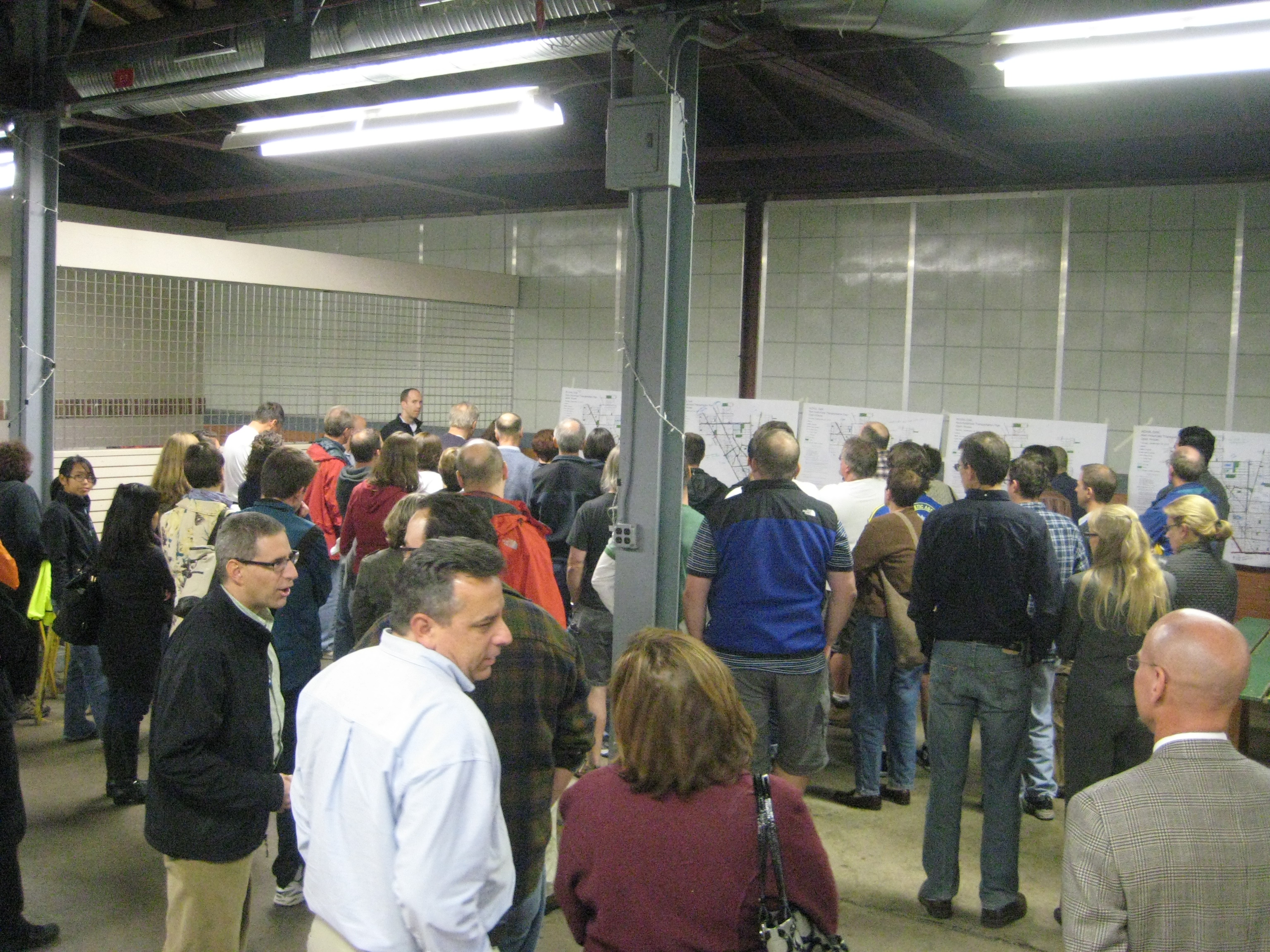
Last week the Royal Oak Review attended the city’s initial meeting to discuss non-motorized planning — how to make it easy and safer for bicyclists and pedestrians in Royal Oak.

They’ve just published this article titled Pedal Power:

Mayor Jim Ellison said it was very encouraging to see all the people at the meeting and the ideas being tossed around. He said while funding is tight, having a plan is important.

Tom Regan, who helped start the movement for the city to develop a non-motorized plan, said he was happy to see the large turnout.

“What we’re demonstrating to the city officials and staff is that people in Royal Oak genuinely want these changes, and we’ll have an intelligent plan to make it happen,” he said.

If you want to stay on top of this planning effort, please “like” the non-motorized plan in Facebook.

Or if you were unable to attend and would like to submit comments, you can send them to Marissa Dolin at the Active Transportation Alliance.

Jane Jacobs: Going beyond the simple needs

October 5th, 2010

The My Wheels are Turning blog has another great article about urban design in Traverse City. That article reminds us of this Jane Jacobs quote.

Automobiles are often conveniently tagged as the villains responsible for the ills of cities and the disappointments and futilities of city planning. But the destructive effects of automobiles are much less a cause than a symptom of our incompetence at city building. The simple needs of automobiles are more easily understood and satisfied than the complex needs of cities, and a growing number of planners and designers have come to believe that if they can only solve the problems of traffic, they will thereby have solved the major problems of cities. Cities have much more intricate economic and social concerns than automobile traffic. How can you know what to try with traffic until you know how the city itself works, and what else it needs to do with its streets? You can’t.
— Jane Jacobs, Death and Life of Great American Cities

Bicycle advocates can find many examples to support Jacob’s quote. It’s relatively easy to define transportation problems in terms of motor vehicle levels of service (LOS) and average daily traffic (ADT). LOS and ADTs are easily measured and quantified for motor vehicles.

How do you measure real and perceived safety issues that create latent demand for non-motorized transportation options?

There’s also been recent discussion nationally about how congestion is measured in the U.S. This discussion was kicked off with the recent CEO for Cities report called, Driven Apart: How sprawl is lengthening our commutes and why misleading mobility measures are making things worse.

A new report from CEOs for Cities unveils the real reason Americans spend so much time in traffic and offers a dramatic critique of the 25 year old industry standard created by the Texas Transportation Institute’s Urban Mobility Report (UMR) – often used to justify billions of dollars in expenditures to build new roads and highways…

A close examination shows that the UMR has a number of major flaws that misstate and exaggerate the effects of congestion, particularly the Travel Time Index (TTI).  TTI is the ratio of average peak hour travel times to average free flow travel times… Because this methodology does not take into account travel distances, it universally rewards cities that are spread out as opposed to compact urban areas.

It’s bottom line, common sense conclusion: “What creates traffic jams isn’t more cars and fewer highways, it’s sprawl.”

And Transportation for America published this article today which concurs.

The cycle is familiar by now. A study tells us what we all know: our roads are congested. We pour billions into new roads and lanes to “reduce congestion.” Then the study comes out two years later and just as before, our roads are still congested. There’s a call for new roads, new roads open up, we drive further and further, congestion goes up. Rinse and repeat.

That hypothetical study exists in Metro Detroit. It’s SEMCOG’s Congestion Management System Plan. It fails to mention sprawl as a possible cause for congestion (and never mentions increased bicycling as a partial solution.)

It does focus plenty on the LOS’s for motorists during peak travel time.

Opposition to the Clinton River Trail bridge funding

October 4th, 2010

There has been a national discussion on the merits of stimulus funding. In response, Transportation Secretary Ray LaHood has traveled among transportation projects and noted how they’ve benefited from stimulus funding.

Locally, the Oakland Press has been covering public opposition to the Clinton River Trail bridge in Pontiac. Unfortunately the newspaper seems more interested in being a soapbox for the uninformed.

“They could have awarded that $2 million as a tax credit for a developer,” he said, maybe enticing a department store to take over the massive empty space. “That would create permanent jobs.”

No, they couldn’t. This is federal transportation dollars with very specific strings attached. To think MDOT could convert this to a tax credit for a Wallmart is asinine. It’s media stories such as this that help give life to these unrealistic opinions — not once, but twice.

(In fact in their first article, the Oakland Press incorrectly reported that there is no trail on the east side of the bridge. We spoke with an attendee at Arts, Beats, and Eats who called this the bridge to nowhere, an impression that they could have gotten from reading this initial article.)

“The trail could have gone straight along sidewalks on the south side of Orchard  Lake Road,” she said, “and (stimulus) money could have improved the aesthetics on the Orchard Lake Road corridor and people would still have had a bike trail.”

No, it couldn’t. This transportation stimulus funding was for “shovel ready” projects. Neither of those mentioned were even planned. Besides, it would be against best practices and the national design guidelines to put cyclists on a sidewalk because it’s unsafe.

“Why didn’t stimulus money go toward cutting dead trees?”

Apparently the dead tree cutting lobby in DC just ain’t what it used to be. They didn’t bring home the bacon.

Dear Oakland Press,  If you want to publish articles about whether economic stimulus funding is philosophically good or bad, that’s fine. But, don’t hold the Clinton River Trail bridge hostage by publishing unworkable, unrealistic, if not impossible alternatives without letting your readers know why these aren’t alternatives at all. The true alternative to the bridge is for MDOT to have spent this money on a non-motorized transportation somewhere else.

Is it really about race?

There was significant opposition to the Clinton River Trail in Sylvan Lake when it was first proposed.

From what we saw first hand, that opposition was largely based on race.  Sylvan Lake had closed roads and created barriers between itself and their pre-dominantly black Pontiac neighbors to the east. The trail threatened to create a non-motorized path that would connect those two communities.

At one Sylvan Lake city council meeting a resident said “those people” would use the trail to break into their garage and steal their snowblower.

A Pontiac resident smartly responded by asking the question: Why would anyone walk more than a mile, take your snowblower, then push it another mile back? Why wouldn’t they just drive?

And now that the Clinton River Trail bridge is being built — the final connection between these two communities — we can’t help but wonder if this race issue is at least partially to blame to fueling this discussion.

Of course, we’re not counting on the local media to look into it.
Metro Times looks at Detroit cycling

October 2nd, 2010

The Metro Times continues to do a tremendous job covering the cycling scene in Detroit. They get it.

This week they added another great article to their resume called Two-wheel revolutions: New options for nomotorized traffic on the way in Detroit.

The articles stitches together stories on the Strategic Framework, Greater Riverfront East project, Tour de Troit, Complete Streets, and this info on MDOT’s new bike lanes.

Along Michigan Avenue west of downtown, bike lanes should be painted by November as a “trial,” says Matt Chynoweth, a development engineer with the Michigan Department of Transportation’s Detroit Transportation Service Center.

“We’re going to evaluate for a year and if we have a spike in pedestrian accidents out there then we may have to evaluate it and take it out,” he says.

Bike lanes are an easy way to increase safety by helping motorists realize cyclists are nearby. And some planners say they could be introduced all over the city for little more than the cost of the paint.

Chynoweth will be at the Corktown Residents’ Council meeting will be Tuesday, October 5 at 6:30pm to discuss these new bike lanes. The meeting is being held at the Most Holy Trinity School at 1229 Labrosse in Detroit.

More on GREEN

Sandi Svoboda also blogged about the Greater Riverfront East Environmental Network (GREEN) last week. This project has the potential to transform Detroit’s lower east from the Dequindre Cut to the Pointes: greenways, road diets, bike lanes, and much more.

One of the big focuses is extended the Detroit RiverWalk east to Detroit’s border. Given the marina district, it could be crazy expensive to develop the route along the river’s edge, so the routing may be creative.

Still more Tour de Troit talk

October 1st, 2010

Photo from the Bikes, Books, & a Little Music blog

Additional Tour de Troit ride reports have been posted in some local blogs and web columns.

First is a guest column in the Heritage Newspapers titled, Tour de Troit eye-opening ride. It’s a bit heavy on the outsiders OMG-there’s-blight theme, but it also give a nod to some optimism.

There’s a youthful, arty and optimistic vibe among the ride’s organizers. In pockets along the route, one encounters that same vibe in the neighborhoods. Sometimes it comes from just three or four homes or stores with vitality, a grouping surrounded by scary wasteland.

Next is from the very intriguing blog, Bike, Books & a Little Music. The author Charlie has a nice summary of both the Critical Mass ride and the Tour de Troit. Woven into the story are some great photos, including the one shown here.

The Transport Michigan web site offers a very comprehensive look at the Tour de Troit.

The Tour’s dedicated organizers deserve credit for their success. But they’ve also got larger trends blowing at their back: a resurgent interest in rebuilding the American city (and Detroit especially) as a sustainable, just, and prosperous metropolis, and an emerging global movement advancing bicycling as a healthy means of transportation in these times of sedentary lifestyles, economic dislocation, and mounting climate change. Given the symbolism of bicycling in the world’s automobile capital, the Tour’s ascent is a bellwether of truly national significance.

“It’s just like Amsterdam, with helmets,” one rider exclaimed as the Tour prepared to depart.

Is the Tour’s success reflect this renewed interest in urban environments?

Longtime cyclist Karen De Coster wrote a fine article that covered much more than just the Tour. Its title asks the question, Is Detroit a Bicyclist’s Paradise?

As we ride, people pop out of everywhere to watch. Businesses and shops empty out. Who can resist watching a line of 3,000 cyclists passing by? People hang out of apartment and residential home windows – waving, cheering, watching, and smiling. My friend’s 18-year-old daughter said she was quite taken by that whole experience. She had only seen and known about the warts of Detroit, with its all-too-obvious ramshackle topography. Yet there is another and more extraordinary side to the city, one that most people never experience because they only zing through Detroit on freeways or crawl along the surface streets behind glass.

Unfortunately, perceptions are often built on hearsay rather than concrete experience. It’s easy to sit around all day watching anemic television programming and news bites, yet pretend to know what’s going on outside of the uninspiring shelter so many people create for themselves. Criticism is an important outcome of critical thinking, but it should be the culmination of one’s own experience and taste, not the result of impetuous me-tooism. Accordingly, getting out and seizing the adventure firsthand is the only valid way to form judgments and gain knowledge of the orbit around you. So, even if Detroit is not exactly the traditional bicyclist’s paradise, spontaneously exploring the city and its history on two, non-motorized wheels is undeniably a memorable experience.

We agree. Bicycling is a great way for people to see and experience the real city of Detroit.

When Detroit gets back on its feet, will we credit the Tour de Troit for helping thousands of Metro Detroiters gain a more accurate view of the city, its people, and its opportunities?