Posts Tagged ‘Detroit’

Tom Cooper: Fastest man in Detroit

Wednesday, November 21st, 2012

Prior to the advent of auto racing in the early 1900s, bicycle racers were the fastest men alive. And from 1895 to 1900, no Detroiter was faster than Tom Cooper.

Cooper was born in Birmingham, but moved to Detroit with his family at age 18. He became a pharmacist by trade but eventually switched to bicycle racing.

Turning professional

Friend John Colquhoun told the Detroit Free Press about Cooper’s breakthrough race when he beat champion racer Eddie “Cannon” Bald in Battle Creek on July 22nd, 1895.

“Cooper was a low salaried drug clerk at the time, fair and ruddy faced. He had no racing wheel [i.e. bicycle] of his own — he couldn’t afford it.

“As they were lining up for the pistol, Cooper could scarcely keep his admiring eyes off the great Bald. Finally Bald took offense at the individual ovation and asked the ‘kid’ what he means.

“‘I was just thinking,’ Cooper replied, ‘how fortunate I would be if I could finish second to you, Mr. Bald.’

‘”Get t’ell out of my way,’ was all the satisfaction Cooper got, ‘or you’ll not finish at all.'”

That apparently inspired young Cooper who soundly beat Bald. Afterwards Cooper was approached with a sponsorship deal.

“‘How would you like to sign for the rest of the season at $50 a week?’

“‘For $50 a week!’ cried Cooper. ‘Come sign me for life.'”

The bidding began and he was eventually under contract earning $200 a week (~$5,500 a week in today’s dollars) while also getting paid $1,000 to use a sponsor’s saddle and $500 to use another’s chain.

After six years of professional cycling — and most likely being the highest paid athlete in Detroit sports — he’d saved $60,000 to $100,000.

Cooper was the pride of the Detroit Wheelmen cycling club.

He set world records in 1897, was the National Cycling Association (NCA) U.S. Champion in 1899, and spent the 1900 season racing in Europe.

After returning from Europe he agreed to a match race against Marshall “Major” Taylor, who was the League of American Wheelmen champion and world champion in 1899, and the NCA Champion in 1900.

Taylor wrote in his autobiography, “If there were two riders on earth that I wanted to meet in match races above all others, they were Eddie Bald and Tom Cooper.”

The race was held in front of a 10,000 spectators at Madison Square Garden in New York City. Taylor won the first two races to take the best of three. Cooper left humiliated.

He continued to race the U.S. circuit in 1901 but retired afterwards at the age of 25.

Interestingly enough, his last bike race may have been at Detroit’s first major automobile race on October 10th, 1901. He and Barney Oldfield raced a motorized tandem bicycle against the clock, which received “scarcely a ripple of applause” according to the Detroit Journal.

Henry Ford was in that first auto race. He had Tom Cooper ride with him during his warm up laps. The champion cyclist advised Ford on how to best race the track and handle his machine. Ford won the race.

Afterwards, Cooper headed to Colorado to manage a coal mine but he would be back the next summer itching to race once again — this time in automobiles.

Read more about Cooper’s return to Detroit and his partnerships with Henry Ford and Barney Oldfield


Keeping the invisible bicycle riders invisible

Tuesday, November 20th, 2012

From what we’ve heard, Portland is a fine U.S. bicycling city, but that doesn’t mean it’s a relevant model for all cities. That’s a point many national bicycle advocates seem to miss.

We were reminded of that with this recent post by Bikes Belong embracing the city of Portland’s four distinct categories of bicyclists:

  • Strong and fearless
  • Enthused and confident
  • Interested by concerned
  • No way, no how

These categories have limited application in some parts of Detroit, like Midtown or the Central Business District, but for much of the city, they don’t apply. It’s not an inclusive model.

We love the folks at Bike Belong, but embracing this Portland model for all for all of America shows a disconnection with urban areas like the city of Detroit as well as invisible bicycle riders.

Who are the invisible bicycle riders? They don’t fit the stereotyped bicycle rider model that you see in bicycle magazines or on web sites. They use bicycles as transportation but if they could afford a car, they might choose one instead. They don’t have the latest and greatest bicycle — it’s a tool not a lifestyle. They probably don’t wear a helmet. They may be new arrivals to this country and they’re likely to be male. We wouldn’t be surprised to learn that they were more likely to suffer from crashes.

And they probably do not complete the surveys or studies used to create and support the Portland bicyclist model — certainly even Portland has invisible cyclists.

It’s not just about the cars

The other disconnect is this model’s focus on sharing the road with cars.

Survey after survey and poll after poll has found again and again that the number one reason people do not ride bicycles is because they are afraid to be in the roadway on a bicycle. They are generally not afraid of other cyclists, or pedestrians, or of injuring themselves in a bicycle-only crash. When they say they are “afraid” it is a fear of people driving automobiles. This has been documented and reported in transportation literature from studies, surveys and conversations across the US, Canada, and Europe.

Detroit has very low motor traffic volumes on a majority of its streets. Sharing most roads is not a big deal when you have your own travel lane or two. Certainly there are exceptions such as the major spoke roads (e.g. Jefferson, Gratiot, Woodward, Grand River, Michigan, and Fort.) Arguably, Detroit bike lanes in many cases serve more as advertisements and for driver education.

At Complete Streets workshops and focus groups, Detroiters have said their primary concern is public safety, not from cars but from insecure vacant structures, stray dogs, the lack of public lighting, etc. Perhaps this helps explain our rapid growth of neighborhood group rides on well-lit bicycles.

Of course, another major issue is most Detroit neighborhoods do not have a bike shop.

These are issues can found in varying degrees in urban areas across the U.S.

If we are committed to building an equitable transportation system, we must be committed to being inclusive, not just of all bicycle riders, but of all parts of the country.

Detroit bike parking: Getting better, room for improvement

Wednesday, October 31st, 2012

We just updated the information for bike parking in Detroit.

Wayne State, Southwest Detroit, and even parts of Downtown doing a great job adding bike parking.

Still, there are other areas that have a significant lack of parking. In the map snapshot, we’ve highlighted those areas in yellow.

Ironically, many of those area have an abundance of surface lot parking — for cars!

And while this focuses just one part of Detroit, the city needs more bike racks throughout.

One other thing to keep in mind when looking at the map is that each red dot is a bike parking area. These areas may have multiple racks, some which fit a couple bikes and some that fit a dozen.

Effective road safety education

Tuesday, October 30th, 2012

If only the Michigan Driver’s Test had a question on cycling driver’s might know to respect us…

Ah, right. We’ve heard this many times. Bicycle advocates even spent political capital trying unsuccessfully to get this put into state law.

We think it’s mostly a waste of time and here’s why. Most people learn driving habits at an early, impressionable age. Teenagers don’t show up for driver’s education with a blank state of mind. Chances are they’ve been in cars their entire lives and learned the basics of driving from observing others. A couple questions won’t change a

And that’s why it’s important to teach road skills early.

Some schools in Europe have classes for young students that teach safe cycling and walking skills on miniature road courses. Cleveland has something similar with their Safety City.

The Washington Area Bicyclist Association has a design for a very cool traffic garden as shown in the photo. Wouldn’t this be a neat training area around Detroit, perhaps located close to schools or parks or the Detroit RiverWalk? With the proper signs and designs, young cyclists and pedestrians could learn how to safely share our public road spaces through playing.

Through MTGA, we initiated some discussions on how to fund such infrastructure. Perhaps Safe Routes to School is the best fit.

Interestingly enough, it was also recently discussed at the Governor’s Traffic Safety Advisory Commission.

With all the bike lanes and sharrows being added to Detroit streets, one of more traffic gardens could be one means for improving public education on safely sharing our streets.


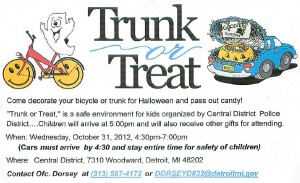
Kids decorate bikes for Detroit Trunk or Treat

Sunday, October 28th, 2012

From the Detroit Police:

Come decorate your bicycle or trunk for Halloween and pass out candy!

“Trunk or Treat” is a safe environment for kids organized by Central District Police District… Children will arrive at 5:00pm and will also receive other gifts for attending.

When: Wednesday, October 31, 2012, 4:30pm – 7:00pm

(Cars must arrive by 4:30pm and stay entire time for safety of children)

Where: Central District, 7310 Woodward, Detroit, MI 48202

Contact Officer Dorsey at (313) 587-4172 or DORSEYD832@detroitmi.gov