Posts Tagged ‘History’

The Bicycle Pavilion on Belle Isle

Friday, October 2nd, 2009

Detroit's bicycle pavilion on Belle IsleIn 1898, the League of American Wheelmen (LAW) Michigan Division secured a $10,000 appropriation from the city of Detroit. The money was to build a bicycle pavilion on Belle Isle.

They followed up with another $2,500 the following year to “furnish up bicycle pavilion with pump, repair outfit, racks, and other conveniences” according to Edward Hines.

During this time, the mayor of Detroit was William Maybury. The Mayor was presumably a bicyclist since he was a member of the LAW. A statue of Maybury is in Grand Circus Park, sitting in a chair opposite of Mayor/Governor Hazen Pingree.

Just prior to this pavilion being constructed, a New York park agency inquired about how Detroit handles bike parking and bike rentals. Detroit park commission secretary and manager M. P. Hurlbut explained that there was a small (less than 1,000 square feet) pavilion that was bid out to companies renting bikes on Belle Isle. The winning bid was $1,000.

Hurlbut then explained the purpose of the larger planned pavilion:

It is to be a two-story building and the first or ground floor ‘will be used by bicycle riders in case of stormy weather to store their wheels in, and undoubtedly some time in the future there will be a privilege for renting bicycles leased from this building, and possibly a temporary repair shop.

“Wheels” is another term for bicycles.

110 years after being built, the pavilion still stands on Belle Isle, though it is now called the Athletic Pavilion. It is between the now-closed zoo, athletic fields, and tennis courts in the center of the island. From the outside, it seemed to be in decent shape.

The size and grandness of this pavilion is a testament to the strength and importance of bicyclists in the city of Detroit in the late 1890s.
Edward Hines asks you to join the League

Tuesday, September 29th, 2009

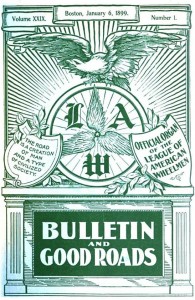
LAW-bulletin-good-roadsHere’s a piece of Detroit cycling history: A membership plea from Edward Hines that was published May 11th 1899 in the League of American Wheelmen Bulletin.

Here are 20 arguments why you should belong to the Michigan Division LAW. If you are a member read them over carefully and then present them to your friends urging them to join our ranks. Also send in your renewal promptly. If you are not a member read them over and be convinced that you should be a member and then forward us your application.

  1. Drafted introduced and passed the Anderson Bicycle Baggage Bill compelling the railroads of Michigan to carry bicycles as personal baggage free of charge (1897)
  2. Defeated the passage of a special tax of $1 a year on wheelmen in 1897
  3. Issued a road book in 1897 and 1898
  4. Secured a Supreme Court decision against the toll-road corporations, prohibiting them from charging wheelmen toll
  5. Put an active and wide awake wheelman on the Park Board in Detroit
  6. Secured the passage of an anti glass and tack law in Detroit
  7. Secured the passage of a most liberal bicycle ordinance for Detroit – no lamps, no bells, 12 miles an hour speed limit, keep to the right for all vehicles, no riding hands off, no riding more than three abreast, and sidewalk riding permitted on unpaved streets
  8. Prosecuted 23 “road hogs” in 1898 winning every case
  9. Secured a more severe punishment for bicycle thieves
  10. Secured an appropriation of $10,000 from the city of Detroit to build a bicycle pavilion for wheelmen on Belle Isle in 1898
  11. Secured an additional appropriation of $2,500 to furnish up bicycle pavilion with pump repair outfit racks and other conveniences for wheelmen in 1899
  12. Drafted and secured the passage through the state legislature in 1899, a bill to protect cycle paths and to provide for punishment of violations
  13. Encompassed the defeat of a bill before the present legislature to prohibit wheelmen using sidewalks under all circumstances in all parts of the state
  14. Secured a dry strip of five feet in width on all the principal sprinkled streets in Detroit
  15. Arranged with the Board of Public Works in Detroit to remove glass or other hurtful substances, likely to damage bicycles or bicycle tires immediately upon notification
  16. Secured the passage of some good roads amendments before the present session of the state legislature – not all we hope to secure in the way of a good roads bill, but an entering wedge
  17. Have kept up a constant agitation for good roads is gradually bearing fruit
  18. Have secured the repeal of a dozen local ordinances in various parts of the state which worked a hardship upon wheelmen
  19. Has made cycle path building possible in Michigan
  20. Maintains a sharp lookout on all legislative matters the rights and privileges of wheelmen and creates and stimulates wheeling enthusiasm

Now when you have read the above through carefully yourself the question. Don’t I as a wheelman get $1 a benefit through the LAW whether if ride much or little. Are you not willing to lend a helping hand to help us carry our future plans. We want more cycle paths, we want roads, we want danger signs erected, we want guide erected, we want to be fully protected at all times with our bicycle, we want our rights and privileges maintained, and can get what we want by joining the LAW, sticking to LAW, and getting our friends in the LAW. We spent all of our money to secure benefits and privileges for wheelmen and to have our various wants taken care of we must have the financial and numerical support of the wheelmen of our state. It isn’t enough that you should merely belong you should do something occasionally for the wheelmen’s cause and the time to start is now. I again say read the above over carefully then hand this to a friend get his application and have him pass it along to a friend of his.

Edward N Hines, Chief Consul
League of American Wheelmen (L.A.W.) Michigan Division

There was a bicycle pavilion on Belle Isle? There still is. We’ll post more about that soon.

Also the LAW had folded by 1924. At some point thereafter, Detroit’s “most liberal” bicycle ordinances were changed to require bicycle bells, lights, and registrations.

Shared space: Detroit in 1890

Monday, September 28th, 2009

Fort Street in Detroit, 1890The Shorpy.com web site publishes some amazing photos.

One recent addition is of Fort Street in Detroit. It’s looking west from Woodward Avenue back in 1890.

Notice what’s missing in the photo besides cars and trucks? There are no signs or traffic lights or crosswalks.

At this time, there really were no rules of the road because they weren’t necessary. Road users operated at similar, slower, and safer speeds. Everyone was responsible for not crashing into others.

This type of road design is becoming more popular in Europe. It’s called shared space.

After a recent MDOT training with John LaPlante, I asked him about implementing shared space. He said it can work in America in some residential areas or downtowns. He brought up the excellent point that European drivers have a culture of sharing the road with other users like pedestrians and bicyclists. That makes it much easier for them to successfully implement shared spaces. Too often American drivers suffer from a sense of road entitlement.

Did you notice all the bikes parked in front of the now-demolished Hammond Building? This was the “Golden Age” of bicycling in Detroit.

Woodward: the first mile of concrete highway

Thursday, August 13th, 2009
Woodward celebration

A cake in need of a Blumenauer bike pin

The Woodward Avenue Action Association (WA3) had a ceremony today to celebrate the 100th anniverary of the world’s first mile of concrete highway. That first mile was Woodward Avenue from McNichols to Seven Mile Road in Detroit. It was just 18 feet wide.

This historic milestone was very much the result of decades of tireless work, often led by bicyclists such as Horatio “Good Roads” Earle and Edward Hines. WA3 was generous enough to let me briefly speak at today’s event to highlight the cyclists’ role in this project and the Good Roads movement.

Hines, former chief consul for the League of American Wheelmen Michigan Division was a Wayne County road commissioner (along with Cass Benton and Henry Ford.) He helped oversee this project. Back in 1893, he helped create legislation that enabled county road commissions.

Earle followed Hines as Chief Consul of the Wheelmen before becoming a state senator and our first state highway commissioner. He founded both MDOT and the American Road Builders Association. The National Cement Association called Earle the “Father of the Concrete Roads of the World.”

For this Woodward paving project, Earle helped secure Wayne County’s bond and completed the approval inspection on June 21, 1909.

It’s highly ironic that some motorists question cyclists rights to the roads when we were there first and literally paving the way for improved motoring.

Moving Forward

In speaking today, I also noted that we got stuck focusing exclusively on automobiles for some time and that’s now changing. Detroit’s non-motorized master plan calls for bike lanes on Woodward. WA3 has contracted Giffels-Webster for non-motorized planning along Woodward from Eight Mile to Maple.

And we are closer than ever to getting light rail on Woodward.

I told the crowd this means “giving people more transportation options,” which elicited perhaps the biggest cheer of event.

Thanks!

So, if you go for a ride today, make sure you thank Mr. Earle and Mr. Hines for the smooth ride beneath your tires.

And here’s an Earlism to consider: “One anvil outlasts hundreds of hammers. If you are anvil-like, a little hammering will not hurt you.”

Evans & Dodge Bicycle Company

Saturday, February 7th, 2009
img_1625

The Dodge Brothers mausoleum at Woodlawn Cemetery in Detroit. Photo by Alex Dolpp.

Detroit has some interesting bike history due in part to the strong connection between bicycles and early automobile manufacturing.

One interesting connection is the Dodge Brothers Company, second only to Ford in car sales during the 1920s and now a brand of the Chrysler Corporation.

But before the Dodge Brothers made cars, they made bicycles.

From the book, The City of Detroit, Michigan, 1701-1922 by Clarence Monroe Burton, William Stocking, Gordon K. Miller:

The Dodge motor car stands as a tribute to the work of two brothers – John F. and Horace E. Dodge. As young men they learned the machinist’s trade in their father’s shop at Niles, Michigan, which was their home town.

In 1894 they went to Windsor, Ontario, where they became machinists for the Dominion Typograph Company. Their ability to produce excellent machine work and tools brought them to the attention of Fred S. Evans, a Detroit manufacturer.

About this time the brothers invented the first ball bearing bicycle, and after this accomplishment they joined Mr. Evans in organizing the Evans & Dodge Bicycle Company in 1897 and leased the plant of the Dominion Typograph Company at Windsor, carried on the business for two years, then sold out to a Canadian bicycle concern.

With their plant equipment, the machinery and the cash received in the deal, they came to Detroit and in 1901 opened a machine shop in the Boydell Building on Beaubien Street.

When, in 1903, Henry Ford began the manufacture of his motor car, he asked the Dodge brothers to undertake the manufacture of engines, transmissions and steering gears in quantity production. This they did and so rapidly did their business grow in connection with the development of the Ford car, that when they abandoned the Hastings Street plant in 1910 it was the largest and best equipped machine plant in Detroit.

Continue reading about the Dodge Brothers