Posts Tagged ‘MDOT’

Detroit RiverWalk lands a Transportation Enhancement grant

Wednesday, November 10th, 2010

Senators Levin and Stabenow escort Transportation Secretary LaHood on the RiverWalk

That short gravel section of the RiverWalk just west of the Ren Cen may soon be history. MDOT has awarded construction funding to help get it built.

The Detroit Wayne County Port Authority is constructing a public dock and terminal in downtown Detroit, between the Renaissance Center and Hart Plaza. The Port Authority also will construct a portion of the Detroit Riverwalk, directly in front of the terminal building. The project will provide various amenities, including ornamental railings, site furnishings and a security system. The project cost is $318,739, including $159,370 in federal TE funds and $159,370 in local match from the Port Authority.

The city of Ann Arbor also received funding that will “construct bike lanes and sidewalks on the East Stadium Boulevard bridges that cross over South State Street and the adjacent Ann Arbor Railroad track.”

MDOT’s press release also provided more details on this federal funding source called Transportation Enhancements (TE).

Under federal law, 10 percent of federal surface transportation funds are set aside for TE projects. Administered by MDOT, the grants enable communities to invest in projects such as streetscapes and nonmotorized trails. TE funds provide a maximum of 80 percent of the money required for each project, with the remainder coming from state and local government and the private sector.

This funding source is absolutely critical to getting bike projects on the ground in Metro Detroit and across the U.S.  Did the recent election results put this funding at risk? Bike-friendly Congressman Oberstar is no longer calling the shots, Mica is.

So last week, BikePortland asked Kevin Mills, Vice President of Policy for the Rails-to-Trails Conservancy, “Is the Transportation Enhancements program in jeopardy?” Mills answered:

“The Bureau of National Affairs recently reported that Rep. Mica may take transportation funding ‘back to basics’ and that Transportation Enhancements may be among the programs cut. However, Mr. Mica has vocal constituents and political allies back home for whom trail systems and bicycling are high priorities. He has expressed support for trails and participated in ribbon cuttings on numerous occasions, and he supports robust transportation spending overall. If there is an attack, it is likely to stem from House leaders directing committee chairs to push for aggressive cuts in programs that they do not perceive as core federal functions.”

We hope any attempt to take away Enhancements is met with a very enthusiastic response from cyclists. Losing this funding source would devastate many Detroit bike projects that are planned for the near future.
Planned Detroit RiverWalk improvements

Thursday, November 4th, 2010

SEMCOG has been asked to add 60 projects to the 2011-2014 Transportation Improvement Program (TIP).

Among those additions, MDOT has submitted 3 non-motorized pathway construction projects for the Detroit RiverWalk.

  • 2011: $15.5 million for pathways at various locations between Cobo Hall and the Belle Isle Bridge, perhaps including the unfinished section in front of the new Port Authority.
  • 2012: $5.4 million for pathways from Chene (Park) to Jos Campau.
  • 2013: $11 million for pathways from Meldrum (Mt. Elliot Park) to the Belle Isle Bridge. This is the Uniroyal site.

Yes, the details are vague, but it’s enough information to get excited. If this goes as planned, the RiverWalk will connect with Belle Isle by 2013.

Milliken State Park expansion?

The DNRE is also looking at expanding their state park located on the RiverWalk.

This is an excerpt from  a presentation given at the August 18th Natural Resources Trust Fund meeting, which has provided funding to the RiverWalk and state park. The presentation was by Vicki Anthes from the DNRE and Faye Alexander-Nelson from the Detroit Riverfront Conservancy.

Ms. Anthes outlined two parcels that are critical for additional development of the state park. The first parcel is the Atwater Loft building, which has sat vacant for some time. The Detroit Economic Development Corporation is willing to discuss acquisition of the property. This property would have a huge impact on how the remainder of the park is developed. The other property, north of Atwater Street, is the Globe Building and some vacant land just north of it. She discussed additional parcels of interest to future development of the park — Watermark parcel, existing City of Detroit owned Chene Park and Holsom property. None of these properties have been developed. The DNRE would like the City of Detroit to consider these properties for acquisition to the Milliken State Park to expand recreational opportunities. Another parcel for consideration is located on the the west riverfront area and is approximately 40 acres. The City of Detroit owns this property as well. If all parcels were acquired, the state park would go from 31 acres to approximately 78 acres.

The Atwater Loft building mentioned above is that vacant land just east of the Rivard Plaza parking lot. The minutes imply that Chene Park is undeveloped, which is obviously not correct. The DEGC does have plans to expand Hart Plaza so that it replaces Chene Park. This is a really needed if there’s any hope of increasing residential living opportunities in the area around Chene. Living next to an amphitheater brings noise and parking issues.

What this really shows is the market for condos directly on the river isn’t what the DEGC thought, at least not in this current market. The DNRE can apply for Trust Fund grants to acquire and develop park land, so they’re really the only game in town right now.

The presentation included  more information on the Globe Buiding.

Ms. Anthes further outlined the vision of development at the Globe Building property. A portion of the interior space could provide opportunities for an adventure and discovery center. There would be hands-on activities for visitors to experience outdoor recreation and natural resources, such as climbing a giant White Pine tree, simulated kayaking trip or an indoor archery center.

Interesting ideas. It’s great to see the DNRE is expanding their role in Detroit — as they should. This state park is more readily accessible than any other in Michigan. It’s highly visible and a huge asset to the community.

Dequindre Cut Expansion

At this same Trust Fund meeting, Tom Woiwode from the Community Foundation for Southeast Michigan discussed the planned northward extension of the Cut to Mack Avenue.

From the minutes:

The original plan was to connect the trail into Eastern Market. In the first phase of the project, the trail got users as far as Gratiot. North of Gratiot the property was privately owned. The railroad company owns this property. Just last month the railroad company has agreed to sell the property.

The Community Foundation is prepared to provide the match required for the acquisition. With this property, the Dequindre Cut will actually directly connect with Eastern Market. The Michigan Department of Transportation (MDOT) provided a $393,000 grant towards the Dequindre Cut south trail construction. They have expressed interest in continuing the project north and have some construction funds available.

There you go, D-Cut fans. The wheels of trail expansion are turning…

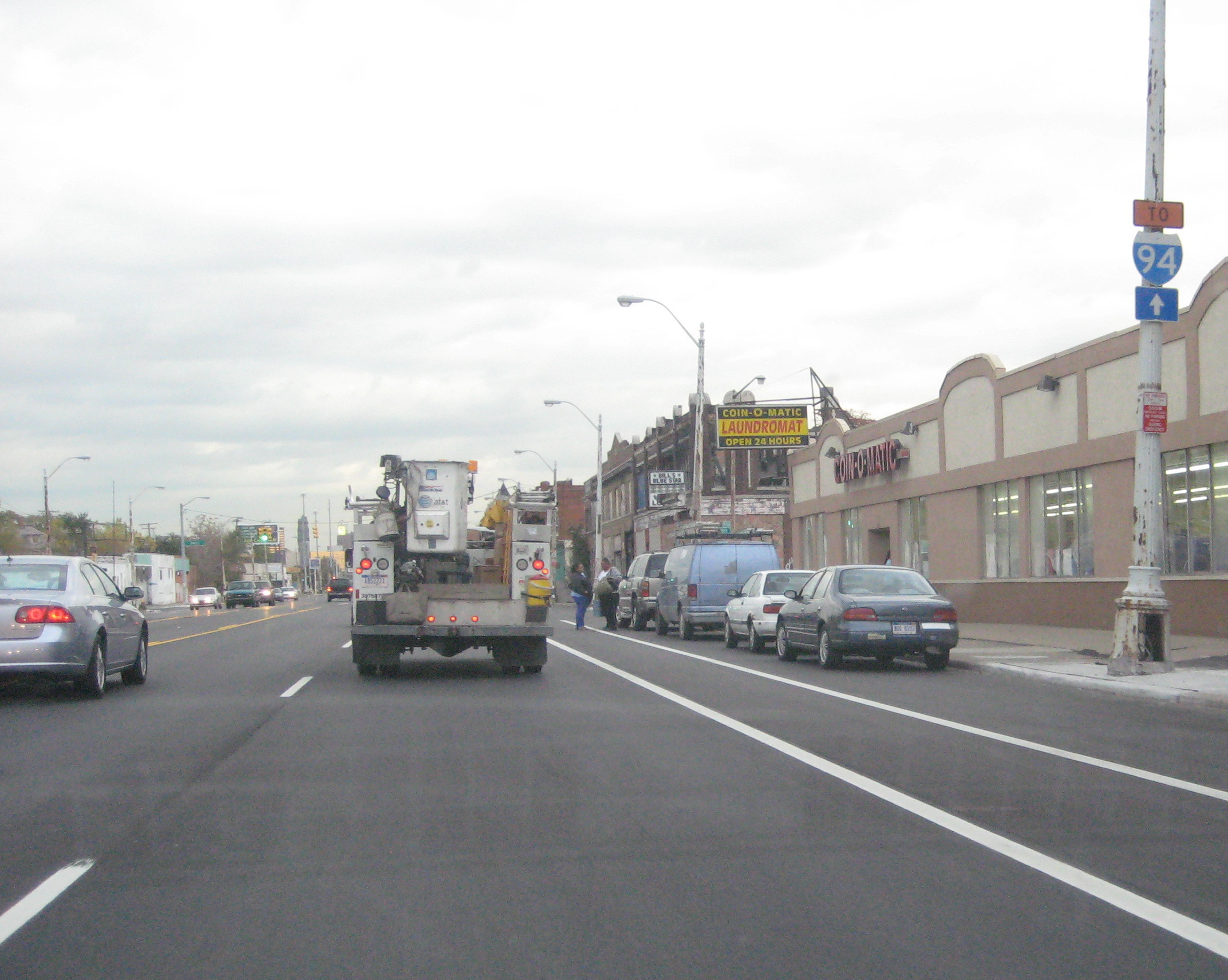
More coverage on the Michigan Ave bike lanes

Wednesday, November 3rd, 2010

They don’t appear to be done yet, but they’re getting there.

The bike lane paint is on the ground for most of Michigan Avenue. The pavement markings and signage are the finishing touches and are not installed yet.

When completed, this 2.5 mile stretch of Michigan Avenue from Livernois to Rosa Parks will have a more clearly defined space to bike in.

When completed, these additional 5 miles (both sides of the road) means Detroit will have more miles of bike lanes then all the other communities in Oakland, Macomb, and Wayne Counties combined. That’s not so much a bragging point for Detroit as it is a sad reflection of how far behind everyone else is.

Model D covered this topic as well. In these economic times, we’ve heard people ask about the additional cost of adding bike lanes. The MDOT project manager answered that question.

Well, what’s notable is the addition of bike lanes, which reconfigures the trunk line into two lanes of vehicular traffic and one dedicated parking lane in either direction, a center turning lane and bike lanes. Bike lanes added a “negligible” cost to the overall $7.2 million project, according to Matthew Chynoweth, development engineer at the MDOT Detroit Transportation Service Center.

So when your local road engineer says they can’t do a road diet and add bike lanes due to funding, “negligible” is a good word to use.

Give your answer at the ballot box

Tuesday, November 2nd, 2010

Detroit cyclist Horatio “Good Roads” Earle ran for Michigan Senate in November of 1900. With his win, he went to Lansing and created the Michigan Department of Transportation (MDOT).

By the way, the Good Roads of Earle’s time are the Complete Streets of today. In 1900, there were very few motorized vehicles on the road, no stop signs, no traffic signals, no crosswalks. Everyday was a Ciclovia. If a road were paved, it was a Complete Street.

This is an excerpt from The Autobiography of “By Gum” Earle:

My fourth effort was in 1900 as a candidate for state senator from the Third District in Michigan, and I won, which gave me a chance to officially promote the good roads cause in which I was so interested. Every paper in Detroit opposed my nomination, and when they lost out, they said the doughnut won, but I went to Lansing, and by gum, Michigan has shown the world how to build good roads.

A good deal of my success in the campaign was due to the efforts in my behalf made by the “Detroit Wheelmen.” One of the most effective pieces of campaign literature was the one which follows, recalling the laws and privileges secured for the bicyclists, who were at that time in the hey-day of their strength and influence.

PONDER A MINUTE

Baggage law for you,
Dry strip for you,
Bicycle shelter for you,
Bicycle ordinance for you,
Hotel discount for you,
Path protection law for you,
Toll knocked out for you,
Equal rights with horse for you,
No tags on wheels for you,
No lamps on wheels for you,
No bells on wheels for you.

Chief Consul Horatio S. Earle has been one who has worked without a cent of pay for these things. Will you get out and vote, and get others to vote for him for state senator, Third District, next Tuesday? Give your answer at the ballot box.

League of American Wheelmen Committee

This list echoes the one made my Edward Hines when he solicited bicyclists to join the Michigan Division of the L.A.W. Hine’s list provides more details on each item.

Yes, nearly 110 years later we are fighting the same battles. We fought mandatory bicycle registration (“tags on wheels”) and are working on getting roll-on bicycle service with AMTRAK  and the M1 Rail (“baggage law”).

And of course we’re still fighting for Good Roads.

Gov Candidate Snyder attacks bike/ped project

Tuesday, October 12th, 2010

The Michigan gubernatorial debate may not have helped too many with their voting decision this November, but it did bring out one surprise. That surprise was brought to our attention by fellow transportation nerd Transport Michigan.

Near the end of the debate, candidate Rick Snyder ripped MDOT for adding a pedestrian bridge while reconstructing the freeway interchange — arguably making this part of Geddes Road a Complete Street.

FINLEY: We all know Michigan has the worst roads in the nation. Mr. Snyder, would you support an increase in the gasoline tax to fix them?

SNYDER: I don’t support an increase in the gas tax, because we need to get efficient first. I mean, we need to look at value for money budgeting. Because if you go around our state our roads are terrible, but let’s tighten our belts, let’s be efficient and see where we can deploy these dollars to fix the roads that really need to be fixed. A classic illustration I used from the Ann Arbor area, if you went to the Michigan/Michigan State game you had to suffer over the Stadium Street bridge potentially. Two lanes are permanently closed on that bridge. I think it’s got a rating of like 2 out of 10. At the same, I live near Geddes Road and US 23. They just built a bike and pedestrian bridge across US 23 at the cost of millions of dollars. What they didn’t bother to tell us is a quarter mile south that there’s a bridge over the Huron River and there’s a bike and pedestrian path there. So let’s get efficient about where we’re deploying these dollars. There’s a much better way to do things. And that’s what we should focus on first.

Transport Michigan offers a great rebuttal.

Snyder is surely correct that inefficiencies exist in state transportation policy. But why target a much-needed bike/pedestrian bridge, when the state is spending far more colossal sums to widen roads across the state? We know from experience that expanding road capacity will only bring more congestion. Highway widening isn’t just wasteful: it ultimately worsens the problem it’s intended to fix. You’d think a candidate who favors walkable cities, and opposes the crippling spread of urban sprawl, would see the need to link Washtenaw County’s two biggest towns with bicycle and pedestrian facilities, and see the foolishness of so many other more expensive roadway projects.

We agree. If Synder has  provided a classic example of anything, it’s of someone giving an easy but impossible solution.

As Transportation Michigan aptly pointed out, the federal funding for this project could not be spent on the Stadium Boulevard bridge.

And according to Synder’s debate comments, if there’s another crossing within a quarter-mile, it’s a waste of transportation money. Is that correct?

If so, he didn’t bother to tell us there are two alternative routes for the Stadium Boulevard bridge within a quarter mile.

By his own logic, why is the Stadium bridge required at all?

What about Bernero?

We should add that candidate Virg Bernero’s response to the same question hinted that he’s done more of his homework and has a little better grip on Michigan’s transportation funding situation. He references MDOT’s inability to fully match federal funding and he understands at least some of the issues surrounding falling fuel tax revenues.

He is also the mayor of Lansing, a Bicycle Friendly Community, and his web site actually includes the word “bike” albeit once.

Virg will continue to support green transportation in our communities by making cities walkable and bikeable and increasing public transportation options.

While there was a reference to “walkable” and an undefined “green infrastructure”, we couldn’t find “bike” or it’s common permutations on the Synder web site.