There is a tendency to not blame motorists in the public discourse. It’s reflected in the terms used by officials and the media when collisions are called “accidents” and drivers “lose control of their vehicle.”
It’s apparently easier to blame Mother Nature than Motorist Nature.
Tom Vanderbilt’s How We Drive blog had an excellent article on this topic which we covered back in October. Though we’ve already posted this quote from Vanderbilt, it’s so good that it’s worth repeating:
Whether from personal on-road experience, or from reading studies, or from examining in-car footage of crashes and near-crashes, I am often struck by how often people seem to put themselves, and others, at great risk. Following closely at high speed on the interstate, or driving fast through a neighborhood street, they act in a way that suggests they believe that nothing could go wrong, or that they would be in control if it did. Over time, this behavior is typically rewarded, perhaps through sheer luck, until the ‘black swan’ event that they never expected actually happens. Then, as is often the case, begins a process of denial, an attempt to assuage the cognitive dissonance that has come between the image of themselves as a good and cautious driver and an event that was ‘beyond their control.’
And unfortunately our language, media, and public officials often reinforce this beyond-your-control excuse.
Laws that require bicyclists to use helmets are certainly the result of good intentions — making cycling safer. Unfortunately these laws result in reduced health and safety by discouraging cycling.
First, let’s look at Australia, where a mandatory bicycle helmet law went into effect in 1992. The results are “ambiguous” according to a report from the Bicycle Federation of Australia
Any countries or jurisdictions considering the introduction of compulsory helmet wearing laws should look very closely at the available data to see if it still supports such a move in light of the ambiguous Australian experience. It is essential that reliable evaluation methodologies be recognised, and the common shortcomings of both databases and interpretation which bedevilled the early Australian evaluations be avoided.
Resources devoted, on the European model, to improving facilities for cyclists and to reducing urban speed limits are likely to be far more cost-effective than the introduction of helmet legislation. These measures must be considered as a valid alternative to helmet legislation or as a vital and integral part of such legislation.
It is crucial that a good and extensive data base of regional or national hospital admissions, and if possible hospital casualty department treatments be assembled for the decade or so preceding the legislation. This is needed to allow a reliable comparison with data collected after the introduction of any legislation.
Note that the second paragraph reiterates a point we’ve made before. We’d make bicycling much safer in Michigan if we devoted more time promoting safe bicycle facilties (e.g. bike lanes) rather than helmets.
In both Western Australia and New Zealand, helmet use increased from negligible levels to more than 80% in around eight years, yet follow-up studies did not show long-term benefits for the cyclist populations relative to control groups. Study of injury trends in each state of Australia for the period when helmet laws were passed shows stable characteristics, revealing no evidence of extra prevention due to legislation coming into force.
And this same article notes that mandatory helmet laws significantly discourage cycling at a time when we need more people getting exercise.
The one clear population-level effect of helmet laws that has been widely reported is the deterrence of cycling. In every case where data are available, cycle use has fallen by 25-50% when a helmet law was enforced. This has a direct consequence on the risk of death in cycling. Study of international evidence points to a reliable relationship between the amount of cycling and the risk in cycling12-a power-law relationship with an index value of around 0.4. A fall in cycle use of 50% would increase risk per cyclist by more than 50%, whereas an increase in cycling of 100% would reduce the risk by almost 40%. Public health would benefit substantially. A report by the Commons Select Committee on Health specifically cited a resurgence in cycling as ‘probably the most effective response’ that could be made to address the obesity ‘time bomb’. It is most likely that road deaths would fall overall; even in Britain one hour of cycle use is not more likely to result in a road death than one hour of driving, because the third-party risk from cycling is so low.
The last point about third-parties is an interesting one. Motor vehicle crashes with pedestrians and cyclists too often result in death. Cycling crashes do not. The more we can promote bicycle use in place of motor vehicle use, the more we can improve overall safety.
This is especially true in our downtowns where there is a greater concentration of pedestrians.
And one way of encouraging a shift from car use to bike use is through bike rentals. Paris is the world leader in bike rentals. They have over 20,000 rental bikes throughout their city. The bike rentals are free for the first half-hour. One only needs a credit card to place a deposit on the bicycle — and it’s fully automated. There is a bike rental station about every 1,000 feet so they’re never too far away.
In it’s first year, there were 27.5 million trips made on these Paris bikes, or about 120,000 per day.
What did it cost Paris? Zero. An advertiser paid for the system and subsidizes its use in exchange for advertising space.
It’s been so successful that other cities such as Washington D.C. and Chicago are pursuing similar systems.
So what does this have to do with mandatory helmet laws? There is no reliable and safe way to rent helmets with these bike rental systems.
From Austrailia to Israel, mandatory bicycle helmet laws are a significant obstacle to these bicycle rentals.
Overall, the safety results are quite conclusive. Mandatory bike helmet laws are no substitute for designing our roads for safe bicycling and making it easy for people to choose bicycling.
Bicyclists not being seen by drivers is a major cause of crashes. That’s especially true this time of year with the shorter days and Daylight Saving Time.
“Drivers should always pay close attention and look out for other users of our roadways,” said MDOT Director Kirk T. Steudle. “In addition, pedestrians and bicyclists should wear bright and/or reflective clothing to significantly improve the likelihood of being noticed by motorists.”
Increasing ones visibility doesn’t have to be all that expensive. Wearing brighter clothes with reflective strips and adding bike lights are a good start. Those rear red LED blinky lights are almost a necessity.
Momentum Magazine has created a cheesy but fun video about getting more visible. Note that the video production lighting was powered solely by bike lights.
First, we must thank all the cyclists that came to Monday’s City Commission meeting. It was impressive and that made the difference, as noted below.
And thanks for being patient. It took more time than expected (and more time than normal) to get to the public comment period. There’s an old adage that lawmaking is like making sausage. You don’t want to see how it’s done. Monday’s meeting was no exception.
But, once we were able to speak about improving cycling in Royal Oak, the Commission listened and acted. They modified the evening’s agenda and added a discussion on cycling.
That discussion led to the creation of a small bicycling task force that will work with the city manager to develop recommendations on how we can improve biking safety in Royal Oak.
Our task force has already arranged a meeting later this month with Tom Hoover, Royal Oak’s city manager. The Woodward Avenue Action Association is supportive of our efforts and will participate in this discussion as well.
I also got a quote in the November Complete Streets e-Newsletter:
It’s difficult to ride your bike to the zoo when it shouldn’t be. Royal Oak spends so much on parking. If we increased the number of people riding bicycles in the city we’d save money.
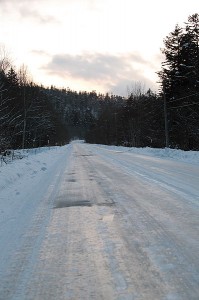 There is a tendency to not blame motorists in the public discourse. It’s reflected in the terms used by officials and the media when collisions are called “accidents” and drivers “lose control of their vehicle.”

