Posts Tagged ‘Safety’

Our Lame Road Safety Videos

Sunday, March 8th, 2009

A new series of public service advertisements (PSA) were released in the U.S. to target youth reckless driving.

National Highway Traffic Safety Administration (NHTSA) data shows that, on average, more than 300,000 teens are injured in car crashes each year, nearly 8,000 are involved in fatal crashes and more than 3,500 are killed. Research also shows that teen drivers are involved in more than five times as many fatal crashes as adults. Young drivers are more likely to speed, run red lights, make illegal turns and die in an SUV rollover.

“This PSA campaign has a real opportunity to reach teens around the country,” said Thurbert Baker, Attorney General of Georgia. “By speaking up about reckless driving, young people can save lives, both their own and those of their friends.”

We love Fred Willard and Rob Riggle as much as anyone, but these are absolutely forgetable, sanitized and uninspired videos, but especially when compared with other safety videos from other countries.

These other videos don’t just “speak up” about reckless driving, they graphically display those Black Swan moments when taking risks adds up to a horrific result. They’re graphic. They’re memorable.

From Think! UK:

More videos from Think!:

From “The Faster you go. The bigger the mess.” series:

http://www.youtube.com/watch?v=_z8Mnf22D30

From cycling-related video from Speed Matters:

http://www.youtube.com/watch?v=TZwPVKOPLjY

Monday Media Roundup

Monday, March 2nd, 2009

Little Stimulus Money for Michigan State Parks

Despite the huge backlog in much-needed capital improvements, the Lansing State Journal is reporting that our state parks will not be receiving much economic stimulus funding.

Before all the details of the federal stimulus plan were known, the department put together a wish list of projects it could have ready to go in 90 days. The list included 586 proposals totaling $356.6 million, including more than $200 million and more than 300 projects involving park improvements. So far, only three DNR requests have got to the final round for consideration by federal officials.

Of course the stimulus money is going towards road projects. Our state parks have hundreds of miles of roads, many of which require repairs. However, the state considers these parks roads as “private” and not eligible for funding. These roads don’t even receive funding from the state fuel tax. This is just another fundamental reason why our state park operations are not sustainable.

Best Cars in a Crash (but not the safest)

Auto-centric viewpoints are common. Here’s one that’s often blindy repeated.

Forbes Magazine is reporting on the best cars in a crash and only considers safety from the viewpoint of those inside the car. A quarter of all road fatalities in Metro Detroit are pedestrians and cyclists. Which cars are safer for them? Large SUVs that take more lane width, have larger blind spots, have longer stopping distances, and are less manueverable?

Another problem with this type of article is it assumes a crash is inevitable. In a one-on-one situation, more manueverable, lighter vehicles are more likely to avoid a crash than their heavier counterparts.

This topic was well covered in an older New Yorker article. They review a study of fatalities per million cars which includes drivers, passengers, and the other crash victims. Mid-size cars were in found to cause the least number of fatalities.

Conservative Voice against Sprawl

We’ve spoken up against sprawl largely because it results in auto-centric communities that are often unsafe or impractical to bike or walk in.

Christopher Caldwell has this excellent op-ed in the Financial Times that points out the costly and inefficient economics behind sprawl:

In 1958, the great journalist William Whyte coined the term “sprawl”, in an article for Fortune. He noted with horror that, a mere two years after the Highway Act, already huge patches of once green countryside have been turned into vast, smog-filled deserts that are neither city, suburb, nor country. Developments were concentrated in random political no-man’s-lands near interchanges and exits. Road lobbyists and real estate developers colluded against meaningful regulation and planning, with the result, Whyte wrote, that “development is being left almost entirely in the hands of the speculative builder”.

Whyte warned that sprawl was not just bad aesthetics but bad economics. A subtler and more serious problem than blight was that, for local authorities, the cost of providing utilities and other services was exorbitant. “There is not only the cost of running sewers and water mains and storm drains out to Happy Acres,” Whyte wrote, “but much more road, per family served, has to be paved and maintained.” The infrastructure network that came out of the Highway Act had higher overheads than the one it replaced. It became a bottomless pit of spending.

Of course the Road Commission for Oakland County is paying the price for building a sprawled road network that it can no longer afford to maintain. They did no land use planning. And the Oakland County Commission has regularly selected road commissioners from the county’s sprawling communities, so this outcome is no surprise.

And the article even includes a nod to Detroit: “The encirclement of Detroit’s neighbourhoods by highways is often cited as a primary cause of its decline.”

Winter Bike Commuting & Safety

Wednesday, February 18th, 2009
Bike share of work trips, 2000/2001

Bike share of work trips, 2000/2001

Yesterday’s Detroit Free Press had a decent article on those still commuting by bike during the winter.

Bike enthusiasts, law enforcement and transportation officials say people like Bierman are among a growing number of commuters in metro Detroit who are responding to the sluggish economy and rising gas costs by riding bikes to work during the winter — despite a total snowfall that measures more than 21 inches above average so far.

We’ve heard from naysayers that Detroit won’t be popular for biking because of our winters.

Not true.

A higher percentage of people bike to work in Canada than the U.S. — three times higher according to one report. In fact a much higher percentage of people bike to work in the Yukon Territory than either California or Florida.

This same report offers some explanations as to why.

One explanation is safety, and that was a highlighted concern in the Free Press article. Since 1988 Canada has done a signficantly better job at making biking safer compared with the U.S.

In fact, compared with many European countries, the U.S. is much more dangerous.

Due to the lack of comparable time-series data on cycling levels in Canada and the United States, we can only attempt a standardized comparison for the latest available year. We also include selected European countries as a basis for comparison, since cycling is generally considered safer in Europe than in North America (Pucher and Dijkstra, 2003). That impression is certainly confirmed by Fig. 4, which shows rates of cycling fatalities per 100 million km cycled in each country. Fatality rates range from a low of 1.03 in Denmark to a high of 5.74 in the USA. With fatality rates well under 2.0, Denmark, the Netherlands, and Sweden have the safest cycling. Canada has 2.39 cycling fatalities per 100 million km cycled, just about the same rate as France (2.04) and Germany (2.43). The United States has, by far, the most dangerous cycling, with a fatality rate of 5.74 almost six times as high as in Denmark, almost three times as high as in Canada, and about twice the rates in Italy and the UK.

Besides safety, the report notes one other statistically significant explanation for biking levels: the price of gas.

“I’ve got some rights on the road!”

Sunday, February 1st, 2009

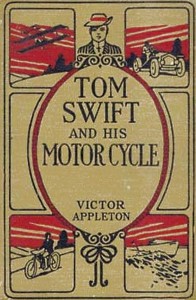
tom-swiftNinety-nine years later and bicyclists are facing the same issues Tom Swift faced in the first chapter of the  first book of the popular series, Tom Swift and His Motor Cycle, or, Fun and Adventure on the Road.

Aggressive driving.

Cyclists’ rights to the road.

Hat’s off to Tom Swift for keeping such a calm demeanor.

From the 1910 book which is freely available via Project Gutenberg:

As the boy spoke, the breeze, created by the speed at which the car was traveling, lifted off his cap, and sent it whirling to the rear.

Andy Foger turned for an instant’s glance behind. Then he opened the throttle still wider, and exclaimed:

“Let it go, Sam. We can get another. I want to see what time I can make to Mansburg! I want to break a record, if I can.”

“Look out, or you’ll break something else!” cried a lad on the rear seat. “There’s a fellow on a bicycle just ahead of us. Take care, Andy!” (more…)

Good Biking Tips from Gordie Howe’s Son

Tuesday, January 27th, 2009

Newspaper articles on safe cycling often make experienced cyclists  cringe.

That’s not the case with today’s Free Press article:

As the youngest of Gordie Howe’s sons, I was raised by someone who grew up during the Depression in Saskatoon, Saskatchewan, where temperatures hover at minus-20 all winter. My dad ate oatmeal three times a day, walked or skated five miles to school, and lived in a two-bedroom house with 11 siblings and no indoor plumbing. Popular toys were rocks and sticks.

So when I decided to begin commuting to work on my bike, my dad wasn’t impressed. He merely said, “Watch out for cars.” Good advice.

In the article Howe notes that the U.S. News and World Report “ranked biking to work the No. 1 way to improve your life in 2009.”  He also mentions donating to the Capuchin Soup Kitchen bike shop, which we noted earlier.