Archive for the ‘Funding’ Category

Detroit TIGER III grant: a multi-modal enhancement plan

Sunday, October 16th, 2011

The city of Detroit’s TIGER III $25.7 grant request is a work in progress, but this agenda item for an upcoming city council meeting is revealing:

Submitting reso. autho. to endorse TIGER III Grant Application to USDOT for approximately $25.7 million in funding for the Link Detroit! Multi-Modal Enhancement Plan. (Public Works Department intends to submit an application for funding to construct a series of multi-modal infrastructure improvements to create a fully functional transportation system through the Midtown area to Eastern Market continuing on to the Detroit Riverwalk and into the heart of Downtown, collectively called Link Detroit! Multimodal Enhancement Plan.)

So just what are those multi-modal infrastructure improvements?

There are basically five which all tie together:

  • Streetscape improvements in Eastern Market
  • Construction of a Dequindre Cut extension from Gratiot to Mack with a formal entrance in to Eastern Market. As mentioned earlier, this will be a rail with trail non-motorized pathway.
  • Replacement of bridges over this new section of the Cut
  • Bike lane, path, and sidewalk connections from the Dequindre Cut extension to Hamtramck
  • A Midtown Loop connector between Eastern Market and Midtown

As you can see, getting funding to complete these projects would provide major walk and bike connections to Eastern Market, the RiverWalk, Midtown, and Hamtramck. It would be absolutely huge.

TIGER III grants are due at the end of this month and it is quite competitive. $547 million will be granted.

Keep your hands up for Detroit — and your fingers crossed.

Woodward Corridor lands huge Complete Streets grant

Thursday, August 18th, 2011

Here’s some exciting news about Woodward that has nothing to do with the Dream Cruise.

Senator Carl Levin’s office and the Federal Highway Administration just announced a $752,880 grant for “developing a Complete Streets plan for Michigan’s 27-mile Woodward Avenue corridor that connects 11 communities and two Southeast Michigan Counties.”

“Transportation investments like these will create jobs and improve the quality of life for Michigan residents as well as strengthen the state’s economy,” said Secretary [U.S. DOT Secretary Ray] LaHood. “The demand from the states for these funds shows just how critical the need is for infrastructure investment.”

The funding is being awarded to the Woodward Avenue Action Association (WA3) who will be releasing more details soon.

WA3 has been a big supporter of Complete Streets and they are members of the Detroit Complete Streets Workgroup.

It will be interesting to see how this new planning effort fits with some prior Woodward bike/walk plans, the forthcoming Royal Oak non-motorized plan, and the Woodward Light Rail project.

But as for the Dream Cruise, there is a Complete Streets connection. The best way to move within the Woodward Corridor during the Cruise is on foot or by bike. Making Woodwared a Complete Street could give better, safer, and faster transportation options during the event.

Complete Streets Resolution passes

And in related news, Oakland County Commissioners passed a Complete Streets resolution for the county.

Special thanks to everyone who contacted their commissioner. It worked.


Detroit Bike Shorts for June 7th

Tuesday, June 7th, 2011

Here are various bike-related updates from around the state and Metro Detroit area —

Model D Speaker Series: Urban Mobility

If you missed this event, don’t worry. Jason Rzucidlo has a nice writeup with photos.

Of course, Model D also covered the event.

Marja Winters, deputy director of the city’s Planning and Development department, said non-motorized transit options are an essential component to the mayor’s Detroit Works Project. Credit the growing movement across the country to urban areas, often for the diversity of options a city affords. “The quality of place is becoming the number one determining factor,” she said. “And ranking high in the decision-making process is the notion of alternative forms of transit.”

We probably would not have heard similar quotes from Detroit’s planning department just a few years ago. This really signals the great deal of progress and increased awareness that has happened during that time.

Bicycle Friendly State rankings

Michigan continues to drop in the state rankings developed by the League of American Bicyclists. The Mitten state is now ranked 22nd and was given a “D”.

This 10 spot drop since 2008 is likely attributable to new ranking criteria and the lack of progress in key areas — progress that other states have made. Michigan received an “F” score in the categories of Infrastructure, Evaluation & Planning, and Enforcement.

Ride challenge for MDOT Director

With the U.S. Secretary of Transportation Ray LaHood biking to work yesterday, we suggested MDOT’s Director Kirk Steudle could do the same via Twitter.

@michigandot OK Director Steudle. You’re next and please post pics  http://t.co/hVNYoFs

MDOT responded with “I forwarded your tweet to Dir. Steudle to let him know. Thanks! ”

GM’s Akerson calls for fuel tax increase

The unwillingness in Washington DC and Lansing to increase fuel taxes has helped led to a transportation funding crisis. (Yeah, sprawl and the lack of regional planning in Metro Detroit are factors as well.)

Bill Ford Jr. has previously advocated for a fuel tax increase. Now, so to has GM’s CEO Dan Akerson according to this Detroit News article.

A government-imposed tax hike, Akerson believes, will prompt more people to buy small cars and do more good for the environment than forcing automakers to comply with higher gas-mileage standards.

“You know what I’d rather have them do — this will make my Republican friends puke — as gas is going to go down here now, we ought to just slap a 50-cent or a dollar tax on a gallon of gas,” Akerson said.

“People will start buying more Cruzes and they will start buying less Suburbans.”

An increased fuel tax can also encourage more people to bike, walk, and use public transit, while providing improved funding.

I-275 Metro Trail

There was a reopening ceremony for a portion of the I-275 bike path on Saturday. We weren’t there, but the Detroit Free Press was. The I-275 path will continue to be expanded northward as the southern portion is rebuilt and reopened. You can stray up to date with the progress by visiting the Friends of the I-275 Pathway on Facebook.

Michigan Airlines Rail-Trail

The Spinal Column is reporting that the Surface Transportation Board has denied a quick abandonment for the rail corridor that many hope will soon become a trail.

STB board members denied Michigan Air-Line Railway’s petition because it didn’t “provide the Board with sufficient evidence regarding the revenues and costs associated with the line, thereby making it impossible to determine what burden, if any, (Michigan Air-Line) Railway incurs in continuing to operate the line.”

Nevertheless, Michigan Air-Line Railway still hopes to get the STB’s approval to abandon the railroad, therefore allowing the trail project to move forward.

“We’re still moving forward with the grant applications,” said Commerce Township Planner Kathleen Jackson. “The NRTF board doesn’t make the grant decision until December, and (Michigan Air-Line Railway) hopes to have an answer by then.”

We do hope this gets resolved prior to the Natural Resource Trust Fund grant decision is made in December. This is the third attempt at getting this grant which will help pay for most of the property.

Detroit road obesity makes for easy cycling

Monday, April 25th, 2011

Detroit’s loss of population is well documented. No matter where the recent census counts fall, the reality is Detroit has a million fewer residents since the 1950s.

And since the 1950s, Detroit lost its streetcar network while gaining one of America’s most extensive urban expressway networks.

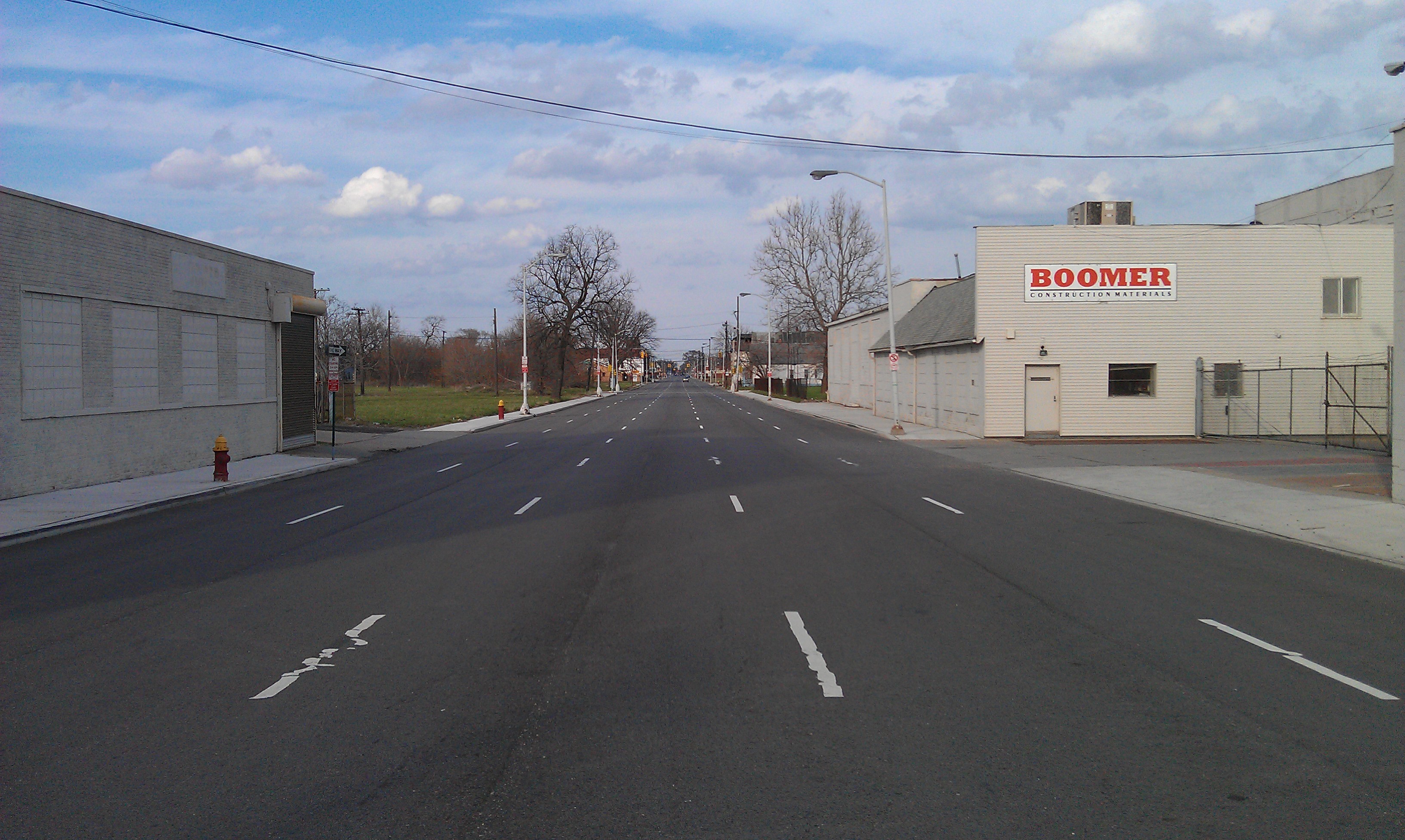
This has resulted in roads like Forest just east of Dequindre. Five lanes one-way with limited hours of parking.

Despite its one-way design, the road’s recent repaving and lack of traffic makes this ideal for biking.

And from 2004 to 2009, there are no reported motor vehicle crashes involving bicyclists or pedestrians on this segment of Forest from Dequindre to Gratiot.

Marked in Red

However, the MDOT and SEMCOG bicycle maps say otherwise. Both bicycle maps show this road in red, which means it’s generally unfavorable for bicycling due to the heavy traffic.

Huh?

We looked at the SEMCOG traffic counts and did not find any relevant traffic counts near this section of Forest. There was one count from June 2006 taken on Forest west of Dequindre however Forest is now closed at Dequindre. Even still, that traffic count was only 6,823 vehicles during a 24-hour period. The MDOT map says over 15,000 cars a day use this section of Forest.  SEMCOG map says there are over 10,000 vehicles per day.

Unfortunately it appears Forest is not the exception on these maps. There are other super wide, one way Detroit roads with little to no traffic that are shown in red, including Rosa Parks and 14th from Warren to I-75. Second Avenue from Forest to Temple is red on SEMCOG’s map despite its lack of traffic.

This really just reinforces the idea that Detroit needs a good bike map that is designed for cyclists and provides recommended routes — like Forest.

Road Diet?

Does road dieting a road without cars make it more bike friendly? Is a road with so few cars a Complete Street? These are questions that don’t get asked in most cities but are very relevant in Detroit.

Perhaps it makes more sense to approach this with a financial perspective. Could a road diet reduce the road maintenance costs and storm water runoff? Could we convert those outside travel lanes to half bike lane, half pervious surface. The pervious surface (perhaps as bio swales) would provide some separation between the parking/vehicle travel lanes and the bike lane while also absorbing the road’s storm water runoff. Could the city maintain (e.g. sweep) a physically-separated cycle track?

Eliminating vehicle lanes on Federal aid roads (such as Forest) affects Michigan’s federal transportation funding formulas. The state would get the same amount of funding, but less would be distributed to counties and cities like Detroit. There is a financial incentive for not losing vehicle lanes on federal aid roads, but is it enough to justify the added cost?

Hopefully the answer to these questions will emerge over time from the Detroit Works Project and more analysis.

But until then, go bike on E. Forest and enjoy the wide open road.

Third time a charm for Wixom-area Rail-Trail?

Monday, April 4th, 2011

As reported in the Spinal Column, Wixom, Walled Lake, and Commerce and looking to apply for Michigan Natural Resource Trust Fund monies for a third time.

The Michigan Airline Railway property spans from West Bloomfield Township to the western city limits of Wixom and is considered the missing link in a trail that traverses the county and connects to a cross-state corridor spanning the Lower Peninsula.

The target 5.33 miles of Michigan Airline Railway corridor crossing the trailway council communities would be converted into a non-motorized recreational trail to link the Huron Valley and West Bloomfield trail segments.

“Our resolution emphasis is on the acquisition of the property at and surrounding the Walled Lake depot and including the depot,” [Wixom city manager Mike] Dornan said.

This grant request was denied in 2009 when there was no commitment for the required matching funds from MDOT.

Last year it was rejected due to protests of a local business still using the line. According to the Trust Fund minutes, “Chairperson Muchmore responded he feels this proposed trail project has some loose ends that need to be resolved.”

The Spinal Column reports that the local business issue has been resolved and that this section of railroad is being formally abandoned this summer.

…the railroad owner has filed a petition for exemption which would lead to the abandonment of the railway, which has led the trailway council to try again.

“The three communities now feel we are on better ground now that the railroad will be abandoned,” [trailway council administrator Kathleen] Jackson said.

We sure hope so. This is a critical link locally, regionally, and statewide. It is part of the Great Lake to Lake Trail (formerly known as the Michigan Airline Trail.)

Also, the Spinal Column supported this rail-trail in this editorial.

LinkMichigan Natural Resources Trust Fund Nov. 2010 minutes (PDF)