Archive for the ‘General bike news’ Category

Bicycle parking and racks updates

Thursday, July 30th, 2009
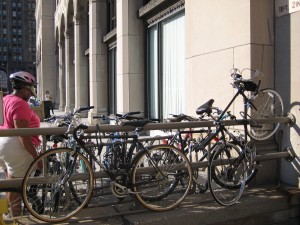
bike parking around the New Center in DetroitBike parking has been a hot topic of late.

In Ann Arbor and Hamtramck

Both cities’ efforts to promote bicycling were mentioned in this recent metromode article, Cheap Ways To Revitalize Your Downtown. And both cities are looking to improve bicycle parking — a hot topic this past couple weeks within the city of Detroit.

In Detroit

We recently mentioned a rekindled bike parking discussion with the Detroit Tigers that was initiated last year by Wheelhouse Detroit.

There’s also been discussion at various meetings that not only recognized the importance of improved, safe, and convenient bike parking, but included some steps we can take.

It’s been noted that bike parking within parking structures could be a very good option. And they’re shelted too. The city owns 11 structures. We probably need to not only add bike racks but produce signage so bicyclists can find them.

And rather than buy racks, why not solicit local designs and local builders to create them as is done in Buffalo, New York? Let’s keep the money local and create green jobs.

We’re also looking to pull together some recommendations on bike racks, including designs and location. Many cities have such recommendations, so Detroit’s will likely take the best of those.

Reduced Motor Vehicle Parking Requirements

And, Detroit’s city planning commission is revising motor vehicle parking zoning requirements and may include language for bike parking. ?We’ve suggested that businesses along bike routes might be required to have fewer vehicle parking spaces. And perhaps space requirements could be reduced for any business so long as they provide bike parking. (By the way, providing bike parking is easy points for LEED certification too.)

A Washington Post article, Don’t Build Parking, And They’ll Come–Without Cars, while primarily addressing transit and walking, certainly applies to cycling as well.

Free or nearly free parking induces car usage, the planners say… Don’t build the parking, and residents will be more likely to buy into a transit- and walking-based urban life.

In New York City

The New York City recently took steps to help improve bike parking within some buildings. They also have a great design guide, which we’ve previously mentioned which includes specifications for bicycle racks. And finally, kudos to NYC for this map showing nearly all of their CityRacks.

CDC: Build bike lanes, lose weight

Thursday, July 30th, 2009

Centers for Disease Control and Prevention (CDC)This week the Centers for Disease Control and Prevention (CDC) released a report called Recommended Community Strategies and Measurements to Prevent Obesity in the United States.

In the report, they recommend the following strategies:

Communities Should Enhance Infrastructure Supporting Bicycling

Enhancing infrastructure supporting bicycling includes creating bike lanes, shared-use paths, and routes on existing and new roads; and providing bike racks in the vicinity of commercial and other public spaces. Improving bicycling infrastructure can be effective in increasing frequency of cycling for utilitarian purposes (e.g., commuting to work and school, bicycling for errands). Research demonstrates a strong association between bicycling infrastructure and frequency of bicycling.

The report also cites evidence that “improving bicycling infrastructure is associated with increased frequency of bicycling.” In other words, if you build it, they will bike it.

Also their suggested means for measuring success is the “total miles of designated shared-use paths and bike lanes relative to the total street miles (excluding limited access highways).”

Note that shared-used paths are trails that are nearly always within their own right-of-way (e.g. rail trails.) They should not be confused with side paths or sidewalks, often called safety paths within Oakland County, which should not be designated bicycle facilities according to national guidelines.

Other related suggested strategies include:

  • Enhance infrastructure supporting walking.
  • Improve access to public transportation.
  • Zone for mixed-use development.
  • Support locating schools within easy walking distance of residential areas.

If this sounds like the CDC is promoting Complete Streets then you’re certainly in agreement with Barbara McCann from the National Complete Streets Coalition.

And if you’re interested in staying on top of the Complete Streets movement within Michigan, visit the relatively new Michigan Complete Streets web site.

(via Streetsblog)

Metro Detroit biking in the media

Monday, July 20th, 2009

Dequindre Cut

It’s grand opening in May officially kicked off the Summer of Dequindre Cut Love. It was far and away the most talked about trail at the MTGA RiverDays booth. And at the Palmer Park Green Fair, Lt. Governor John Cherry was quick to locate the Dequindre Cut on the Detroit Greenways brochure.

The word is out.

And one major reason is the world class graffiti along the Cut. Yesterday’s Detroit News ran an article that discusses that graffiti with some of the artists that created it. The article includes both a video and an audio tour. It was interesting to learn that some of the graffiti is over 20 years old.

Additional link: Photos of the Dequindre Cut graffiti prior to the trail construction

Detroit Ferry Service?

Currently the only convenient means for getting ones bike across the Detroit River into Canada is by driving it. That may change as the Wayne County Port Authority will soon have support facilities for ferry service on the RiverWalk. The Free Press is reporting their receipt of $7 million in funding to further that effort thanks to Senator Carl Levin.

Imagine if taking your bike to Windsor, Canada was as straightforward as taking it to Mackinaw Island (with customs, of course.)

Special Needs Bike Camp

Today’s Detroit News has a great article called, Bike camp clears hurdle for special needs children:

Because of their limitations, only 10 percent of children with Down syndrome and 18 percent of children with autism can ride a bike, said Dale Ulrich, director of U-M’s Center for Physical Activity & Health in Pediatric Disabilities.

But after the camp, most who attend can ride a bike, and the study is finding the children are more likely to stay physically active, leading to many health benefits. This is especially good for children with Down syndrome since it often leads to excess weight. Children with autism often suffer from sleep disorders that are treated with medications, some of which cause weight gain.

Besides the health benefits, learning how to ride a bike also helps the children become more social, verbal and independent, Ulrich said.

No Sidewalks

This Free Press article, Road sound raises residents’ fury, shows how backwards some communities can be.

…The residents did post one victory. The township board agreed not to run a sidewalk alongside Square Lake Road.

“The beautification project is not most important right now, safety is the issue,” township Clerk Janet Roncelli said.

Apparently pedestrians safety is not a priority for Bloomfield Township.

Downsizing Detroit

The Free Press revisits how we can manage the downsizing of Detroit. While not directly about biking, a planned downsizing would lead to vast greenspace and opportunities for additional greenways and trails.

And in a related vein, the Detroit News is noting the return of wildlife within the city, including red foxes.

The red fox is carving out a place of its own deep into downtown, joining the ranks of raccoons, skunks, opossum, white-tailed deer and red-tailed hawks finding homes in untended lots, houses and buildings in the rusting one-time car capital.

And don’t forget the red-necked pheasants!

Does your commute suck?

Thursday, July 16th, 2009

My Commute sucksTom Greenwood wrote a Detroit News column earlier this month that highlighted a new web site called mycommutesucks.org where commuters can report how good or bad their commute is.

Like most Metro Detroiters, Greenwood is often blinded by auto-centrism. In other words, the transportation options on the other side of the windshield are rarely recognized or understood.

For example, I don’t think he understands that non-auto commuting can provide additional simultaneous benefits. Sure, the San Francisco woman has a 90 minute round trip commute, however that also includes 40 minutes of exercise, time to relax, grab some food, read the paper, and apparently socialize.

Another factor rarely considered when compared commute modes is cost. As an example, for me, biking three miles into downtown Royal Oak takes about 5 minutes longer than driving. However, I need to work about 6 minutes to cover the added vehicle and parking costs. In effect, biking is slightly quicker, but especially once I include the time to find a parking space.

Also, based on his column, I don’t think Mr. Greenwood realizes that the group behind this web site, Transportation for America, is pushing for a new federal transportation bill that reduces auto dependence while increasing other options such as biking and mass transit.

Our congested roads have lanes added to them – yet promptly fill up again. More and more people are riding the train and bus, yet service is being cut. Biking has never been more popular, but it seems our streets have never been more difficult or dangerous to use.

I think that just put a crack in the windshield…

Cycling’s gender gap in Metro Detroit

Thursday, July 9th, 2009

The Detroit Free Press recently ran an article about an o2WomensRide for novice women cyclists in suburban Detroit.

E.J. Levy, 56, of Bloomfield Hills noticed that the local cycling community didn’t offer many group rides for novice women, [so] he started one.

The cycling community tends to cater to a hard-core, competitive crowd. Often, that’s guys who enjoy going fast, Levy says.

That’s great. Oakland County needs more slower rides and not just for novice women.

But perhaps what’s most striking about Levy’s comments is they are not accurate within the city of Detroit.
IMG_2803
The cycling community in Detroit offers many rides for novice women and does not cater to the competitive, lycra crowd.

In fact Detroit rides are far more inclusive of all types of riders when compared with the suburbs. The speeds of the Detroit Synergy, Tour de Troit, and Wheelhouse Detroit rides are slower than the o2WomensRide. Normal cotton clothing is almost de rigueur on Detroit rides, and on some, helmets are optional.

And you can ride a old Huffy on a Detroit ride without fear of a snarky comment.

The result is there’s a seemingly higher percentage of women on the Detroit rides.

[In fairness, we must add that Defying the Law, a Ferndale-based ride also caters to novices, as did Royal Oak’s now-defunct Motor City Motorless ride.]

Similar Gender Gap across the U.S.

Metro Detroit’s gender gap is not alone. This New York Times article discusses the gender gap on rides in the Big Apple.

In the article, John Pucher, a professor of urban planning at Rutgers, notes the lack of a gender gap among European nations.

“Someone was telling me, maybe American woman don’t like to sweat as much as European women. Maybe that’s why American women don’t cycle to work, but Dutch women do,” Mr. Pucher said. “But I think that’s a bunch of baloney.”

“I think the No. 1 reason you have so few women cycling in New York City is because it’s seen as a dangerous activity,” Mr. Pucher said.

With the exception of areas like Central Park and designated bike trails (which female cyclists populate almost as zealously as their male counterparts) bike riding in most parts of the city is hardly leisurely. “It’s like going into battle,” Mr. Pucher said. “You need a helmet and gloves.”

Certainly safety is a determining factor in Metro Detroit’s gender gap as well. And studies show that women have greater concerns about perceived bicycling safety than men.

While rides catering to women are a start, to truly close the gender gap, we need to continue pushing Metro Detroit governments for bike lanes and other safe bicycling facilities.

Jackie Phelan in Detroit

Speaking of women bicycle advocates, Jackie Phelan was recently in Detroit. Among other things, she’s the founder of WOMBATS (Women’s Mountain Bike and Tea Society). There’s more information on her visit on the Wheelhouse Detroit blog — one of Metro Detroit’s few if not only women-owned and managed bike shops.