Archive for the ‘General bike news’ Category

Bicycle Film Fest comes to Detroit

Wednesday, July 8th, 2009

Bicycle Film FestivalMark your calendar. The Bicycle Film Festival is coming to Detroit on July 17th and 18th.

The films will be shown at the Downtown YMCA’s Boll Family Theatre at 1401 Broadway, just a couple blocks south of Comerica Park.

Friday, July 17th

  • 6:30 PM – Opening reception in the theatre lobby
  • 7:00 PM – Program 1 – Where Are You Go – Premiere
  • 9:00 PM – Program 2 – Fun Bike Shorts
  • 10:00 PM – Goldsprints at The Park Bar (2040 Park Ave.) with “real cheap drinks” and DJ Haute To Death

SATURDAY JULY 18

  • 6:30 PM – Opening reception in the theatre lobby
  • 7:00 PM – Program 3 – Road To Roubaix
  • 9:00 PM – Program 4 – Urban Bike Shorts
  • 10:00 PM – After party at the Cass Cafe (4620 Cass Ave.) with the bands bands Pedal Shop, Steven And The Reelers and The Reverend Robert David

Program 1 & 3 are full length feature films while programs 2 & 4 are shorts.

Tickets are $8 dollars per program and are now on sale.

There are also plans for a 30 mile Saturday morning ride, a picnic at Campus Martius, and a late afternoon Alleycat Ride before the Saturday reception.

Bike parking will be available.

Nothing says independence like a bicycle

Saturday, July 4th, 2009

Frazz comic strip by Jef Mallett

Started in April of 2001, the Frazz comic strip from time to time reflects author Jef Mallett’s love of biking. Today’s Fourth of July strip is a great example.

Jef was raised in Big Rapids and his addiction to cycling began with riding to school because he despised taking the bus. Jef now lives in Lansing, where his cycling addiction continues.

For those less familiar with the strip, Frazz is a thirty-something school custodian who lives an idyllic life being around well-behaved kids and getting plenty of time to ride both on-road and off.

“Frazz is who I want to be,” says Jef. “Frazz is a just a regular, likeable guy.”

You can catch your daily dose of Frazz at comics.com/frazz.

Jeff’s also written some Frazz books, which are available at Amazon.com.

Pro-bicycle pitches for conservative ears

Thursday, July 2nd, 2009

Bicycle facility funding often takes verbal punches from some conservative voices who don’t consider it as a valid transportation option as driving.

Here are a couple advocacy approaches that might be more successful when appealing to conservative audiences.

Increasing National Security

William Lind, director of the Center for Cultural Conservatism at the Free Congress Foundation, was recently intereviewed in the Infrastructurist. And though he was talking about public transit, one could easily substitute biking into this same argument.

National Security is always a big interest to conservatives and any time you can talk in those terms, you’re going to have their attention. Virtually every American knows that our greatest single national security vulnerability at the moment, the one that has enmeshed us in the middle east, is our dependence on foreign oil, most of it coming from unstable parts of the world. And this can drag us into unwanted wars, as it has it can result not only in high gas prices, like we had last summer, but in complete cutoffs like we had in ’73 and ’79, where events halfway around the world suddenly leave our gas stations without any gas to sell. And at present, if that happens, most Americans have no backup.

Reducing Public Health Costs

The Associated Press recently noted a new report on obesity in the U.S. and its affect on Medicare costs.

Health economists once made the harsh financial calculation that the obese would save money by dying sooner, notes Jeff Levi, executive director of the Trust for America’s Health, a nonprofit public health group. But more recent research instead suggests they live nearly as long but are much sicker for longer, requiring such costly interventions as knee replacements and diabetes care and dialysis. Studies show Medicare spends anywhere from $1,400 to $6,000 more annually on health care for an obese senior than for the non-obese.

“There isn’t a magic bullet. We don’t have a pill for it,” said Levi, whose group is pushing for health reform legislation to include community-level programs that help people make healthier choices like building sidewalks so people can walk their neighborhoods instead of drive, and providing healthier school lunches.

“It’s not going to be solved in the doctor’s office but in the community, where we change norms,” Levi said.

Making our communities more bikeable can play a major role in reducing obesity and reducing public health care costs.

Where does Michigan stand? Here are some health statistics from the report:

  • 29% of Michigan adults are obese
  • Michigan has the ranked ninth in the percentage of obese adults
  • 12% of Michigan high school students are obese
  • On average, this obesity costs Michigan residents $291 per person in medical expenses. This is $33 per person above the national average.

Which state is the fattest? Mississippi has the highest obesity rate at nearly 33% — a title they’ve held for the past five years.
Promoting Livability and Livable Communities

Thursday, June 25th, 2009

Transportation Secretary Ray LaHood at the National Bike SummitBack in January, we reported on one of President Obama’s urban policy goals, which should push our local road agencies and elected officials to build more bike-friendly communities:

Build More Livable and Sustainable Communities: Our communities will better serve all of their residents if we are able to leave our cars to walk, bicycle and access other transportation alternatives.

In March, the Secretary of Transportation Ray LaHood further addressed livable communities in his blog by saying, “One of my highest priorities is … to help promote more livable communities through sustainable surface transportation programs.”

LaHood reiterated that message at the National Bike Summit since livable communties are bikeable communities and Complete Streets.

Again from his blog:

The upcoming reauthorization of DOT’s surface transportation programs provides an opportunity for us to feature bicycling as part of a new American mobility within livable communities.

Now more recently, LaHood outlined six livibility principles that “help us coordinate federal transportation, environmental protection, and housing investments at our respective agencies.”

  1. Providing more transportation choices;
  2. Expanding access to affordable housing, particularly housing located close to transit;
  3. Enhancing economic competitiveness, giving people access to jobs, education and services as well as giving businesses access to markets;
  4. Targeting federal funds toward existing communities to spur revitalization and protect rural landscapes;
  5. Increasing collaboration among federal, state, and local governments to better target investments and improve accountability;
  6. Valuing the unique qualities of all communities–whether urban, suburban, or rural.

Clearly, at least for most of Metro Detroit, the federal government is taking the lead promoting livable communties. How that filters down to our local level remains to be seen, but certainly transportation funding will play a major role.

And for now, it seems bicycle advocates need to start using the terms “livability” and “livable communities” when we push for Complete Streets, bike lanes, etc.

We have friends and support in Washington D.C.

We need to take advantage of that as we try bringing Metro Detroit’s transportation priorities into the 21st century.

Great Lakes Metro Summit in Buffalo

Monday, June 22nd, 2009

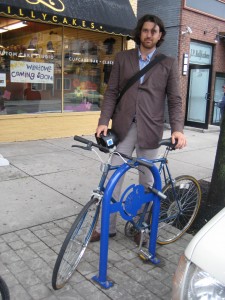
img_2735Last week the Great Lakes Metros Summit was held in Buffalo, New York.

And to quote Artvoice, this event was where “activists and policymakers from around the Great Lakes gathered to share homegrown solutions to Rust Belt problems.”

At the Summit, I moderated a panel on Complete Streets and Transit while also providing a brief overview status of Detroit’s greenways and non-motorized transportation based on my work for the Michigan Trails and Greenways Alliance (MTGA).

Our panel included Rory Neuner from the Michigan Environmetnal Council and a League of Michigan Bicyclists director. Rory is very active with the Walk and Bike Lansing campaign. They are working on a Complete Streets policy for Lansing.

If you are a Lansing resident, please visit their web site to learn how you can help make Lansing “accessible and walk & bike friendly!”

Next on the panel was Dom Nozzi of Richmond, Virginia. Dom has an invaluable web site devoted to making cities more bikeable and walkable. His four-part speech from Bloomington, Indiana really defines a vision for how we need to prioritize transportation for people first rather than cars.

After the summit, I had a chance to talk with Dom. One interesting point he made is that many people are stuck with outdated transportation paradigms, primarily that mobility — high speeds, wide roads — is the primary goal. They’ve committed themselves to this paradigm and cannot step back to view the bigger picture. They are often unconvinceable. An advocates best hope is they will be replaced or retire.

And also on the panel was Justin Booth, who certainly plays a major role in all the good things happening in Buffalo with respect to biking.

Justin created Buffalo’s Blue Bicycle program, a low-cost, simple, innovative means for sharing bikes across town.

Also, Justin helped create the Rusty Chain beer program here a portion of sales from a custom locally-brewed beer go towards bike racks — an example of which is shown next to Justin in the above photo. To date the program has generated $10,000, which has been matched with city and federal funding (CMAQ). As a result, businesses within Buffalo’s Central Business District can request bicycle racks which are installed for free.

Buffalo recently installed 110 bicycle racks! Justin noted that the racks are custom designed and made locally.

That’s something worth raising a glass to.