Archive for the ‘MDOT’ Category

Detroit Bike Shorts for June 7th

Tuesday, June 7th, 2011

Here are various bike-related updates from around the state and Metro Detroit area —

Model D Speaker Series: Urban Mobility

If you missed this event, don’t worry. Jason Rzucidlo has a nice writeup with photos.

Of course, Model D also covered the event.

Marja Winters, deputy director of the city’s Planning and Development department, said non-motorized transit options are an essential component to the mayor’s Detroit Works Project. Credit the growing movement across the country to urban areas, often for the diversity of options a city affords. “The quality of place is becoming the number one determining factor,” she said. “And ranking high in the decision-making process is the notion of alternative forms of transit.”

We probably would not have heard similar quotes from Detroit’s planning department just a few years ago. This really signals the great deal of progress and increased awareness that has happened during that time.

Bicycle Friendly State rankings

Michigan continues to drop in the state rankings developed by the League of American Bicyclists. The Mitten state is now ranked 22nd and was given a “D”.

This 10 spot drop since 2008 is likely attributable to new ranking criteria and the lack of progress in key areas — progress that other states have made. Michigan received an “F” score in the categories of Infrastructure, Evaluation & Planning, and Enforcement.

Ride challenge for MDOT Director

With the U.S. Secretary of Transportation Ray LaHood biking to work yesterday, we suggested MDOT’s Director Kirk Steudle could do the same via Twitter.

@michigandot OK Director Steudle. You’re next and please post pics  http://t.co/hVNYoFs

MDOT responded with “I forwarded your tweet to Dir. Steudle to let him know. Thanks! ”

GM’s Akerson calls for fuel tax increase

The unwillingness in Washington DC and Lansing to increase fuel taxes has helped led to a transportation funding crisis. (Yeah, sprawl and the lack of regional planning in Metro Detroit are factors as well.)

Bill Ford Jr. has previously advocated for a fuel tax increase. Now, so to has GM’s CEO Dan Akerson according to this Detroit News article.

A government-imposed tax hike, Akerson believes, will prompt more people to buy small cars and do more good for the environment than forcing automakers to comply with higher gas-mileage standards.

“You know what I’d rather have them do — this will make my Republican friends puke — as gas is going to go down here now, we ought to just slap a 50-cent or a dollar tax on a gallon of gas,” Akerson said.

“People will start buying more Cruzes and they will start buying less Suburbans.”

An increased fuel tax can also encourage more people to bike, walk, and use public transit, while providing improved funding.

I-275 Metro Trail

There was a reopening ceremony for a portion of the I-275 bike path on Saturday. We weren’t there, but the Detroit Free Press was. The I-275 path will continue to be expanded northward as the southern portion is rebuilt and reopened. You can stray up to date with the progress by visiting the Friends of the I-275 Pathway on Facebook.

Michigan Airlines Rail-Trail

The Spinal Column is reporting that the Surface Transportation Board has denied a quick abandonment for the rail corridor that many hope will soon become a trail.

STB board members denied Michigan Air-Line Railway’s petition because it didn’t “provide the Board with sufficient evidence regarding the revenues and costs associated with the line, thereby making it impossible to determine what burden, if any, (Michigan Air-Line) Railway incurs in continuing to operate the line.”

Nevertheless, Michigan Air-Line Railway still hopes to get the STB’s approval to abandon the railroad, therefore allowing the trail project to move forward.

“We’re still moving forward with the grant applications,” said Commerce Township Planner Kathleen Jackson. “The NRTF board doesn’t make the grant decision until December, and (Michigan Air-Line Railway) hopes to have an answer by then.”

We do hope this gets resolved prior to the Natural Resource Trust Fund grant decision is made in December. This is the third attempt at getting this grant which will help pay for most of the property.

New MDOT video: My Bike and I

Thursday, May 5th, 2011

Here’s a corny but cute video from MDOT that is “intended to help people explore alternate modes of transportation.”

Their timing is great given that May is National Bike Month and that gas prices are reaching new records in Michigan. According to an unscientific Free Press on-line survey given last month, over 60% of the respondents said they were “making changes to their living habits.” Perhaps more will discover biking as cost effective transportation.

But at the risk of sounding hypercritical, why is Wally wearing an orange safety vest during the day? Is cycling that unsafe that you can’t ride to the neighborhood coffee shop without one? It’s too bad he didn’t look a little more normal. That said, at least he’s not wearing spandex.

Below is the MDOT press release announcing the video and their micommute web page.

FOR IMMEDIATE RELEASE THURSDAY, MAY 5, 2011

CONTACT: Janet Foran, MDOT Office of Communications, 517-335-7176
foranj@michigan.gov
Josh DeBruyn, MDOT bicycling and pedestrian coordinator, 517-335-2918

MDOT promotes bicycling on new Web site and YouTube

May 5, 2011 — As National Bike to Work Week (May 16-20) approaches, the Michigan Department of Transportation (MDOT) is promoting a new video about the benefits and savings of bicycling on the MDOT YouTube channel at www.youtube.com/MichiganDOT. It is part of the new “Mi Commute” Web site that includes tips and tools to help with the cost of commuting. The Web site www.michigan.gov/micommute explores bicycling, public transportation, and other modes of travel that may help commuters save precious gas dollars.

(more…)

Ribbon cut on new section of Conner Creek Greenway

Saturday, April 30th, 2011

Another section of the Conner Creek Greenway was opened yesterday in Detroit on Arbor Day — a holiday for tree planting created by a J. Sterling Morton, a Michigan Wolverine from Monroe, Michigan.

The event at Maheras Gentry Park began with a parade, music, and a long line of kids from the Detroit Merit Charter Academy. The kids were dressed in frog costumes they had made earlier. The frog theme was a nod to the parks historic condition as marshland. It was an amazing site to see.

Following the parade, remarks were made by those who helped make this greenway possible (i.e. the funders): Karla Hall of the DTE Energy Foundation, Tony Kratofil of MDOT, and Tom Woiwode from the Community Foundation for Southeast Michigan.

During his remarks, Kratofil announced MDOT’s commitment to funding the next portion of the Conner Creek Greenway. That portion is along Conner Avenue from McNichols to Eight Mile. That project includes a new section of sidewalks, bike lanes, bike routes, and some landscape improvements.

Wayne County Commissioners Tim Killeen and Bernard Parker also presented a resolution from the commission as well.

The new sections of greenway had been mostly completed late last year. That included bike lanes from Jefferson to Maheras Gentry Park along Clairpointe and a shared-use path from the park entrance to the existing paths near the river. The bike lanes on St. Jean built earlier last year were also part of the opening celebration.

Crain’s Detroit Business and Model D has media coverage prior to the event, while TV20 News has post-event coverage.

AMTRAK aiming for roll-on bicycle service by spring

Thursday, April 28th, 2011

Last August, MDOT solicited comments on the State Rail Plan.  We asked cyclists to comment in favor of AMTRAK allowing roll-on bicycle service for all of its trains in Michigan. Currently AMTRAK requires bicycles to be partially disassembled and boxed.

In the last legislative session, a rider was attached to the 2010 MDOT budget appropriation bill which said:

For rail passenger service supported in any part through capital or operating assistance from funds appropriated in this act, the department shall work with the rail carrier to identify ways in which reasonable transport of bicycles by passengers can be accommodated.

There are three AMTRAK lines in Michigan. Only two, the Pere Marquette (Grand Rapids to Chicago) and the Blue Water (Chicago-Lansing-Port Huron) are provided operating assistance from MDOT.

Our concern was the Wolverine line (Chicago, Ann Arbor, Detroit, and Pontiac) would not get roll-on bicycle service.

We spoke with an MDOT staff person yesterday. She said AMTRAK has told them all three lines will have roll-on bicycle service and they are aiming for spring.

We asked if the bicycles would be in a separate baggage car but apparently AMTRAK is removing some seats and installing bicycle racks. We don’t know how many bikes these train will accommodate. It varies among the current AMTRAK lines, with some allowing three bikes per passenger car.

Apparently one potential hold up is their reservation system needs to be updated.

There are more details on AMTRAK’s onboard bicycle rack accommodations on their web site, including:

You can reserve space for bicycles when you make a ticket reservation. We charge a fee (generally ranging from $5 to $10 depending on route and distance traveled) for reserving a space in the bike rack. If space is available, you will be issued a ticket for bike rack space. Be prepared to give this ticket to the conductor when boarding with your bicycle.

However, you will not be able to use the onboard racks if you have a “tandem, recumbent or other unusual bikes.”

Start planning your summer bicycle trip to Chicago now… Hopefully Amtrak will have the service up and running by then.

Detroit road obesity makes for easy cycling

Monday, April 25th, 2011

Detroit’s loss of population is well documented. No matter where the recent census counts fall, the reality is Detroit has a million fewer residents since the 1950s.

And since the 1950s, Detroit lost its streetcar network while gaining one of America’s most extensive urban expressway networks.

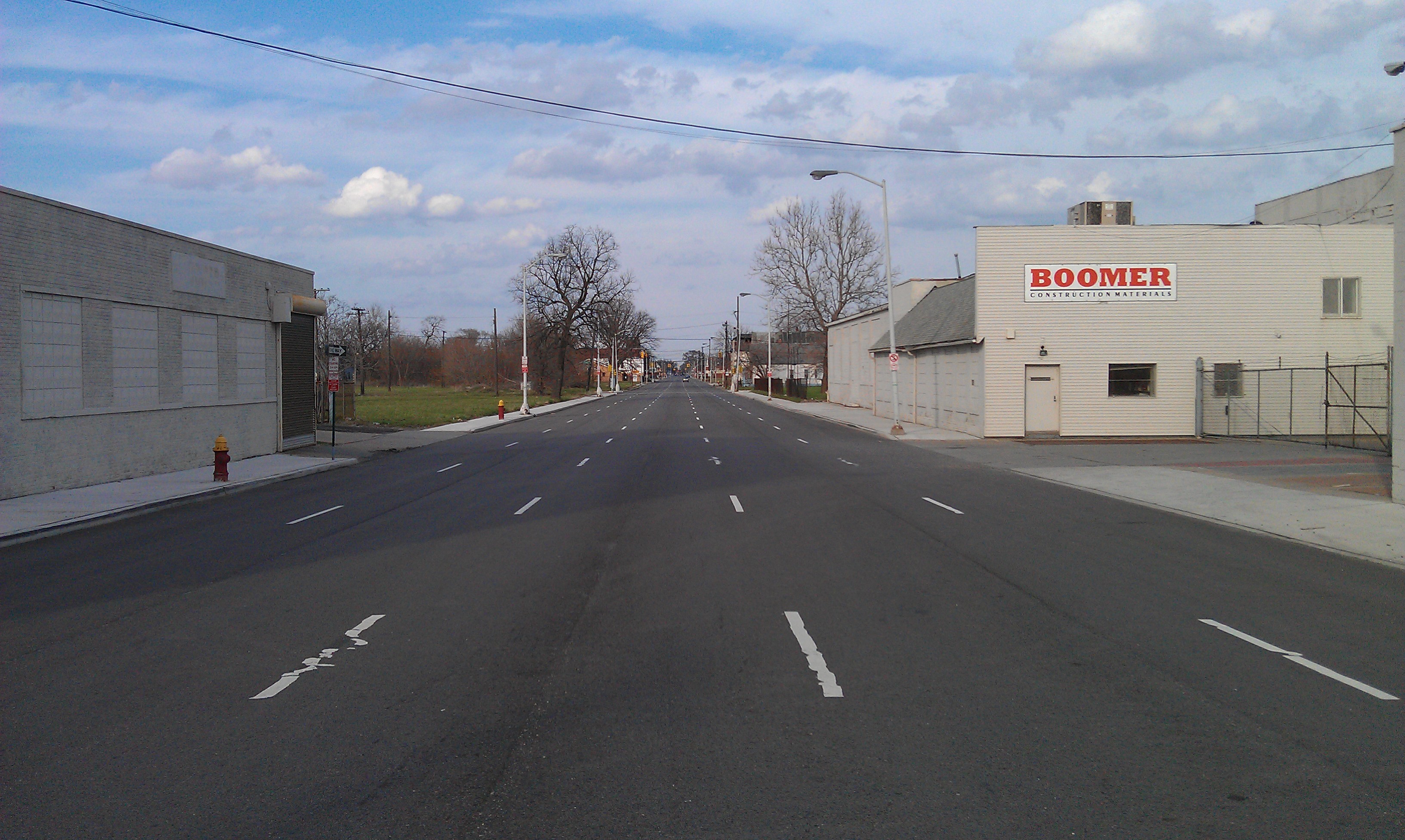
This has resulted in roads like Forest just east of Dequindre. Five lanes one-way with limited hours of parking.

Despite its one-way design, the road’s recent repaving and lack of traffic makes this ideal for biking.

And from 2004 to 2009, there are no reported motor vehicle crashes involving bicyclists or pedestrians on this segment of Forest from Dequindre to Gratiot.

Marked in Red

However, the MDOT and SEMCOG bicycle maps say otherwise. Both bicycle maps show this road in red, which means it’s generally unfavorable for bicycling due to the heavy traffic.

Huh?

We looked at the SEMCOG traffic counts and did not find any relevant traffic counts near this section of Forest. There was one count from June 2006 taken on Forest west of Dequindre however Forest is now closed at Dequindre. Even still, that traffic count was only 6,823 vehicles during a 24-hour period. The MDOT map says over 15,000 cars a day use this section of Forest.  SEMCOG map says there are over 10,000 vehicles per day.

Unfortunately it appears Forest is not the exception on these maps. There are other super wide, one way Detroit roads with little to no traffic that are shown in red, including Rosa Parks and 14th from Warren to I-75. Second Avenue from Forest to Temple is red on SEMCOG’s map despite its lack of traffic.

This really just reinforces the idea that Detroit needs a good bike map that is designed for cyclists and provides recommended routes — like Forest.

Road Diet?

Does road dieting a road without cars make it more bike friendly? Is a road with so few cars a Complete Street? These are questions that don’t get asked in most cities but are very relevant in Detroit.

Perhaps it makes more sense to approach this with a financial perspective. Could a road diet reduce the road maintenance costs and storm water runoff? Could we convert those outside travel lanes to half bike lane, half pervious surface. The pervious surface (perhaps as bio swales) would provide some separation between the parking/vehicle travel lanes and the bike lane while also absorbing the road’s storm water runoff. Could the city maintain (e.g. sweep) a physically-separated cycle track?

Eliminating vehicle lanes on Federal aid roads (such as Forest) affects Michigan’s federal transportation funding formulas. The state would get the same amount of funding, but less would be distributed to counties and cities like Detroit. There is a financial incentive for not losing vehicle lanes on federal aid roads, but is it enough to justify the added cost?

Hopefully the answer to these questions will emerge over time from the Detroit Works Project and more analysis.

But until then, go bike on E. Forest and enjoy the wide open road.