Archive for the ‘MDOT’ Category

More coverage on the Michigan Ave bike lanes

Wednesday, November 3rd, 2010

They don’t appear to be done yet, but they’re getting there.

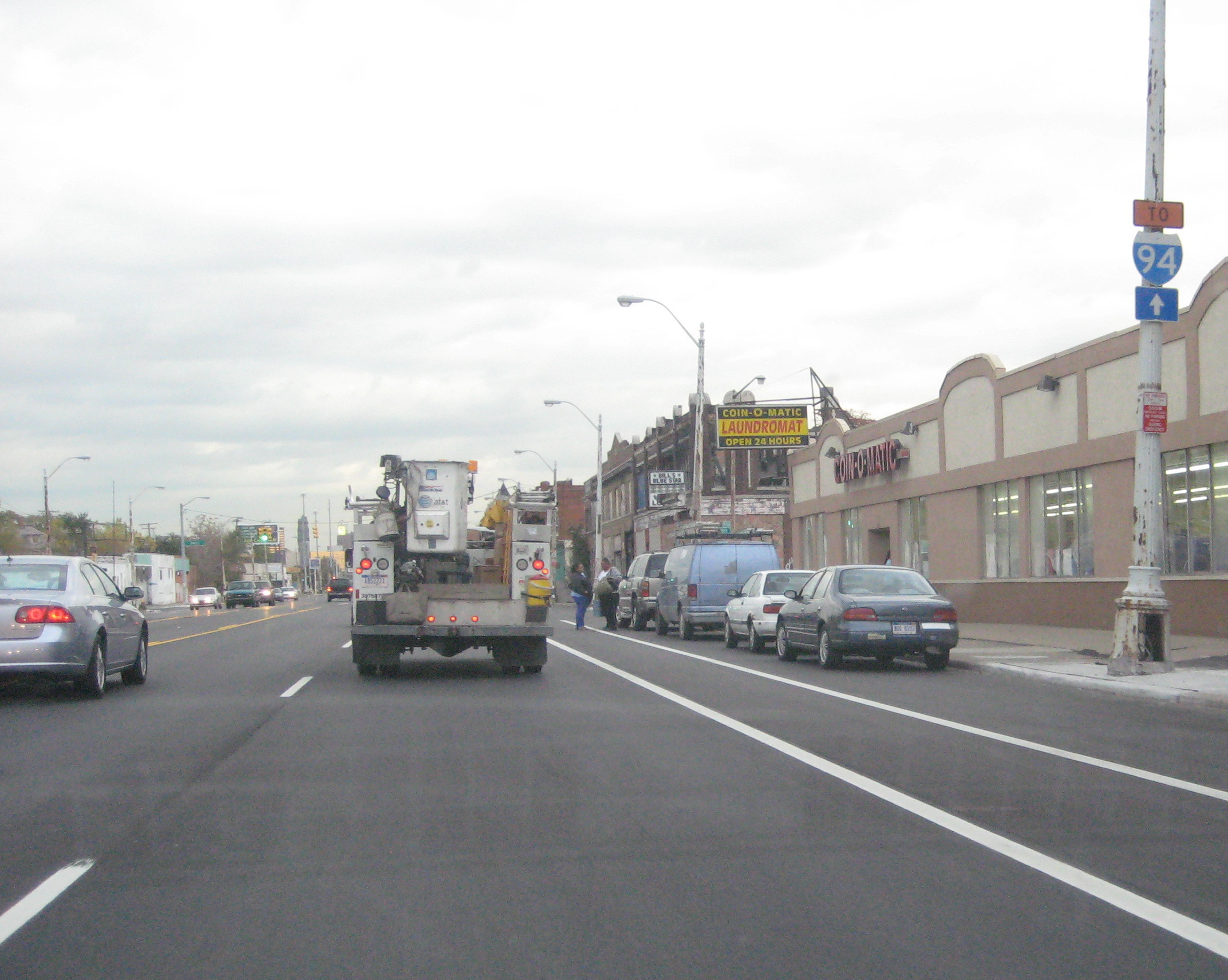
The bike lane paint is on the ground for most of Michigan Avenue. The pavement markings and signage are the finishing touches and are not installed yet.

When completed, this 2.5 mile stretch of Michigan Avenue from Livernois to Rosa Parks will have a more clearly defined space to bike in.

When completed, these additional 5 miles (both sides of the road) means Detroit will have more miles of bike lanes then all the other communities in Oakland, Macomb, and Wayne Counties combined. That’s not so much a bragging point for Detroit as it is a sad reflection of how far behind everyone else is.

Model D covered this topic as well. In these economic times, we’ve heard people ask about the additional cost of adding bike lanes. The MDOT project manager answered that question.

Well, what’s notable is the addition of bike lanes, which reconfigures the trunk line into two lanes of vehicular traffic and one dedicated parking lane in either direction, a center turning lane and bike lanes. Bike lanes added a “negligible” cost to the overall $7.2 million project, according to Matthew Chynoweth, development engineer at the MDOT Detroit Transportation Service Center.

So when your local road engineer says they can’t do a road diet and add bike lanes due to funding, “negligible” is a good word to use.

Give your answer at the ballot box

Tuesday, November 2nd, 2010

Detroit cyclist Horatio “Good Roads” Earle ran for Michigan Senate in November of 1900. With his win, he went to Lansing and created the Michigan Department of Transportation (MDOT).

By the way, the Good Roads of Earle’s time are the Complete Streets of today. In 1900, there were very few motorized vehicles on the road, no stop signs, no traffic signals, no crosswalks. Everyday was a Ciclovia. If a road were paved, it was a Complete Street.

This is an excerpt from The Autobiography of “By Gum” Earle:

My fourth effort was in 1900 as a candidate for state senator from the Third District in Michigan, and I won, which gave me a chance to officially promote the good roads cause in which I was so interested. Every paper in Detroit opposed my nomination, and when they lost out, they said the doughnut won, but I went to Lansing, and by gum, Michigan has shown the world how to build good roads.

A good deal of my success in the campaign was due to the efforts in my behalf made by the “Detroit Wheelmen.” One of the most effective pieces of campaign literature was the one which follows, recalling the laws and privileges secured for the bicyclists, who were at that time in the hey-day of their strength and influence.

PONDER A MINUTE

Baggage law for you,
Dry strip for you,
Bicycle shelter for you,
Bicycle ordinance for you,
Hotel discount for you,
Path protection law for you,
Toll knocked out for you,
Equal rights with horse for you,
No tags on wheels for you,
No lamps on wheels for you,
No bells on wheels for you.

Chief Consul Horatio S. Earle has been one who has worked without a cent of pay for these things. Will you get out and vote, and get others to vote for him for state senator, Third District, next Tuesday? Give your answer at the ballot box.

League of American Wheelmen Committee

This list echoes the one made my Edward Hines when he solicited bicyclists to join the Michigan Division of the L.A.W. Hine’s list provides more details on each item.

Yes, nearly 110 years later we are fighting the same battles. We fought mandatory bicycle registration (“tags on wheels”) and are working on getting roll-on bicycle service with AMTRAK  and the M1 Rail (“baggage law”).

And of course we’re still fighting for Good Roads.

Gov Candidate Snyder attacks bike/ped project

Tuesday, October 12th, 2010

The Michigan gubernatorial debate may not have helped too many with their voting decision this November, but it did bring out one surprise. That surprise was brought to our attention by fellow transportation nerd Transport Michigan.

Near the end of the debate, candidate Rick Snyder ripped MDOT for adding a pedestrian bridge while reconstructing the freeway interchange — arguably making this part of Geddes Road a Complete Street.

FINLEY: We all know Michigan has the worst roads in the nation. Mr. Snyder, would you support an increase in the gasoline tax to fix them?

SNYDER: I don’t support an increase in the gas tax, because we need to get efficient first. I mean, we need to look at value for money budgeting. Because if you go around our state our roads are terrible, but let’s tighten our belts, let’s be efficient and see where we can deploy these dollars to fix the roads that really need to be fixed. A classic illustration I used from the Ann Arbor area, if you went to the Michigan/Michigan State game you had to suffer over the Stadium Street bridge potentially. Two lanes are permanently closed on that bridge. I think it’s got a rating of like 2 out of 10. At the same, I live near Geddes Road and US 23. They just built a bike and pedestrian bridge across US 23 at the cost of millions of dollars. What they didn’t bother to tell us is a quarter mile south that there’s a bridge over the Huron River and there’s a bike and pedestrian path there. So let’s get efficient about where we’re deploying these dollars. There’s a much better way to do things. And that’s what we should focus on first.

Transport Michigan offers a great rebuttal.

Snyder is surely correct that inefficiencies exist in state transportation policy. But why target a much-needed bike/pedestrian bridge, when the state is spending far more colossal sums to widen roads across the state? We know from experience that expanding road capacity will only bring more congestion. Highway widening isn’t just wasteful: it ultimately worsens the problem it’s intended to fix. You’d think a candidate who favors walkable cities, and opposes the crippling spread of urban sprawl, would see the need to link Washtenaw County’s two biggest towns with bicycle and pedestrian facilities, and see the foolishness of so many other more expensive roadway projects.

We agree. If Synder has  provided a classic example of anything, it’s of someone giving an easy but impossible solution.

As Transportation Michigan aptly pointed out, the federal funding for this project could not be spent on the Stadium Boulevard bridge.

And according to Synder’s debate comments, if there’s another crossing within a quarter-mile, it’s a waste of transportation money. Is that correct?

If so, he didn’t bother to tell us there are two alternative routes for the Stadium Boulevard bridge within a quarter mile.

By his own logic, why is the Stadium bridge required at all?

What about Bernero?

We should add that candidate Virg Bernero’s response to the same question hinted that he’s done more of his homework and has a little better grip on Michigan’s transportation funding situation. He references MDOT’s inability to fully match federal funding and he understands at least some of the issues surrounding falling fuel tax revenues.

He is also the mayor of Lansing, a Bicycle Friendly Community, and his web site actually includes the word “bike” albeit once.

Virg will continue to support green transportation in our communities by making cities walkable and bikeable and increasing public transportation options.

While there was a reference to “walkable” and an undefined “green infrastructure”, we couldn’t find “bike” or it’s common permutations on the Synder web site.

MDOT seeks input on a Huron Valley Trail detour

Friday, October 8th, 2010

There is a bridge that carries I-96 traffic over the Huron Valley Trail just east of Milford Road. As part of a larger freeway construction project, MDOT wants to replace the bridge with a low maintenance box culvert. (The Huron Valley Trail currently passes under Kensington Road in a box culvert at Island Lake State Recreation Area.)

When MDOT initially asked the Huron Valley Trail committee about creating a detour, they declined. It appears some minds have changed.

MDOT is now hosting a public meeting to discuss having a trail detour.

The Michigan Department of Transportation (MDOT) is making improvements in your community. The Huron Valley Trail is expected to be closed under the railroad bridge in the Spring of 2011 & we need your help. On October 13, 2010, stop by anytime between 3pm-7pm to share your ideas and be a part of the planning process.

We’ll be at the Lyon Township Municipal Center, 58000 Grand River Ave about½ mile west of Milford Rd.

See you there!

For more information, call Sue Datta at (248) 483-5135.

It seems to us that this might be a good time to put bike lanes on Milford Road.

Also, if you want to stay on top of issues like this, there is a new Friends of the Huron Valley Trail email list.

Opposition to the Clinton River Trail bridge funding

Monday, October 4th, 2010

There has been a national discussion on the merits of stimulus funding. In response, Transportation Secretary Ray LaHood has traveled among transportation projects and noted how they’ve benefited from stimulus funding.

Locally, the Oakland Press has been covering public opposition to the Clinton River Trail bridge in Pontiac. Unfortunately the newspaper seems more interested in being a soapbox for the uninformed.

“They could have awarded that $2 million as a tax credit for a developer,” he said, maybe enticing a department store to take over the massive empty space. “That would create permanent jobs.”

No, they couldn’t. This is federal transportation dollars with very specific strings attached. To think MDOT could convert this to a tax credit for a Wallmart is asinine. It’s media stories such as this that help give life to these unrealistic opinions — not once, but twice.

(In fact in their first article, the Oakland Press incorrectly reported that there is no trail on the east side of the bridge. We spoke with an attendee at Arts, Beats, and Eats who called this the bridge to nowhere, an impression that they could have gotten from reading this initial article.)

“The trail could have gone straight along sidewalks on the south side of Orchard  Lake Road,” she said, “and (stimulus) money could have improved the aesthetics on the Orchard Lake Road corridor and people would still have had a bike trail.”

No, it couldn’t. This transportation stimulus funding was for “shovel ready” projects. Neither of those mentioned were even planned. Besides, it would be against best practices and the national design guidelines to put cyclists on a sidewalk because it’s unsafe.

“Why didn’t stimulus money go toward cutting dead trees?”

Apparently the dead tree cutting lobby in DC just ain’t what it used to be. They didn’t bring home the bacon.

Dear Oakland Press,  If you want to publish articles about whether economic stimulus funding is philosophically good or bad, that’s fine. But, don’t hold the Clinton River Trail bridge hostage by publishing unworkable, unrealistic, if not impossible alternatives without letting your readers know why these aren’t alternatives at all. The true alternative to the bridge is for MDOT to have spent this money on a non-motorized transportation somewhere else.

Is it really about race?

There was significant opposition to the Clinton River Trail in Sylvan Lake when it was first proposed.

From what we saw first hand, that opposition was largely based on race.  Sylvan Lake had closed roads and created barriers between itself and their pre-dominantly black Pontiac neighbors to the east. The trail threatened to create a non-motorized path that would connect those two communities.

At one Sylvan Lake city council meeting a resident said “those people” would use the trail to break into their garage and steal their snowblower.

A Pontiac resident smartly responded by asking the question: Why would anyone walk more than a mile, take your snowblower, then push it another mile back? Why wouldn’t they just drive?

And now that the Clinton River Trail bridge is being built — the final connection between these two communities — we can’t help but wonder if this race issue is at least partially to blame to fueling this discussion.

Of course, we’re not counting on the local media to look into it.