Archive for the ‘On-road bicycling’ Category

Wrapping up the National Bike Summit

Monday, March 16th, 2009
Mike Reuter, Todd Scott, Cullen Watkins

Mike Reuter, Todd Scott, Cullen Watkins

Here’s additional information from the National Bike Summit.

Bicycle Respect and Recognition

We reported earlier that Congressman Oberstar said, We need to make bicyclists a standard transportation mode by law.

BikePortland.org published more information on Oberstar’s initiative last week:

Today at the National Bike Summit in Washington D.C., Oberstar will meet with the country’s top bike lawyers to discuss the potential of a new legislative initiative to draft the country’s first piece of legal policy that would directly relate to the respect and recognition of bicycles as users of our roadways.

Portland bike lawyer Ray Thomas… describes the initiative as a way to create a federal law to ensure equitable treatment of people on bicycles who are involved in crashes. Too often, he says, drivers do not receive serious charges in collision cases. The way the system is set up now, police officers and prosecutors (for a variety of reasons) will often not even attempt to press serious charges against motorists.

Oberstar wants to fix the system so there’s a better chance that justice will be done.

A Plan for Circuit City Stores

One of the most interesting ideas I heard at the Summit was at an IMBA advocacy session. Sitting next to IMBA trail guru Rich Edwards, I began discussing potential indoor mountain bike facilities in Detroit.

Rich mentioned another more suburban opportunity.

567 Circuit City stores have closed around the U.S. These stores are large, well-lit, have concrete floors, heat, water, and very few uses — especially in this market.

One alternative idea is to make them into indoor dirt parks.

John Burke (right) holds a Detroit Gets Green pin

John Burke (right) holds a Detroit Gets Green pin

Trek Ride in Detroit

I attended the Summit with Mike Reuter and Cullen Watkins from American Cycle and Fitness. They invited me to a Trek dealer event at the Summit hosted by President John Burke.

After giving John a brief overview of what we’re achieving in Detroit, he offered to come to town this spring for an urban tour.

Detroit is 140 square miles with zero bike shops stocking new bikes on their floor.

Cyclists are Important Users

Ray LaHood, the Department of Transportation Secretary has a blog where he recently left comments on attending the National Bike Summit.

On Wednesday, I had the pleasure of addressing the National Bike Summit. I was invited to speak as a member of the Obama administration, but I have been a supporter of bicycling for many years and was a member of the Congressional Bike Caucus when I was in Congress.

Still, I don’t think the League of American Bicyclists knew what to expect when they invited me to their summit.

I hope they were pleasantly surprised because I am committed to investing in programs that encourage bikes to coexist with other modes and to safely share our roads and bridges. And there’s strong support in Congress for these goals as well.

Secretary LaHood also noted his excitement for the Active Transportation pilot program. The city of Detroit has submitted a proposal for participating in this program under the next federal transportation bill.

Complete Streets Bills Re-Introduced

Monday, March 16th, 2009
Photo courtesy of Dan Burden

Photo courtesy of Dan Burden

While meeting with members of Congress at the National Bike Summit, Complete Streets legislation was re-introduced. The same bill was introduced in the Senate in 2008 but died in committee.

The basic premise is road agencies should adopt a policy that ensures all transportation modes are reasonably accomodated, includinng biking and walking.

According to bill sponsor Senator Tom Harkin:

When Americans choose to leave their car at home and walk or ride a bike to school or work, they are making a healthy decision. We need to ensure streets, intersections and trails are designed to make them easier to use and maximize their safety.

This legislation will encourage Americans to be more active, while also providing more travel options and cutting down on traffic congestion.

Everyone is encouraged to use this quick online form letter to ask your Senator and Representative to support this legislation.

We typically got receptive but uncommitted support while in Washington DC, perhaps in large part because the bills were only recently introduced.

More details from the Complete Streets web site: (more…)

Why We Need Bicycle Boulevards

Saturday, February 28th, 2009
[geo_mashup_map width=”300″ height=”300″ zoom=”13″]

If you’ve never heard of a bicycle boulevard, don’t be alarmed. They are relatively new and I’m not aware of any that have been built in Metro Detroit.

Recently the Streetsblog Wiki added an entry that describes bicycle boulevards. That’s a great place to start and the Berkeley video is certainly worth watching.

So where does it make sense to add these in Metro Detroit?

We think of some typical street scenarios that make sense, including lightly-traveled residential streets that:

  • provide direct connection to downtowns or other major destinations, but are not fire routes.
  • parallel a main arterial or trunkline road with relatively high traffic volumes.
  • are boulevards or one-ways.

We’ve shown two sample bicycle boulevards for Royal Oak above: Vinsetta Boulevard and Sherman Drive.

Vinsetta is a natural. It already has high recreational use, it’s very scenic, provides a park connection, and has low traffic volumes. Converting it to a bicycle boulevard would likely involve:

  • removing all stop signs along Vinsetta
  • traffic calming the street so cars are naturally inclined to drive a steady 20 MPH
  • reduce vehicle cut-through traffic
  • improving the major road crossings for cyclists and pedestrians

The advantage for cyclists is the street would be much more friendly for riding, especially with younger riders.

It really wouldn’t slow the trip time for motorists since time lost due to lower travel speeds would be offset by having fewer signs — and they’d save gas.

The advantage for pedestrians is lower motorist speeds drastically reduces the odds for injuries or fatalities in the case of collisions — even for a reductions from 25 MPH to 20 MPH. This is especially true for child and senior pedestrians.

Of course adding the Sherman Drive takes one directly downtown making this a no-brainer. Engineering a route on the commercial properties south of Catalpa would be a challenge but certainly possible. This would connect with the Sherman Drive “alley” and then Sherman Drive itself.

More Bike-Related Stimulus Updates

Saturday, February 21st, 2009

MDOT’s Project List

Crain’s Detroit has posted a list of the MDOT projects on their economic stimulus list. As we reported earlier, designing and re-constructing the entire I-275 Bike Path is on their list.

Also on their list is for Michigan Avenue: Milling and resurfacing from Livernois to Rosa Parks; $10 million. Will this project include bike lanes like those planned for Corktown, just to the east? We’ll find out.

DNR Project List

Given the large backlog in DNR capital repairs and improvements, it’s not surprising to see their list is quite long. Trail-related highlights include:

  • Statewide: 600 miles rail-trail surface improvements
  • Proud Lake: Floating boardwalk and bridge connection for equestrian trails and the canoe launch to the Powers Unit
  • Sterling State Park: Surface improvements to connect internal trail system to City of Monroe’s trail system at Elm Street
  • Lakelands Trail: Nine miles of asphalt paving/aggregate equestrian trail project, and two staging areas in Pinckney Township;?6 mile asphalt paving/aggregate equestrian trail project, trail head parking in Putnam Township
  • Tri-Centennial State Park: Phase III, development of the mulit-use trail corridor. (This is would extend the Riverwalk through the park and provide connection to the Dequindre Cut.)

Clinton River Trail/MTGA

Michigan Trails and Greenways Alliance submitted many trail projects including two for the Clinton River Trail:

  • Construct a bicycle/pedestrian bridge over Telegraph Rd. to mitigate high-traffic crossing on rail-trail
  • Construct a bike/pedestrian safety island on Orchard Lake Rd. and make trail alignment perpendicular to road to provide continuity and a safe crossing between West Bloomfield Trail and Clinton River trail

New Center Council

There are a slew of interesting projects requested for Detroit’s New Center, including the New Center Bike Lane Greenway Connector Project (along Second and Third Avenues, connecting New Center to Wayne State) and a skate/BMX park.

Other Stimulus Project Requests

There are far more requests than just MDOT’s.

In fact the state just created a special website that discusses this stimulus funding, now called Michigan’s Recovery and Reinvestment Plan.

This new web site does have a list of all the requests they’ve received. Yes, there are over 17,000 requests.

That includes 167 projects from Detroit. All of Detroit’s construction-ready greenways are listed, including Conner Creek, Corktown/Mexicantown, Midtown Loop (and Canfield Connector), Southwest Detroit, and Dequindre Cut.

The entire Detroit Non-Motorized Transportation Plan implementation is on the list, which includes striping 400 miles of bike lanes. And similarly, bike lanes along Detroit’s east end of Jefferson are also listed.

A project to rebuild the City Airport hangers along Conner/Outer Drive is on the list. This is also required to make room for the Conner Creek Greenway.

Focus:HOPE has project requests, one of which calls for adding bike lanes to Oakman Boulevard in Highland Park.

The Hamtramck Trail is also on the list for Hamtramck.

Clearly not all these projects can be funded. Michigan is asking municipalities to prioritize their requests. While indications are some of these bike projects will receive funding, nothing yet is set in stone.

What other trail-related projects of interest in the list for Metro Detroit?

Genesse County and Trails

Friday, February 20th, 2009

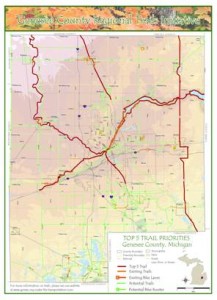
genesee-trailsThursday was the second annual Regional Trails and Greenways Summit in at U of M Flint.

While the focus was primarily on Genesee County, the sessions were applicable to similar efforts elsewhere. And there were many familiar faces from Oakland and Wayne County, including engineering staff from the City of Royal Oak.

There was full day of excellent session topics, including road diets, complete streets, and creating non-motorized master plans. We were even treated to an rousing welcome from Bobby Crim.

For those unable to attend, Genesee County Planning will be putting all of the presentations on their web site.

Last year’s summit presentations are already on-line.

We extend a special thanks to the Ruth Mott Foundation for making this Summit possible.