Posts Tagged ‘MDOT’

Detroit road obesity makes for easy cycling

Monday, April 25th, 2011
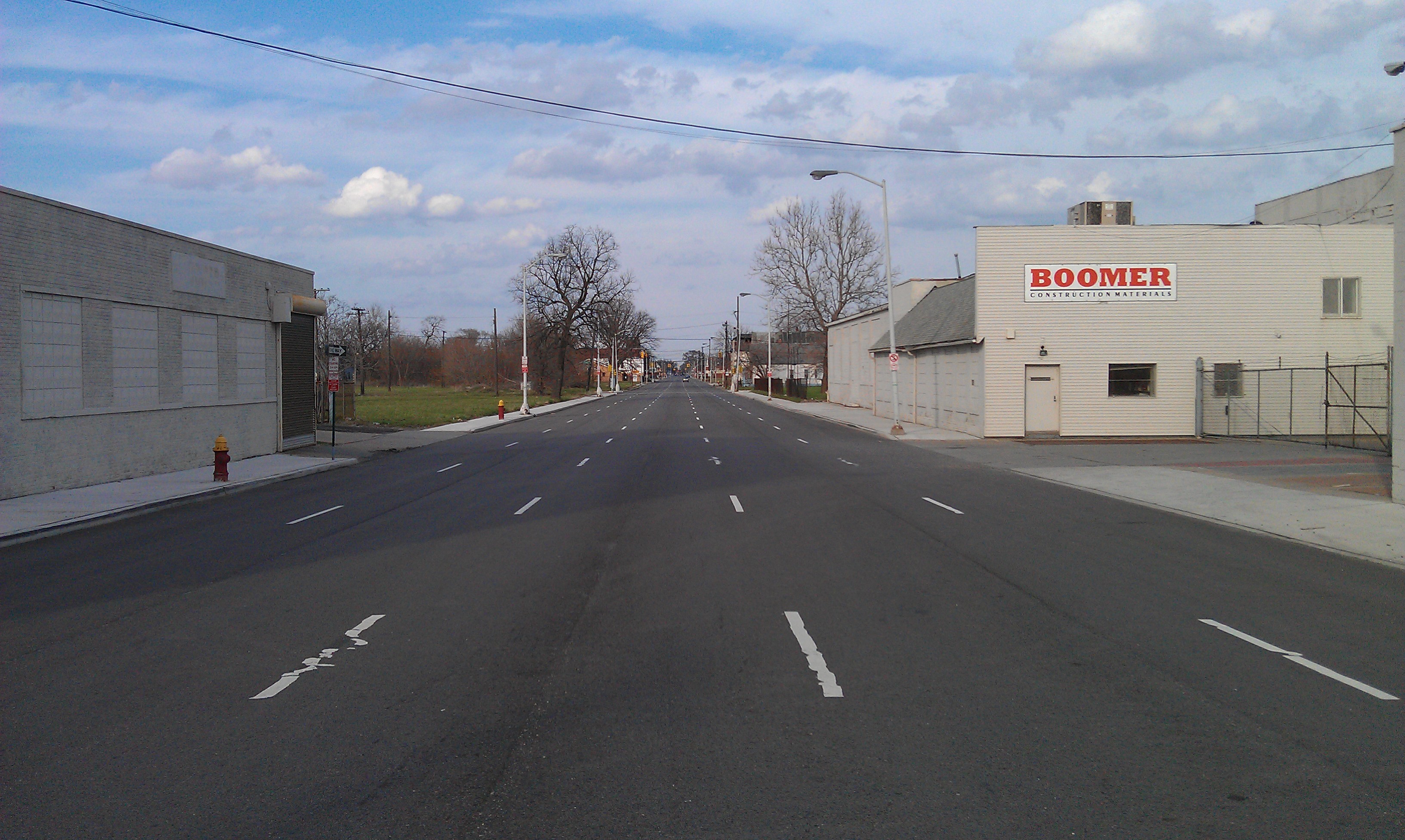
Detroit’s loss of population is well documented. No matter where the recent census counts fall, the reality is Detroit has a million fewer residents since the 1950s.

And since the 1950s, Detroit lost its streetcar network while gaining one of America’s most extensive urban expressway networks.

This has resulted in roads like Forest just east of Dequindre. Five lanes one-way with limited hours of parking.

Despite its one-way design, the road’s recent repaving and lack of traffic makes this ideal for biking.

And from 2004 to 2009, there are no reported motor vehicle crashes involving bicyclists or pedestrians on this segment of Forest from Dequindre to Gratiot.

Marked in Red

However, the MDOT and SEMCOG bicycle maps say otherwise. Both bicycle maps show this road in red, which means it’s generally unfavorable for bicycling due to the heavy traffic.

Huh?

We looked at the SEMCOG traffic counts and did not find any relevant traffic counts near this section of Forest. There was one count from June 2006 taken on Forest west of Dequindre however Forest is now closed at Dequindre. Even still, that traffic count was only 6,823 vehicles during a 24-hour period. The MDOT map says over 15,000 cars a day use this section of Forest.  SEMCOG map says there are over 10,000 vehicles per day.

Unfortunately it appears Forest is not the exception on these maps. There are other super wide, one way Detroit roads with little to no traffic that are shown in red, including Rosa Parks and 14th from Warren to I-75. Second Avenue from Forest to Temple is red on SEMCOG’s map despite its lack of traffic.

This really just reinforces the idea that Detroit needs a good bike map that is designed for cyclists and provides recommended routes — like Forest.

Road Diet?

Does road dieting a road without cars make it more bike friendly? Is a road with so few cars a Complete Street? These are questions that don’t get asked in most cities but are very relevant in Detroit.

Perhaps it makes more sense to approach this with a financial perspective. Could a road diet reduce the road maintenance costs and storm water runoff? Could we convert those outside travel lanes to half bike lane, half pervious surface. The pervious surface (perhaps as bio swales) would provide some separation between the parking/vehicle travel lanes and the bike lane while also absorbing the road’s storm water runoff. Could the city maintain (e.g. sweep) a physically-separated cycle track?

Eliminating vehicle lanes on Federal aid roads (such as Forest) affects Michigan’s federal transportation funding formulas. The state would get the same amount of funding, but less would be distributed to counties and cities like Detroit. There is a financial incentive for not losing vehicle lanes on federal aid roads, but is it enough to justify the added cost?

Hopefully the answer to these questions will emerge over time from the Detroit Works Project and more analysis.

But until then, go bike on E. Forest and enjoy the wide open road.

MDOT drops the I-375 extension project

Wednesday, April 13th, 2011

Streetfilms recently posted a video on freeway removal.

It may surprise many Detroiters that MDOT’s plan to extend I-375 south to Atwater will be officially dropped this summer. Yes, I-375, the shortest signed interstate in the U.S. at 1.06 miles was going to gain a few more blocks to connect with the GM/Renaissance parking lots.

According to an old MDOT press release, “The new interchange will improve access between the interstate system and the area just east of General Motor’s World Headquarters in the Renaissance Center.”

And according to Kurumi.com:

The end of I-375 will be moved from Jefferson (where traffic continues west) to Atwater. Dyche Anderson explains the unconventional interchange design: “Heading southbound from Jefferson, there will be an exit for Franklin St Westbound, and an entrance – heading south – for Franklin Eastbound. There will be an exit for Atwater, but the freeway will do a U-turn and continue northbound. Heading north, there will be an entrance from Atwater, an exit to Franklin St Eastbound, and an entrance from Franklin St Westbound.”

Yes, a U-turn at the end of the freeway!

According to MDOT, this project was “to promote economic growth in downtown Detroit” though we’re not sure how.

They identified key community issues such as “bicyclists” and “safety for the drivers as well as the pedestrians and bicyclists.” Just imagine how having a freeway at Atwater would have affected your biking and walking experience along the RiverWalk!

Of course much has changed since this was proposed, but especially at MDOT. And as a result, they’ve asked for this project to be deleted from the Regional Transportation Plan for Southeast Michigan. That deletion should be taken up by the SEMCOG General Assembly near the end of June.

Removing the rest of I-375?

A few years ago, the Community Foundation for Southeast Michigan supported a planning exercise for Detroit’s East Riverfront area. One topic was converting I-375 from a freeway to a boulevard surface street. The same was proposed for the I-75/Gratiot freeway exit.

This effort was led by Ian Lockwood of Glatting-Jackson who said people shouldn’t have an expectation of driving 55 miles an hour through your central business district.

The benefits of making the below grade freeway into a surface street are the added real estate and greatly improved bike, pedestrian, and even motorist mobility through this area. One can easily imagine the benefits of improved connections between Eastern Market, the stadium areas, central business district, and even the future light rail line.

Perhaps this could be a return of Hastings Street, the main strip for Detroit’s prominent black community which was removed to create the expressway.

Of course that freeway removal plan is nothing more than a plan right now, but…

Windsor updates: Bikes, Trains, and Ferries

Sunday, April 10th, 2011

Bicycle Use Master Plan underfunded

The Windsor Star has a brief mention of the city of Windsor’s bicycling efforts, which according to some bicycling advocates is moving too slowly.

Members of the Windsor Bicycling Committee and the advocacy group Bike Friendly Windsor were at Wednesday’s capital budget meeting to implore council to devote more money to the Bicycle Use Master Plan (BUMP).

Drafted by the city in 2001, the 20-year plan was meant to show the city’s commitment to building an “easily accessible, safe and actively used” cycling network.

But Steve Konkle of Bike Friendly Windsor said BUMP has been the victim of “chronic underfunding.”

According to Konkle, Windsor has less than 25 miles of bike lanes.

Bike Train now daily

The Ontario Bike Train is now daily. The train makes it easy for cyclists to get between Windsor, London, Toronto, and other cities in Ontario. Bicycle racks are available for cyclists.

We spoke with Justin LaFontaine, Projects Director for Transportation Options and the founder of the Bike Train initiative. He said the big buzz among Toronto cyclists is riding in Detroit. And while they can take the bike train to Windsor, there is no option for them to get to Detroit.

They have had conversations with the Detroit/Wayne County Port Authority about ferry service across the Detroit River. The Port Authority is very interested in helping make that international connection for cyclists.

Until there is a convenient way for cyclists to cross the border, Detroit-area cyclists can drive to the Windsor train station. There’s also this interesting web site with the tag line, “Explore Ontario by bike. Stop at bicycle friendly places to eat, visit and sleep.”

What about AMTRAK?

One obvious question is what about bicycles on AMTRAK? The Pere Marquette and Blue Water lines should be getting roll-on bicycle service. However, we do not know about the Wolverine line, the line between Pontiac, Detroit, Ann Arbor, and Chicago. That line is not subsidized by MDOT and therefore is not required to have roll on service per an MDOT appropriations bill. We’re waiting to hear if AMTRAK will provide roll on service nonetheless.

Bikes and Movies: We are Traffic

Saturday, April 2nd, 2011

The group Bikes and Murder is presenting a free showing of the movie We Are Traffic which “chronicles the history and development of the Critical Mass bicycle movement – one of the most spirited and dynamic social/political movements of the apathetic 90s.”

The movie is showing tonight, Saturday April 2nd at 7pm in the Boll Family YMCA in Downtown Detroit, 1401 Broadway.

We will be forwarding this information to Rob Morosi, a spokesperson for MDOT.

In a recent Metromode article about an MDOT road project in Rochester Hill, Morosi gave the following quotes:

“When we’re developing a Complete Street project we’re required to meet with the local community to take into account non-motorized uses and facilities. The idea is to make it a more walkable community,” says MDOT spokesman Rob Morosi.

“Even before the Complete Street legislation we would meet with local communities to see if there’s something we can include that the local community has always wanted but has been prohibited to do because of the way the road is constructed,” he says.

This M-59-Crooks project is “a great example of what we’re doing to address that,” he says. “So now people riding their bikes or walking won’t be in conflict with traffic…People can ride, their bikes, Rollerblade, walk safely.”

First, from what we’ve learned, this project is not a Complete Street. MDOT is simply adding sidewalks. In fact, the bridge itself will be less bikeable when this project is completed because it will no longer have a wide curb lane. It will not have bike lanes.

Second, we aren’t in “conflict with traffic.” We are traffic.

MDOT to finish Clinton River Trail bridge in Pontiac

Wednesday, February 23rd, 2011

According to MDOT, the new trail bridge over Telegraph should be open by mid-June:

FOR IMMEDIATE RELEASE                                            TUESDAY, FEBRUARY 22, 2011

CONTACT: Rob Morosi, MDOT Office of Communications, 248-483-5127

Bridging the gap! Clinton River Trail pedestrian overpass construction begins Monday, Feb. 28, in Oakland County

February 22, 2011 — The first phase of a $2 million investment to construct a pedestrian overpass above US-24 (Telegraph Road) may begin as early as Monday, Feb. 28, according to the Michigan Department of Transportation (MDOT). The new bridge will be constructed just north of the Orchard Lake Road overpass located at the Sylvan Lake/Pontiac border.

Due to the space limitations, lane closures will be needed on both directions of US-24 until mid-March. Weather permitting, crews will implement single and double-lane closures starting Monday, Feb.28 and lasting until Monday, March 14. Lane closures will begin on southbound US-24 and proceed to northbound US-24 during the latter part of the week.

For southbound US-24, a single lane may be closed weekdays between 6 a.m. and 10 a.m. As needed, crews may close an additional southbound lane outside of those peak travel times.

For northbound US-24, a single lane may be closed weekdays from 2 p.m. until 7 p.m. Two-lane closures are permitted outside of the peak afternoon time period.

In order to safely install steel beams above US-24, full closures are expected on the first two Saturdays in March. On Saturday, March 5, southbound Telegraph Road will be closed, while on Saturday, March 12, northbound US-24 will be closed. The full closures will begin at 7 a.m. and end by 3 p.m. on both days. Detours will direct traffic to Old Telegraph Road.

Pedestrians can expect to enjoy the newly constructed overpass by mid-June. This project is funded by the American Recovery and Reinvestment Act (ARRA).