Posts Tagged ‘Safety’

Liberty Mutual rewrites road safety history

Monday, February 8th, 2010

Volume 13 Issue 1 of Libery Mutual’s Liberty Lines magazine includes a timeline called “Model T to Infiniti: 100 Years of Safety Innovations.”

The timeline’s introduction states that “…because of ever-increasing safety innovations, the rate of fatalities has decreased.”

That’s a pretty misleading if not dishonest statement.

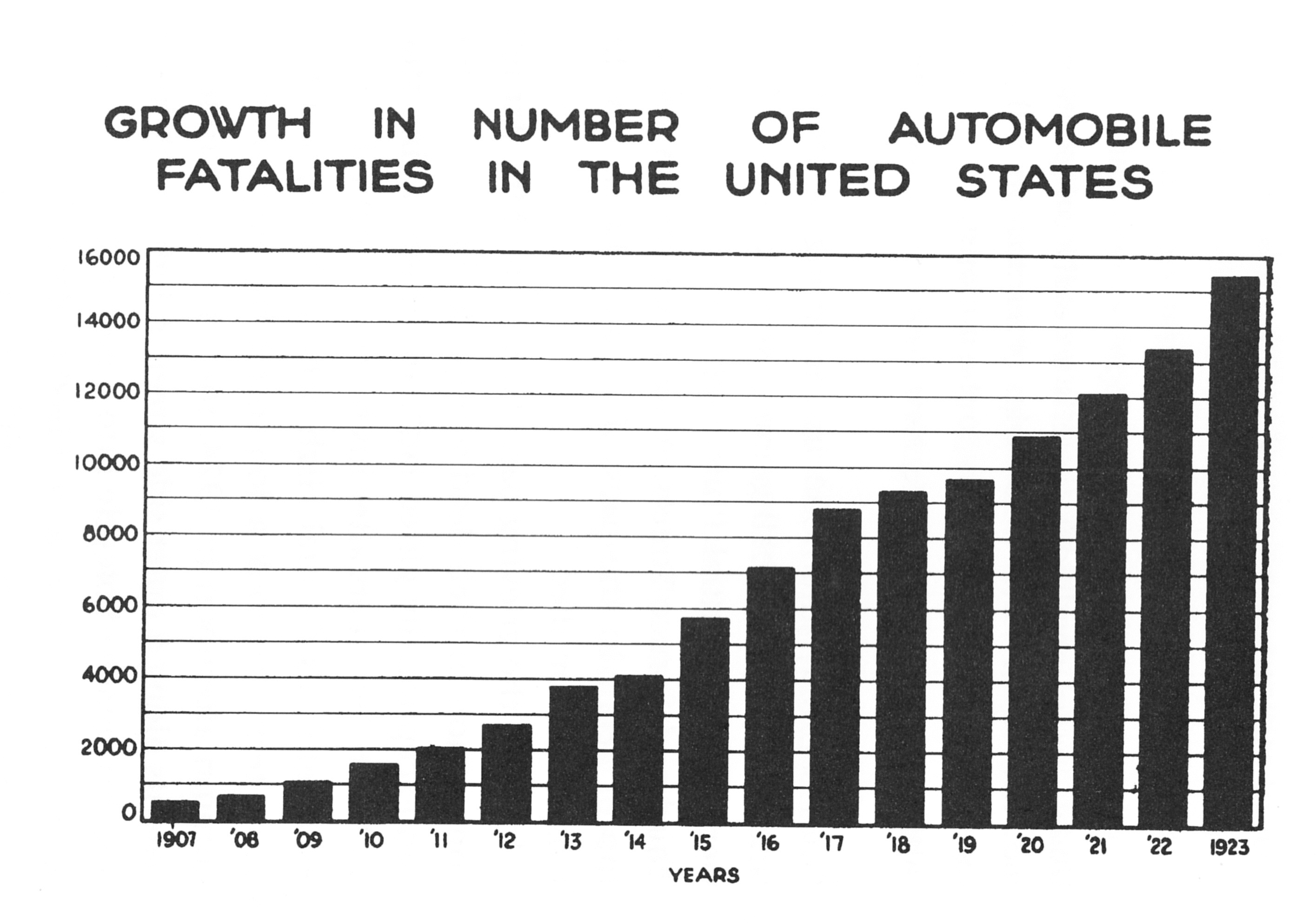
Liberty Mutual’s timeline begins in 1900 when fatalities due to automobiles was a rarity nationwide. By 1907 there were roughly 500 fatalities (fewer than 6 fatalities per million Americans) which grew sharply over time.

There were over 37,000 people killed in 2008 (more than 120 fatalities per million Americans.)

That’s not a lower rate.

Perhaps the fatality rate per 100 million vehicle miles travel has dropped with people driving more, but that’s hardly something to celebrate when we lose the equivalent of a medium-sized U.S. city of people every year.

And about 14% of those fatalities are pedestrians and bicyclists. Looking at a rate based on vehicle miles travel only serves to hide these fatalities.

[The road fatality chart was published in Peter Norton’s excellent book, Fighting Traffic.]

How do you define “safe”?

Saturday, January 23rd, 2010

The following was posted during a discussion on living car-free in Detroit on bikeforums.net (emphasis ours):

Ahh, the myth that the metro area is all Detroit. I live in a very nice suburb that is quiet and safe. The only reason I feel the need to leave here is just so I can depend less upon a motorized vehicle and more upon my own power. The car culture here is strong and the roads are just not safe for riding everywhere I would like to be able to go.

So which is it? The suburb is safe but the roads are not safe?

From a cyclist perspective, if the roads aren’t safe, your community isn’t safe. Cycling advocates shouldn’t let local governments view safety only from behind a windshield.

But surely suburbs do have lower reported crime rates compared with Detroit. Then again, having a motor vehicle on their horn and passing unsafely is?assault with a deadly weapon, though it’s rarely reported.

It does seem Detroit’s streets are safer for cycling — a conclusion supported by the average yearly bicycle crashes per 100K residents from 2004 through 2009.

Detroit 16.5
St. Clair County 18.9
Oakland County 19.4
Wayne County (without Detroit) 25.0
Macomb County 26.1

Also, Detroit has the lowest bicycle crash rate despite having a highest bike to work rate.

And as for living car-free, it would be tough to beat Detroit’s Corktown neighborhood.

Secretary LaHood and US DOT 2010 goals

Monday, January 11th, 2010

Secretary of Transportation Ray LaHood is back in Detroit today for the auto show.

He recently listed what the US DOT had in the works for this year, including (emphasis ours):

More safety: I am not about to lay down on this; whether it’s distracted driving, impaired driving, or driving unprotected by seat belts, expect to see more from us on making our roadways safer for everyone.

More livability, sustainability: …in 2010 the TIGER grants we award will include as criteria the project’s contribution to sustainability and livability. Also in 2010, the Obama Administration’s Partnership for Sustainable Communities of DOT-HUD-EPA will continue to align our efforts to promote the Three E’s of economic development, environmental protection, and equitable access to transportation.

Making roadways safe for all users… More livability… More sustainability… These goals all favor bike friendly transportation projects.

Now if only we could Metro Detroit state, county, and local governments working on the same. DOT’s emphasis on livability might force Metro Detroit governments to progress beyond post-WWII concepts of transportation and into the 21st century.

And in conjunction with this new federal emphasis, the House created the Livable Communities Task Force this past fall.

Every community in America — regardless of its size, geographic location, demographic composition, or economic base — aspires to become a place where families are safe, enjoy personal and environmental health, can select from a range of housing and transportation choices, and have access to educational and economic opportunities. These are the building blocks of livable communities.

The Livable Communities Task Force recognizes that federal policies — from transportation to tax incentives to environmental regulations and everything in between — have a profound effect on the livability of communities. This Task Force seeks to identify the ways in which the federal government can affect community livability and improve Americans’ quality of life. This includes reducing the nation’s dependence on oil, protecting the environment, improving public health and investing in housing and transportation projects that create jobs and give people more commuting choices.

Congressman Earl Blumenauer chairs the task force of 20 members, but unfortunately none are from Michigan.

Fuzzy Dice 1, Cyclists 0

Friday, October 16th, 2009

Red fuzzy diceSenate Bill 276, aka the Fuzzy Dice Bill, passed the Michigan Senate unanimously.

According to the Detroit News:

Fuzzy dice hanging from the rearview mirror would no longer be outlawed under a bill that won passage in the Senate today.

The chamber voted unanimously for a measure that strikes down a law that says items dangling from the rearview mirror are a no-no.

“We understand there are many distractions in cars, such as cell phones or GPS systems, but we did not feel that a rosary or air freshener was in the same league,” said Sen. Ron Jelinek, R-Three Oaks, sponsor of the bill. “This will help make it legal to do what thousands of Michigan residents already do — hang a memento from their mirror.”

Great job!

Now let’s look at some bicycle safety bills the Michigan Senate has not passed or voted on.

  • Senate Bills 529 & 530 which “enhance penalties for moving violations causing physical injury or death to bicyclists and other vulnerable roadway users” according to the League of Michigan Bicyclists.
  • Senate Bill 531 which stipulates that driver education “shall include information concerning the laws pertaining to bicycles and shall emphasize awareness of the operation of bicycles on the streets, roads, and highways of this state.”

Bicycle advocates in the state of Washington are also pursuing a Vulnerable User Bill. (Seattle PI via How We Drive)

Advocates for a new law argue that families of those killed or maimed deserve greater sense of justice than a traffic ticket brings. However, a conviction for negligent driving doesn’t carry much steeper punishment. Typically, a first-time offender gets probation or a deferred sentence.

“Do they need an automatic license suspension or do they need driver retraining. These are the questions that we should ask,” Hiller said. He noted that people who don’t control their vicious dogs face more criminal culpability than drivers for negligence behind the wheel.

We’re not sure if that last sentence is true in Michigan.

But, if the Michigan House and Governor follow the Senate’s lead, fuzzy dice will be safe again Michigan.

Rules of the Road: Stop Sign Mania

Monday, October 12th, 2009

A Detroit stop signA common message from bicycle organizations and advocates is bicyclists must follow all the rules of the road.

We believe that those who stand firm by that message (a) aren’t doing as they say, or (b) don’t live in urbanized areas with stop signs on every other residential block, which makes cycling impractical. This message is the easy way out since it puts the burden on bicyclists.

Instead, that message needs to be turned around. It should be that we need to change the rules of the road and our road infrastructure to better accommodate bicycling. This message requires more effort and puts the primary burden on bicycle advocates and local governments.

We’ve already highlighted one change to the rules of the road that would be highly beneficial to bicycling: rolling stops. Rolling stops could improve cycling safety according to a recent BBC article, which notes that “an internal report for Transport for London concluded women cyclists are far more likely to be killed by lorries because, unlike men, they tend to obey red lights and wait at junctions in the driver’s blind spot.”

And, you can’t have group bike rides without rolling stops.

Stop signs don’t calm traffic

One beneficial change to the road infrastructure includes removing unnecessary stop signs in residential neighborhoods.

Most of these signs were installed because there was a perception that it would slow speeding motorists. Studies show that that perception is wrong. Motorists actually speed more between stop signs to make up the time lost to stopping — actually only slowing in most cases. These stop signs are not warranted according to state and federal guidelines. They waste fuel, create more pollutants, and help create more noise.

And in most cases, these stop signs are irrelevant for cyclists. We’re not the ones speeding through the residential streets and putting children, pets, and pedestrians at risk. Cyclists, pedestrians, horses, and street cars were doing fine for 36 years without any stop signs. Stop signs were invented in Detroit in 1915 to deal with the mass adoption of motor vehicles.

Removing stop signs

Yesterday’s Free Press has an article on cities removing stop signs in residential areas. Livonia has removed an estimated 1,500 stop signs. Other cities are doing the same, though to a lessor extent.

Grosse Pointe Woods has removed 18 stops signs since November, and Livonia police Sgt. Dave Studt, the person in charge of his city’s traffic bureau, said Farmington Hills and Novi have expressed interest in Livonia’s efforts.

“By removing these stop signs, we’ve just made it safer for a pedestrian to cross the road,” Studt said. He noted that drivers tend to roll through intersections without stopping completely when a street is oversigned or they speed between stop signs in order to make up time.

He said signs are removed only where they are unwarranted because of traffic flow and other factors.

As a member of the Traffic Safety committee in Royal Oak, we see a half dozen requests for new residential stop signs annually. What the residents really want is a means for slowing speeding motor vehicles while reducing cut-through traffic and noise. On some streets, the majority of motorists are speeding. Royal Oak does not have the resources to police this. The residents need real traffic calming solutions, like neckdowns and roundabouts. Those can be implemented in ways that accomodate bicycling.