Category: General bike news

  • Great Lakes Metro Summit in Buffalo

    img_2735Last week the Great Lakes Metros Summit was held in Buffalo, New York.

    And to quote Artvoice, this event was where “activists and policymakers from around the Great Lakes gathered to share homegrown solutions to Rust Belt problems.”

    At the Summit, I moderated a panel on Complete Streets and Transit while also providing a brief overview status of Detroit’s greenways and non-motorized transportation based on my work for the Michigan Trails and Greenways Alliance (MTGA).

    Our panel included Rory Neuner from the Michigan Environmetnal Council and a League of Michigan Bicyclists director. Rory is very active with the Walk and Bike Lansing campaign. They are working on a Complete Streets policy for Lansing.

    If you are a Lansing resident, please visit their web site to learn how you can help make Lansing “accessible and walk & bike friendly!”

    Next on the panel was Dom Nozzi of Richmond, Virginia. Dom has an invaluable web site devoted to making cities more bikeable and walkable. His four-part speech from Bloomington, Indiana really defines a vision for how we need to prioritize transportation for people first rather than cars.

    After the summit, I had a chance to talk with Dom. One interesting point he made is that many people are stuck with outdated transportation paradigms, primarily that mobility — high speeds, wide roads — is the primary goal. They’ve committed themselves to this paradigm and cannot step back to view the bigger picture. They are often unconvinceable. An advocates best hope is they will be replaced or retire.

    And also on the panel was Justin Booth, who certainly plays a major role in all the good things happening in Buffalo with respect to biking.

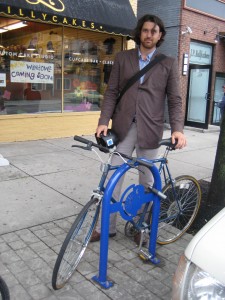
    Justin created Buffalo’s Blue Bicycle program, a low-cost, simple, innovative means for sharing bikes across town.

    Also, Justin helped create the Rusty Chain beer program here a portion of sales from a custom locally-brewed beer go towards bike racks — an example of which is shown next to Justin in the above photo. To date the program has generated $10,000, which has been matched with city and federal funding (CMAQ). As a result, businesses within Buffalo’s Central Business District can request bicycle racks which are installed for free.

    Buffalo recently installed 110 bicycle racks! Justin noted that the racks are custom designed and made locally.

    That’s something worth raising a glass to.

  • Detroit Trails on Facebook

    bandThe Detroit Riverfront Conservancy has an active page on Facebook.

    Their Dequindre Cut trail opening photo gallery is full of great shots, including this one to the right. It certainly shows Detroit knows how to open a trail will style and enthusiasm.

    But there are other Detroit trail- or bike-related groups on Facebook, including these:

  • Mid-America Trails and Greenways Conference

    MTGA is actively supporting biking and trail development in the City of Detroit

    Mark your calendars for October 25th through the 28th. The 2009 Mid-America Trails and Greenways Conference is coming to Kalamazoo, Michigan.

    Here are more details from Nancy Krupiarz of MTGA.

    Just wanted to let everyone know that the Mid-America Trails and Greenways Conference program topics and plenary speakers are up on the MTGA website. Hope you are making plans to attend this wonderful networking and inspiring educational event.

    The pre-conference field trips are also coming together. They include the following options:

    • Mountain bike trip to Fort Custer Recreation Area
    • Horse and Carriage Ride down the Van Buren Trail
    • Bike trip on the Kal-Haven and Kalamazoo River Valley Trail
    • Bike trip at the Battle Creek Linear Park
    • Historical walk in downtown Kalamazoo

    Prices and details will all be in the conference brochure which will be out in July.

    And the post-conference sessions are shaping up for Wednesday, October 27th. They include:

    • Trails 101
    • Water Trails
    • Hands-on sustainable trail building with the International Mountain Bicycling Association (IMBA)
    • Covering the Distance: Long-Distance Trails

    Likewise, prices and details will be in the conference brochure.

    Hope to see you there!

  • Accessibility vs. Mobility

    Traffic engineer Ian Lockwood from Glatting Jackson has been to Detroit a few times now for planning efforts to spur redevelopment and revitalization.

    He’s highlighted a key concept for bicycle, pedestrian, and transit advocates. Current U.S. traffic engineering culture pursues greater mobility, i.e. how fast someone can get between places. That’s often why they are stuck thinking primarily about cars, wider roads, higher speeds, and interstate expressways.

    Lockwood says we should all focus on accessibility instead. In doing so, we’d try to rein in sprawl, increase density, and improve transportation options.

    Perhaps given our automotive heritage, Detroit seems particulary focused on mobility. A recent Brookings Institute report found Metro Detroit led the nation in job sprawl. Seventy-seven percent of our jobs are more than 10 miles from the city center.

    From the Philadelphia Inquirer:

    “From transportation to workforce development to regional innovation and the provision of social services, the spatial distribution of a metro area’s jobs can ultimately influence its economic productivity, environmental sustainability, and social inclusion and equity,” wrote Elizabeth Kneebone, a senior research analyst at Brookings and author of the 23-page report.

    Is there any wonder why we can’t find enough money to repair our roads?

    At a recent traffic engineering meeting, Jonathon Levine, a researcher from the University of Michigan gave a presentation about accessibility versus mobility. Fortunately it’s on-line but be forewarned: it’s a little traffic geeky. Even so, the first couple minutes really nail the point about accessibility versus mobility.

    And for those that can’t make it through the entire video, this slide really captures the main thrust that accessibility should be the ends. The means includes mobility, proximity (how close things are together) and connectivity (can you access them remotely, e.g. through the Internet).

    Levine's Accessibility model for transportation

    This needs to be the transportation paradigm for Metro Detroit, and if it were, it’d make bicycling a viable transportation option for more people more often.

  • More Dequindre Cut Buzz

    Dequindre Cut during construction in the spring of 2009Despite all the depressing news of late swirling around the city of Detroit, one bright spot remains — the Dequindre Cut.

    Let’s start with an excerpt from Jeff Gerritt’s Freep blog:

    The cut is one more reason to feel good about Detroit’s future, if we can start looking at things differently. The city’s population is less than half of its 1950s peak, and it continues to lose more than 10,000 people a year. But its land mass streets, sewers, lighting and the like are still spread over the same 140 square miles geared to accommodate a city of nearly 2 million. Roughly a third of the city is now vacant. To survive and thrive, Detroit must creatively downsize. The Dequindre Cut Greenway shows us how.

    The Cut was also mentioned during last Sunday’s Blessing of the Bikes ceremony at the Spirit of Hope Church in North Corktown. Here too is an excerpt from the Blessing:

    Shower your blessing on cyclists across Detroit, from the Riverfront to Belle Isle, from Rouge Park to the Dequindre Cut, from downtown to Eight Mile, across Michigan, and all around the world. Amen!

    And finally, Model D Media published an article highlighting the big ten greenway efforts in Detroit, Highland Park, and Hamtramck.

    So despite all the doom and gloom from GM to Chrysler and now to Old Tiger Stadium, we still can celebrate having one of America’s most unique and beautiful urban trails right here at home.

    Link: Grafitti art from the Dequindre Cut